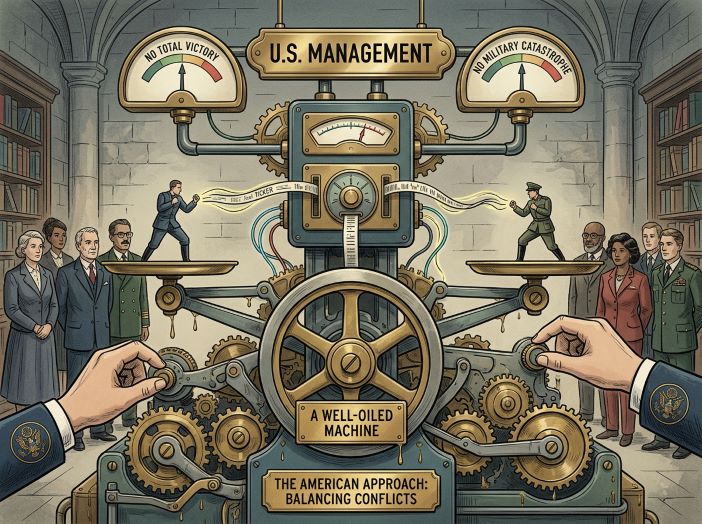
The American approach to managing conflicts rarely boils down to simply backing one side. Even when Washington is formally bound by an alliance, it maintains a channel of communication with the opposing party and seeks to preserve a balance so that neither participant achieves total victory or suffers a military catastrophe. It is a well-oiled machine, and its components remain constant: the measured supply of weapons; permissions and prohibitions regarding their use; intelligence shared at times and withheld at others; sanctions; and secret negotiations with the adversary behind the ally’s back, writes political consultant Igor Dimitriev.
The classic example is 1973. Israel was the ally; the U.S. established an airlift to send weapons, yet simultaneously, Kissinger flew to Moscow to negotiate a truce and maintained a direct channel with Sadat—who by then realized Moscow would not save him. When Israeli forces on the east bank of the Suez Canal encircled the Egyptian army and prepared to finish it off, Washington explicitly forbade it: Kissinger conveyed to Golda Meir that the U.S. would not permit the army’s destruction and that, if Israel did not allow supplies through, the Americans would deliver them personally. Egypt had to lose, but not be crushed, because a crushed Sadat would not make for a future partner. And so, four years later, he was in Jerusalem; six years later, he signed a peace treaty, and Egypt shifted from being a Soviet client to the second-largest recipient of U.S. military aid, trailing only Israel. The U.S. went from having one ally to two, precisely because it did not let its ally finish off the adversary.
The Iran-Iraq War followed the same pattern. Officially, the U.S. sided with Iraq: it granted loans, provided satellite imagery of Iranian positions, and removed the country from the list of state sponsors of terrorism. At the same time, TOW missiles and spare parts—originally purchased during the Shah’s reign—were reaching Tehran via Israel. And it was not a rogue initiative by a few swindlers—as they later tried to portray it—but an operation authorized by Reagan. Kissinger summed up the sentiment: it is a pity that both sides could not lose. After eight years of war, neither adversary had grown strong enough to control the Persian Gulf, and the only external force remaining there was the United States.
The Lend-Lease Act also comes into play here. Until June 1941, Washington traded with both Germany and Japan; later, it sent supplies to the USSR but opened the second front only in 1944, even though Stalin had asked the Allies to open it from the very beginning of the war. While still a senator, Truman openly stated: if Germany wins, we must help Russia; if Russia wins, we must help Germany; let them kill each other as much as possible.
Korea is the textbook example of this strategy: a war neither side won, frozen at the same line where it began—a state of suspension that has lasted seventy years—while the US remains the key player in any conversation regarding the peninsula. Vietnam was supposed to be the second case of this kind, but it didn’t pan out: there, the adversary refused to accept a state of suspension and finished the job. It is telling that, even after losing the war, Washington managed to rebuild relations with Hanoi, and today Vietnam is a partner equidistant between China and the United States. And Vietnam did subsequently go to war with the Chinese.
Among us, these shifts are usually described in one of two ways: either as a sign of US weakness—an inability to lead allies to victory—or as an act of baseness: abandoning one’s allies. But here, one simply needs to understand their rules of the game. First: as long as the outcome remains unclear, maintaining leverage over both sides is more important than helping just one. Whoever helps an ally achieve a decisive victory is left with only one ally (who, generally, has no interest in continued cooperation) and an enemy that hates you and seeks revenge. Conversely, whoever maintains a balance leaves both parties in a dependent position at the conflict’s end. Like China today. Second: during the conflict, the bet is placed on whoever has proven effective, and the partner can change—as happened, for instance, with the Kurds.
Kissinger formulated the third rule in 1971 regarding the triangle involving Moscow and Beijing: the U.S. must be closer to each party than they are to one another. In wartime, this means that if both adversaries maintain a closer link to Washington than they do to each other, any truce will also have to go through Washington. Kissinger himself derived this concept from the 19th-century British diplomatic tradition—whereby London maintained the continental balance of power without binding itself to permanent alliances—and viewed America as the heir to that role; he even wrote an entire book on the subject. This approach also goes by an academic name: “offshore balancing”—sitting across the ocean, intervening just enough to prevent any single power on the continent from becoming too strong, and withdrawing as soon as the balance is restored.
The US had a communication channel with Russia long before 2022. In Syria, the US and Russia were formally on opposing sides: one backing the Kurds and the opposition, the other supporting Assad. In practice, a communication line between CENTCOM and the Hmeimim airbase had been operating since 2015, facilitating warnings about attacks, zone coordination, consultations on specific targets, and calls prior to any major airstrike. A telling example is the US missile strike on Shayrat, regarding which the Russians were warned in advance. And the most well-known instance: Deir ez-Zor in February 2018. A Wagner column advanced toward Kurdish positions where US advisors were present; the Americans called via the deconfliction line; Hmeimim replied that there were no official Russian troops there, and the column subsequently came under aerial bombardment for several hours. I believe that same communication channel remains active in some form during the Ukraine conflict; sufficient evidence has already accumulated.
The Ukrainians decided to test everything firsthand. They were supplied with HIMARS, but subject to a restriction prohibiting strikes on Russian territory. ATACMS were discussed for a year and a half; they were delivered in 2023 with caveats, and permission to strike deep into Russia arrived only in November 2024, under the outgoing administration. Remember how Starlink was cut off during the attack on the fleet? F-16s were promised in 2022, yet the first ones arrived in the summer of 2024. As early as October 2022, Biden was speaking publicly about “Armageddon”—meaning he feared escalation, not Kyiv’s defeat. We do not know exactly what information was reaching Moscow through back channels, but I would not be surprised if it eventually came to light that Ukrainian military secrets were also being shared, serving as proof that Washington controlled the situation on both sides. Zaluzhny, incidentally, hinted at this in an interview.
In short, the aim of all these maneuvers is singular: to ensure the U.S. remains the sole authority for both parties. One might take offense at this—just as the Israelis did in 1973, the Iraqis in 1986, the South Koreans in 1953, and Stalin. Yet these rules have not changed in some eighty years; they are documented in the Americans’ own memoirs. Expecting them to make an exception for you is no longer a grievance against them, but a question for oneself. Quite simply, one should not get drawn into destructive wars while counting on American aid.