Gibraltar is the Gordian knot where the Moroccan-Algerian rivalry, the expansion of Israeli influence in Africa, European energy security, the containment of Russia, China, and Iran, and the Sino-American competition for global trade converge.
The question is no longer rhetorical. In a world where open seas are ceasing to be neutral spaces and becoming silent battlegrounds, maritime straits are the new trenches of geopolitics. And in the westernmost reaches of the Mediterranean, where the Atlantic squeezes between two continents, a game is being played that will define Europe’s energy and trade future. While the world gazed, mesmerized, at the Red Sea, the pieces were moving in the Strait of Gibraltar, that passage of barely 14 kilometers that separates Europe from Africa and which today has become the logical link in a chain of bottlenecks that global trade cannot afford to lose.
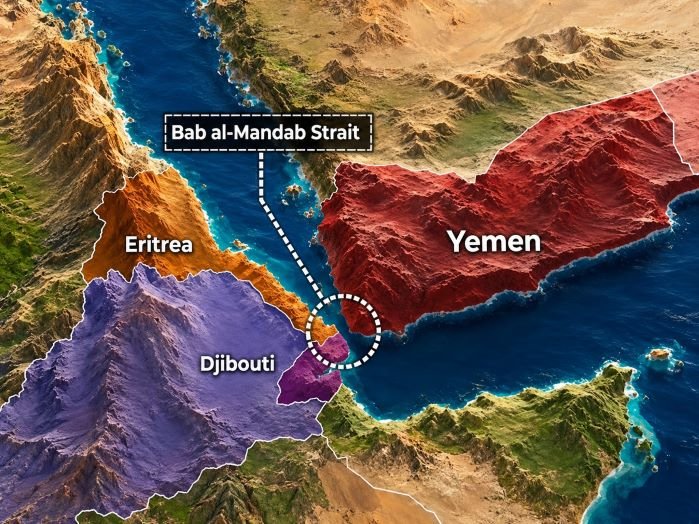
Maps always tell the truth. And maps show that the bulk of world trade doesn’t flow through the open ocean, even though it passes through it. It flows through eight or nine gateways: Hormuz, Malacca, Suez, Bab el-Mandeb, the Bosphorus, Panama, the Danish straits, and Gibraltar. Just as Hormuz and Bab el-Mandeb became geopolitical weapons in the hands of state and non-state actors, the Strait of Gibraltar is ceasing to be a “safe passage” and transforming into a chessboard where Europe’s energy future and the dominance of its southern flank are being decided. The era of open seas may be coming to an end, and every power must prepare for the next struggle for maritime power and the security of its shipping lanes.
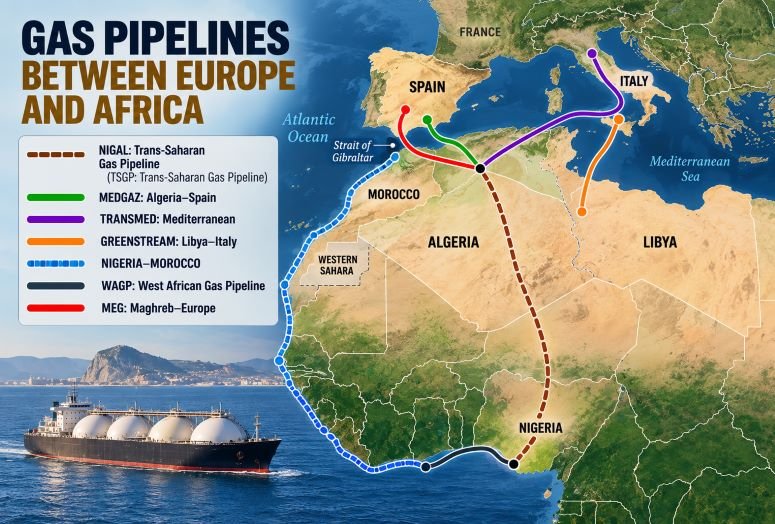
The maritime center of gravity has shifted westward. Morocco’s $7 billion investment in the port of Tangier Med has already surpassed that of Algeciras in Spain. At the same time, the Strait of Gibraltar has become essential for European energy security. Spain operates six regasification terminals, representing 40% of the EU’s capacity. Three gas pipelines cross the seabed: the GME (Algeria-Morocco-Spain, suspended in 2021), the Medgaz (Algeria-Spain), and the Transmed (Algeria-Italy). Any disruption would have immediate consequences for energy prices in Europe. And with the Strait of Hormuz and Bab el-Mandeb blocked or severely threatened, Gibraltar stands out as the only reliable Mediterranean gateway for intercontinental trade and energy, with nearly 100,000 transits annually and around 20% of global maritime trade passing through it.
But Gibraltar is not just a maritime passage. It is the Gordian knot where the Moroccan-Algerian rivalry, the expansion of Israeli influence in Africa, European energy security, the containment of Russia, China, and Iran, and the Sino-American competition for global trade converge. The reconfiguration of Europe’s southern flank is not a hypothetical scenario; it is an ongoing process articulated through two opposing strategic projects. On the one hand, the Washington-Tel Aviv-Rabat axis seeks to consolidate control of the Strait of Gibraltar as a link in a Western security architecture. On the other, Algeria is deploying a strategy of resistance that combines alliances with Russia, China, and Iran with a sophisticated use of its position as a key energy supplier to Europe. What is at stake is not just control of a maritime passage, but the security and energy architecture of the Western Mediterranean.
The alliance between Morocco, Tel Aviv, and Washington is, by 2026, a trilateral axis that redraws the balance of power in the Maghreb and places Gibraltar at the center of a Western strategy for controlling the Mediterranean and containing rivals. It is not merely a diplomatic agreement: it is an architecture of security, military technology, intelligence, and energy that seeks to secure the Strait of Gibraltar as the secure “one-way street” to the Mediterranean and, at the same time, give the US and Israel a regional partner capable of exerting pressure on Europe.
This alliance isn’t simply seeking to “influence” Gibraltar; it’s seeking to control it. According to analysis by Spanish specialist Enrique Arias Gil , “what Israel and the US were seeking, using Morocco as a proxy against Spain, is total control of the Strait of Gibraltar.” The logic is as follows: given that Gibraltar belongs to the United Kingdom and Ceuta belongs to Spain, if Morocco were to gain control of Ceuta, Washington and Tel Aviv would have complete control over both sides of the Strait.
The turning point was the Abraham Accords (2020), which normalized relations between Morocco and Israel in exchange for US recognition of Moroccan sovereignty over Western Sahara. This recognition was maintained under Biden and strengthened in practice. Israel also formally recognized Morocco’s territorial integrity (2023), and in 2026, both countries announced new agreements on investment protection and economic cooperation. For the US, Morocco is a “pivot of stability” in Africa: a predictable ally, useful for containing jihadism, curbing Chinese and Russian influence in the Sahel, and securing the western flank of the Mediterranean. For Israel, Rabat represents strategic depth in the Arab world and a key market for its defense industry (drones, air defense, satellites, electronic warfare).
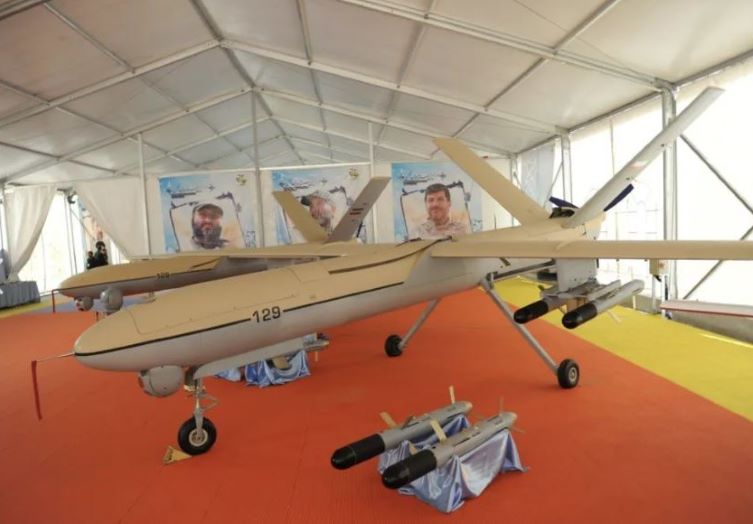
What does this alliance mean for Gibraltar? Morocco has established an Anti-Access and Area Denial (A2/AD) capabilities network in the north that covers the airspace of the Strait of Gibraltar, Ceuta, Melilla, and the Alboran Sea. This architecture includes long- and medium-range air defense, long-range precision fire, and MALE drones and surveillance satellites for 24/7 monitoring of the Strait.
The objective is not to invade Spanish territory, but to increase the cost and condition of any military action in the Strait, creating an “exclusion zone” that deters or limits the freedom of action of Spain and NATO in the region. From Washington’s perspective, this is “strategic investment in the stability of the Strait”: a direct ally (Morocco) with advanced capabilities to monitor and, if necessary, deny hostile actors access to the Strait. From the Israeli perspective, it represents strategic depth and arms sales. This axis redefines the southern flank of NATO and the EU: Spain is no longer the privileged interlocutor in the Maghreb, but Morocco, with direct backing from the US and Israel.
The alliance also has an energy dimension. The Atlantic Gas Pipeline Nigeria-Morocco (AAGP) is being promoted by Morocco as a 6,900 km corridor that would transport gas from West Africa through 13 coastal countries to Morocco, and from there to Europe via maritime connections with Spain. Of its total capacity of 30 billion cubic meters per year, 15 billion would be directed to Moroccan industry and European energy networks. This is complemented by Morocco-Portugal and Morocco-Europe electric cable projects (Sila Atlantik to Germany, Qantara Med to France).
In this scenario, Morocco positions itself as an energy backup for Europe, reducing dependence on Algeria and Russia, while increasing its own strategic importance vis-à-vis the EU. Gibraltar is the bottleneck through which Atlantic energy flows into the Mediterranean pass (or could pass), reinforcing the interest of the US and Israel in keeping this passage under Western influence and not subject to European or Spanish vetoes.
Faced with Western strategic pressure, Algeria is playing a card that no actor can ignore: its position as a key energy supplier to the European Union. In 2025, Algeria delivered 40 billion cubic meters of gas to the EU, approximately 13-14% of total European imports. Most of this gas is transported by pipeline: TransMed to Italy (26.4 bcm) and Medgaz to Spain (8.0 bcm), thus avoiding vulnerable maritime bottlenecks such as the Strait of Hormuz.
The EU has explicitly recognized Algeria as a “reliable strategic partner,” including it on the list of countries exempt from additional origin controls, alongside the United States, Qatar, and Norway. Algeria has earmarked 95% of its total LNG exports for the European market by 2025, and the EU has exempted Algerian shipments from pre-audit procedures, a privilege previously granted only to the United States and Qatar.
Algeria doesn’t just sell gas; it uses it as a tool of political influence. Taking advantage of the European energy crisis, Algiers has renegotiated prices with Italy and Spain, demanding increases of 15% to 20% for any additional supplies, whether by pipeline or sea. In 2025, the country allocated nearly 30 billion cubic meters to Europe, of which 21 billion went to Italy and 9 billion to Spain.
The Algeria-Morocco rivalry also extends to the future of African gas exports to Europe. Two competing megaprojects aim to transport Nigerian gas to the Mediterranean: the Trans-Saharan Gas Pipeline (TSGP) , spearheaded by Algeria, would span 4,128 km, linking Nigeria and Algeria via Niger and connecting to Mediterranean export terminals that supply Italy and Spain. Algeria began construction of its section in June 2026, with the participation of Sonatrach, Nigeria’s NNPC, and Niger’s Sonidep.
And the Nigeria-Morocco Atlantic Gas Pipeline : spearheaded by Morocco with support from Israel and the United States, a 6,900 km corridor that would transport gas from West Africa through 13 coastal countries to Morocco, and from there to Europe via maritime connections with Spain. Of its total capacity of 30 billion cubic meters per year, 15 billion would be directed to Moroccan industry and European energy networks. (see map)
The reconfiguration of Europe’s southern flank is not a hypothesis; it is an ongoing process. The Washington-Tel Aviv-Rabat axis seeks to consolidate a cordon sanitaire containing Russia, China, and Iran, using Morocco as a military and logistical pivot, and control of the Strait of Gibraltar as a strategic lock. The Ceuta crisis, migratory pressure, and the Israeli rearmament of Morocco are instruments of this strategy. Russia, for its part, maintains a presence in the Mediterranean through its relationship with Algeria, with regular visits by the Northern Fleet to Algiers and Oran, and the deployment of modern frigates near NATO shipping lanes. The Russian objective is not to replace Algeria as a supplier, but to maintain a presence and intelligence on NATO’s southern flank, and to have the capacity to deter or disrupt Western energy and naval routes in the event of an escalation.
NATO has incorporated energy security as part of collective defense since its Madrid Strategic Concept (2022) , with an emphasis on protecting critical infrastructure (regasification plants, pipelines, and submarine cables). In April 2026, NATO allies and industry representatives met in Brussels to discuss the implications of developments in the Middle East on the security of critical offshore infrastructure and energy. NATO’s responses are structured around three main approaches: maritime operations in the Baltic and Mediterranean to monitor infrastructure and deter sabotage; sanctions and economic pressure against the Russian ghost fleet and evasion networks; and diversification of supplies, including contracts with Qatar, Algeria, Norway, and the United States, and the development of floating LNG terminals in the Mediterranean and North Sea.
Paradoxically, NATO also exercises with Algeria: Greek and Italian frigates called at Oran (September 2026) and conducted PASSEX exercises with the Algerian navy, visiting the Mers El-Kébir naval base. This demonstrates a dual approach: Algeria is both a key energy partner and a Russian sphere of influence, so NATO seeks to maintain channels of communication and deterrence simultaneously. But the tension is evident. While the Washington-Tel Aviv-Rabat axis seeks to secure the southern flank of the Strait of Gibraltar with Moroccan A2/AD capabilities, Algeria responds by reinforcing its role as a gas hub and keeping the door open to Russia in the western Mediterranean.
Yes, Gibraltar will be the next stage for a crisis. Its strongest foundation lies in this rivalry. The Strait is no longer just a maritime passage; it is the Gordian knot where the Moroccan-Algerian rivalry, the expansion of Israeli influence, European energy security, the containment of Russia, China, and Iran, and the Sino-American competition for global trade all converge. The next crisis in the global maritime “locksmithing” is destined to unfold on its shores. And when that happens, Europe will realize that it has been too preoccupied with looking east to notice that the south was slipping through its fingers.