China Beyond the Wall spoke with Alvaro Garcia Linera, a renowned Latin American intellectual and former Vice President of the Plurinational State of Bolivia under Evo Morales. The full interview is published below.
*
Lama El Horr – Bolivia, which was so widely acclaimed during the first decade of the “process of change,” now projects an image of regression to the rest of the world: shortages of cash and fuel; the declaration of a state of emergency to quell protests and the roadblocks they have triggered; the discrediting of state institutions amid criminal cases of extraordinary gravity** in which the highest-ranking state officials appear to be implicated; the implosion of the MAS, the powerful Movement Toward Socialism founded by Evo Morales; the “preventive” imprisonment of former President Luis Arce the day after his term ended; and political, media, judicial, and military persecution of Evo Morales and some of his former and current comrades in the struggle…
In short, it seems that the November 2019 coup against Evo Morales—during which you were vice president—not only left deep scars on the country but, in fact, never truly ended. Do you share this view?
Alvaro Garcia Linera – Between 2000 and 2005, Bolivia experienced an intense revolutionary process of Indigenous uprisings and cognitive shifts that not only defeated the neoliberal economic model then in place, but also enabled the Indigenous majority—excluded from citizenship for centuries—to gain access to political power and, gradually, to the country’s economic power.
During Evo Morales’s government, from 2006 to 2019, building on this social momentum, a series of reforms were implemented that transformed the country’s structures. Some strategic companies—in hydrocarbons, energy, and telecommunications—were nationalized, allowing the economic surplus to be retained within the domestic market and the economy to expand. Throughout those years, GDP grew by an average of 4.5% annually. The minimum wage rose from $50 a month to $310. Economic rights were expanded, enabling 80% of workers who previously lacked social security to receive a universal old-age pension upon reaching 60, while all peasant and urban informal-sector families gained access, for the first time, to universal health insurance.
Over those 14 years, poverty fell from 60% to 29% of the total population. The 30% of the population who make their living from family farming were finally able to replace the ox-drawn Egyptian plow with modern tractors, while also gaining access to irrigation systems and agricultural insurance against natural disasters.
The country succeeded in eradicating the high levels of illiteracy that had prevailed, and built as many schools as had been constructed during the previous 185 years, since the founding of the republic. And amid all this, Indigenous peoples, who until then had been excluded from full citizenship on the basis of their skin color, language, or dress, took control of state structures, giving rise to what has come to be called a plurinational state and citizenship, combining liberal rights and guarantees with the rights and systems of communal democracy.
But, as happens with any process of social equalization, as in Bolivia, the Creole middle classes, who began to be challenged by the social advancement of Indigenous people and were partially displaced from positions of administrative power, generated an anti-egalitarian reaction that was deeply racist and violent. This led to the police-military coup of November 2019 and to an institutional instability that continues to this day.
An ultraconservative, anti-Indigenous government was installed under the leadership of Jeanine Áñez, one of the coup leaders. Because of rampant corruption, massacres perpetrated against popular sectors, and disastrous economic management, her government was forced to call general elections for 2020. The right-wing coalition that supported her lost to Evo Morales’s party, the MAS, which put forward former Economy Minister Luis Arce as its presidential candidate.
Although this allowed the MAS to return to government, the social fracture that had emerged during the coup was nevertheless brought inside the popular bloc. Evo Morales sought to control the government, while Arce sought to eliminate the prominent role of Indigenous and peasant social movements. The result was a government characterized by corruption within the president’s family and disastrous economic performance.
It had been clear beforehand that, in order to maintain growth rates and the sustainability of social rights, Bolivia needed to move into a second phase of economic transformation, involving accelerated exploration of gas fields and the introduction of a progressive tax regime targeting the country’s great fortunes. But the government preferred to engage in an internal political war and pursue mediocre economic management without structural change, leading to a foreign-exchange and fuel crisis at the end of its term.
All this caused an unprecedented political collapse of the left. There is no better way to pave the way for a far-right government than for a progressive or left-wing government to be unable to resolve an economic crisis. Evo abdicated the electoral power he still possessed; the government’s candidate was punished at the polls, and, in the end, the revanchist and authoritarian right-wing forces secured 92% of the elected seats in the legislature and took control of the government.
But these Latin American right-wing forces that have returned to power are not themselves advancing a reform program capable of resolving the countries’ economic stagnation and social discontent. They are short-term projects based more on political revenge against their opponents and on a nostalgic view of history. They long for free markets and privatization at a time when the world is now moving toward regional protectionism, neo-industrialization, the concentration of foreign investment in major AI technology companies, and, to a lesser extent, raw materials. Consequently, unlike in the 1990s, foreign investment will no longer be a driver of growth for Latin America. It will merely serve as a mechanism for the reprimarization of local economies, meaning that the economic crisis will resurface with greater force. That is what is happening in Bolivia now. For the second consecutive year, the economy will contract; cuts in public spending are generating greater poverty, while the privatization of public companies will amount merely to gifts to close associates, without any capital investment, further intensifying the crisis and, with it, political instability.
The social fault lines opened in 2019 will not be closed anytime soon and will continue to drain the country’s economy and future for several more years. This will continue until an economic and political reform project emerges that is capable of capturing the collective intrusismo and has the audacity to insert Bolivia into the new industrialist currents that are beginning to shape the new course of world history.
Lama El Horr – You have reflected deeply on socialism and the various forms it has taken throughout Latin American history, with a view to democratizing South American societies and liberating the working classes and laborers. In this context, you have focused particularly on the link between class struggle and ethnic discrimination.
You argue that the upheavals of our time are part of an interregnum—a “liminal whirlwind”—that offers the progressive left in the region an opportunity for renewal. During this period, rival ideologies, elites, and economic systems will compete until a new order becomes established. You contend that the progressive left can prevail only by moving beyond moderation and proposing bold solutions.
If we consider, on the one hand, that these upheavals reflect the decline of U.S. hegemony in the face of China and, on the other, that China’s rise is linked to its adoption of “socialism with Chinese characteristics,” how do you see the type of socialism that the South American left might embrace in the future? Do you foresee a continental left “with Chinese characteristics,” or one “with South American characteristics”?
Alvaro Garcia Linera – The structural decline of the neoliberal globalism that prevailed around the world for four decades is giving way to a turbulent period of transition whose ultimate destination remains uncertain. That is the defining feature of a liminal period. The only certainty is that the old regime appears exhausted, even though no credible replacement has yet emerged capable of launching the world into a new cycle of economic growth and lasting political legitimacy. We have been in this situation for more than a decade, and this interregnum may well last another decade.
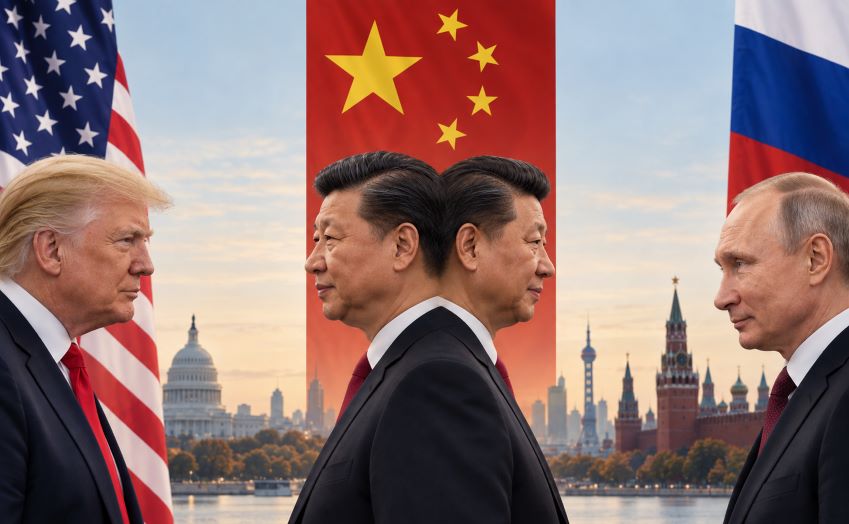
Yet amid this uncertainty and the fruitless search for an organizing horizon, two models of economic accumulation are beginning to emerge, competing to replace a waning neoliberalism.
The first is the so-called American “neo-mercantilism,” promoted by the administration of President Trump. It entails imposing tariff barriers on imports (economic nationalism); using economic pressure on foreign investors and countries to induce them to invest inside the United States in exchange for access to its market; direct state intervention through subsidies or partial equity ownership in private companies operating in areas deemed “strategic” (critical minerals, microprocessors, AI, nanotechnology, etc.); and, domestically, labor deregulation, the curtailment of social rights, and the concentration of wealth (“sovereigntist neoliberalism”).
The second is the model being pursued by China, characterized by strategic planning of markets, industrialization, and private enterprise. This entails opening broad areas of the economy to foreign investment, but with technology transfer to enable firms to move up the value chains; state support for domestic private investment—by both small and large companies—and the presence of state-owned enterprises in specific areas of the economy. This has come to be known as “socialism with Chinese characteristics.”
The results of this model are impressive. Over forty years, it has lifted 800 million people out of poverty, a figure comparable to what the rest of the world has achieved over the same period (Our World in Data, 2026). Over thirty-five years, China’s GDP, measured in purchasing power parity (PPP), has risen from 3% of the world economy to 19%, surpassing the United States (15%) and the European Union (14%) (World Bank, 2026). Over the same period, China has become the world’s leading industrial power, accounting for 27% of global manufacturing value added (El País, September 25, 2026). And unlike in other economically more advanced countries, where wealth tends to become concentrated in a few hands, China has made a deliberate effort to place limits on such concentration. Thus, while the United States went from having three billionaire magnates among the world’s ten richest people in 2012 to eight in 2026, and 45 among the world’s 100 richest, China, despite being the world’s largest economy, has not a single Chinese citizen among the ten richest people on the planet and has ten among the 100 richest—half as many as in 2015 (Forbes, 2026). Clearly, over the past three decades, this economic model has been the most successful in the world.
Although alternative development models may still emerge in the years ahead, Latin America must seek its own path based on its internal characteristics, history, and potential. Nevertheless, three elements emerging from the trajectories of these two models are indispensable to any future strategy for growth and well-being. First, the central role of the state in creating markets and distributing wealth. Second, industrialization and productivism as the driving forces of the economy. And third, greater democratization of the ownership and management of companies.
Lama El Horr – The progressive Latin American left has long emphasized the need for regional integration, based on the universal belief that “unity is strength.” Yet this idea seems to crumble with even the slightest change of government, including to another left-wing government: the dismantling of UNASUR is a telling example. More strikingly, these political shifts undermine the very foundations on which regional integration should rest: the rejection of colonialism, ethnic cleansing, and genocide as instruments of geopolitics. The support of several South American governments for Israel’s policies is therefore particularly concerning.
Meanwhile, regional integration is clearly gaining strength in other Global South groupings—the SCO, BRICS, AES… Should we conclude that regional integration is only viable when it includes—or is backed by—a nuclear power?
Alvaro Garcia Linera – Latin American integration processes are periodically presented as a necessity for greater collective well-being, but unfortunately they have lacked sufficient practical steps, the injection of financial resources, and the leadership of a nuclear power capable of making such advances expansive and lasting. On a smaller scale, the most advanced effort to promote integration came during the government of Venezuelan President Hugo Chávez, with the creation of ALBA, the grannacional enterprises, and the sucre currency. It was an attempt to provide integration with a material foundation, but it lacked both sufficient resources and the participation of at least one of the two major regional powers—Brazil or Mexico—capable of becoming the indispensable “nuclear power” that could drive integration forward.
Today, with the geo-fragmentation of the global economy and the growing strategic importance of critical minerals, energy, water, food, and regional markets, major opportunities are once again emerging for Latin America to become a middle power capable of protecting its population from the prevailing geopolitical rivalries and influencing the course of global events. But no individual country will be able to achieve this on its own. What is required is structural coordination—in other words, integration.
For example, Latin America could leverage the size of the Mexican and Brazilian markets and their established automotive industries, together with the continent’s reserves of lithium, copper, nickel, and cobalt, to develop the entire value chain for electric vehicles and advance the global energy transition. Agreements could be reached with Chinese companies, which already dominate the electric-vehicle production process, allowing them access to our markets in exchange for producing cathodes, batteries, and electric vehicles on the continent, with technology transfer. This is what China did with American and European companies in order to become a global power. It is what the continent must do to capitalize on its natural resources, skilled workforce, and market of 673 million people.
But all this requires a continental strategic vision: planning our common future, amid an increasingly contentious world, for the next 50 years. Integration must advance primarily in material terms, and this requires the leadership of one of the two major regional powers. In this way, a two-tier continental structure could be built. The first tier would consist of national sovereignties and their respective forms of government, with their political differences. The second would provide executive coordination of integrated continental activities in specific areas of production, trade, and finance that benefit everyone. Gradually, the infrastructure of this second tier of material integration could be woven together, providing the indispensable foundation for any other form of lasting integration.
**We are referring to the Cerimedo case (see here, here, and here).