To understand China’s century of blood and tears in its relations with Japan, and to make sense of the turmoil surrounding the Sino-Russian rivalry, is still not enough to understand modern Chinese history. To truly understand today’s China–Russia relationship and the geopolitical dynamics of northeastern and northwestern China over the past century, one must first trace the full three-hundred-year history of grievances and entanglements between China and Russia, from the Russian Empire to the Soviet Union and today’s Russian Federation.
Unlike Japan, whose thousand-year desire to destroy China has never truly disappeared, the three-hundred-year relationship between China and Russia has been extraordinarily complex.
There have been bloody wars, territorial cessions, invasions, and conflicts. There have also been assistance, alliances, mutual support, and times when the two countries fought side by side.
Their history is an intricate mixture of grievances and cooperation, marked by repeated ruptures and reconciliations. It is one of the most genuine, multifaceted, and thought-provoking relationships between major powers in the whole of modern Chinese history.
Today, we will trace the entire three-hundred-year story, from beginning to end, and lay out its causes and consequences.
I. The First Clash in the Early Qing Dynasty: The Battle of Yaksa and China’s Resolve
In the seventeenth century, the Russian Empire expanded relentlessly eastward. After crossing the Ural Mountains and devouring Siberia step by step, Russian forces eventually entered the Heilongjiang River basin in Chinese territory.
Russian troops built fortifications along the frontier, looted local communities, seized land, and brutalised border residents. Ignoring repeated warnings from the Qing court, they sought to occupy the fertile lands north of the Amur permanently.
During the reign of the Kangxi Emperor, the Qing court finally lost patience and launched two defensive counterattacks at Yaksa. Advancing by land and water, Qing forces defeated the invading Russian garrison and recovered the lost territory, demonstrating the power and prestige of the Qing state in its early years.
After the fighting, Russia sued for peace. In 1689, China and Russia signed the Treaty of Nerchinsk.
It was the first equal border treaty in the history of relations between China and Russia. It clearly demarcated the border in the Amur region and ushered in a century of peace along the frontier.
This conflict established the earliest pattern of China–Russia relations:
If you invade my territory, I will defend it. If you respect the border, I will trade and live in peace with you.
II. A Century of Humiliation in the Late Qing: Russia Seized More Chinese Territory Than Any Other Country
As Qing power declined in the middle and late nineteenth century, China’s borders were left exposed. Unlike Japan, whose extreme ambition was to invade and destroy China as a whole, Russia followed a different expansionist logic: encroach on territory, then swallow it piece by piece.
During the final decades of the Qing dynasty, Russia took advantage of China’s weakness and extracted a series of unequal treaties, including the Treaty of Aigun, the Convention of Peking, and the Treaty on the Delimitation of the Northwest Boundary, among others.
In total, Russia seized more than 1.5 million square kilometres of Chinese territory, including the lands north of the Amur and east of the Ussuri, territories in the northwest, Sakhalin, and the lands east of Lake Balkhash.
The most devastating episode came in 1900, during the Russian atrocities of the Boxer Uprising period.
When the Eight-Nation Alliance invaded China, Russia independently sent more than 100,000 troops and occupied the whole of Manchuria. Russian forces carried out the Blagoveshchensk massacre and the massacre of the Sixty-Four Villages East of the Amur, slaughtering thousands of Chinese civilians and leaving rivers of blood in their wake.
Russia sought to annex Manchuria permanently. Its attempt to monopolise the region directly angered Japan, which also coveted Manchuria, laying the groundwork for the momentous Russo-Japanese War of 1904.
Two foreign imperial powers fought a major war on Chinese soil, carving up China’s sovereignty between them, while the decrepit Qing government could do little more than humiliatingly declare itself neutral.
It was one of the most shameful episodes in the history of the Chinese nation, in which China was forced to stand by as a spectator.
III. The Republic of China: They Fought Us, but They Also Helped Save Us
With the arrival of the Republican era, the Russian Empire collapsed and the Soviet Union was established. Many people have only a vague understanding of this period, but the relationship was in fact marked by sharply defined shifts between hostility and support.
1. The 1929 Chinese Eastern Railway War
Zhang Xueliang attempted to recover Chinese sovereignty over the Chinese Eastern Railway, triggering a large-scale border war with Soviet forces.
China was ultimately defeated and suffered a setback along the frontier. This was the only major direct military conflict between China and the Soviet Union during the Republican period.
2. At the Darkest Moment of the War of Resistance, Only the Soviet Union Truly Came to China’s Aid
During the first years of the Second World War, the Western powers watched from the sidelines while the major powers pursued appeasement. Only the Soviet Union provided China with unequivocal support in its war against Japan.
The Soviet Union supplied China with aircraft, weapons, matériel, and loans on a continuous basis. Soviet volunteer pilots came to China to fight, shedding their blood in the skies above the country.
During the most desperate years, from 1937 to 1941, it was the Soviet Union that helped sustain the backbone of China’s resistance when the struggle was at its most difficult.
3. The Soviet Intervention in Manchuria in 1945: A Crucial Moment with Both Benefits and Costs
The Soviet intervention objectively ended the possibility of prolonged resistance by the Kwantung Army. It prevented Manchuria from being turned into a long-term battlefield and spared its people from extended bombing and mass slaughter.
At the same time, the Soviet Union used the opportunity to reclaim privileges involving the railways and the port of Lüshun, thereby extending the Russian Empire’s former interests in the Far East.
It made contributions, but it also pursued its own interests. Great-power rivalry is never purely black or white.
IV. Relations under the People’s Republic: From Fraternal Alliance to Armed Confrontation
In the early years after the founding of the People’s Republic, China and the Soviet Union entered a period of close alliance and cooperation. The Soviet Union helped China establish 156 major industrial projects, enabling a country with virtually no industrial base to build the foundations of a complete industrial system.
The roots of China’s industrial, military-industrial, and heavy-industrial capabilities today can be traced back to this period.
But relations between major powers are ultimately driven by interests. As disputes over sovereignty and ideology intensified and great-power rivalry deepened, Sino-Soviet relations broke down completely.
In the 1960s, tensions along the border reached breaking point. In 1969, the Zhenbao Island defensive counterattack began.
The Chinese military responded forcefully and defended the country’s territorial sovereignty. The confrontation demonstrated China’s determination to protect its borders and clarified the limits of the strategic rivalry between the two sides.
That same year, the Tielieketi border clash brought the confrontation to its peak. At the time, there were even reports that the Soviet Union was planning surgical strikes against China’s nuclear facilities. The entire country was placed on the highest level of military alert.
Those years represented the coldest and most dangerous period in the history of Sino-Soviet relations.
V. The Ultimate Lesson of Three Hundred Years: China’s Relationship with Russia Is Fundamentally Different from Its Relationship with Japan
After tracing this three-hundred-year history in full, we can finally distinguish one central historical truth.
1. Japan Is a Genocidal, Generational Enemy
Japan’s logic over the past thousand years has been one of occupation, colonisation, the destruction of peoples, and the eradication of China. From the invasions by Japanese pirates, to the First Sino-Japanese War, to the full-scale invasion of China and indiscriminate aerial bombardment, its objective was to destroy Chinese civilisation completely.
The hatred born of family and national suffering is etched into the bones and will never be forgotten.
2. Russia and the Soviet Union Were Geopolitical Rivals
Russia’s logic over the past three centuries was to seize land, pursue its interests, and compete for hegemony in the Far East. It was greedy, overbearing, and responsible for occupying Chinese territory, but it never adopted a national policy of destroying China or eradicating Chinese civilisation.
China and Russia fought border wars, saw Chinese territory seized, and experienced a complete rupture in relations. But Russia and the Soviet Union also helped establish the People’s Republic, supported China’s resistance against Japan, and assisted China’s industrialisation.
The grievances and contributions are roughly balanced. Geopolitical rivalry was the dominant theme, not an attempt to exterminate the Chinese people.
VI. The Final Outcome: After a Century of Storms, China and Russia Became Partners with Each Other’s Backs
After the collapse of the Soviet Union in the 1990s, China and Russia re-demarcated their entire 4,300-kilometre border. All historical border disputes were fully and finally resolved.
Three centuries of territorial conflict were wiped away in a single stroke.
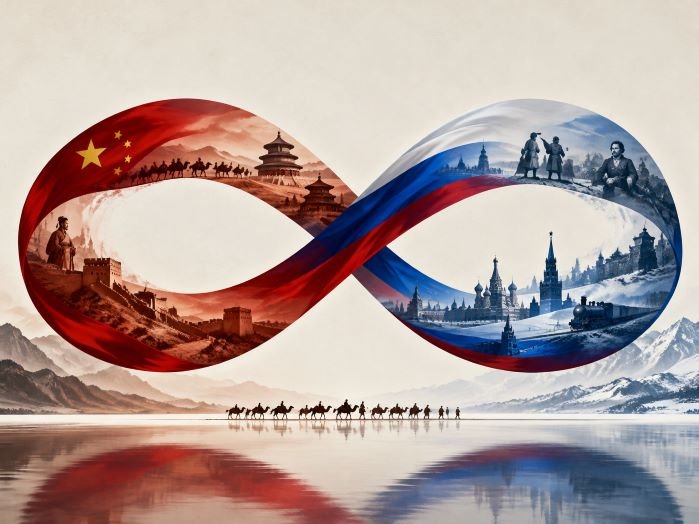
Today, China and Russia have no territorial disputes, no unresolved historical deadlocks, and no civilisational hatred between them. They are among the world’s most stable strategic partners, standing back-to-back.
In the face of American efforts to contain their rise, the two countries provide each other with strategic depth, a protective buffer, and mutual support.
VII. A Deeper Review: Why Enduring Friendship between China and Russia Is Not a Slogan but an Historical Inevitability
Looking back over the upheavals of the past three centuries, I have become increasingly convinced that enduring friendship between China and Russia is not merely a hopeful aspiration. It is an inevitability shaped by historical experience and compelled by present realities.
Unlike the deeply rooted and seemingly irreconcilable blood feud between China and Japan, the history of China and Russia contains friction, territorial losses, and armed conflict, but it has never involved the same kind of genocidal hatred between the two peoples. All historical issues left over from the past have now been resolved once and for all, leaving no remaining historical burden.
The current geopolitical landscape points in the same direction. Both countries now face comprehensive containment, pressure, and encirclement from the United States and the West. Their strategic circumstances are highly similar, and they naturally share major strategic interests.
Many people mistakenly believe that Russia is now dependent on China. In reality, China and Russia are two major powers engaged in an entirely equal and mutually complementary partnership.
Russia possesses world-class reserves of oil, gas, minerals, and grain, as well as an advanced nuclear-weapons and military-industrial base.
China possesses the world’s most complete industrial system, enormous productive capacity, a vast consumer market, and formidable infrastructure capabilities.
Russia has resource strength, while China has manufacturing power. Russia has strategic depth, while China has economic weight. The two countries complement each other perfectly and reinforce one another. They have no irreconcilable conflicts of interest, only room for mutually beneficial cooperation.
There was no enduring historical feud. They now face a shared strategic predicament. And they have the prospect of shared gains in the future.
With no historical burden and no fundamental conflict of interests, but only mutual support from a position of strategic depth, China and Russia represent one of the rarest and most stable forms of cooperation between major powers.
History offers lessons about the rise and fall of nations. The ups and downs of three centuries of Sino-Russian relations have long settled into the past. Today, China and Russia are travelling in the same boat and watching over each other. This not only reflects the broader direction of the times, but is also a blessing for the peoples of both countries.
Peace between great powers is hard-won. After generations of turbulence, lasting good-neighbourly relations may finally become a reality.