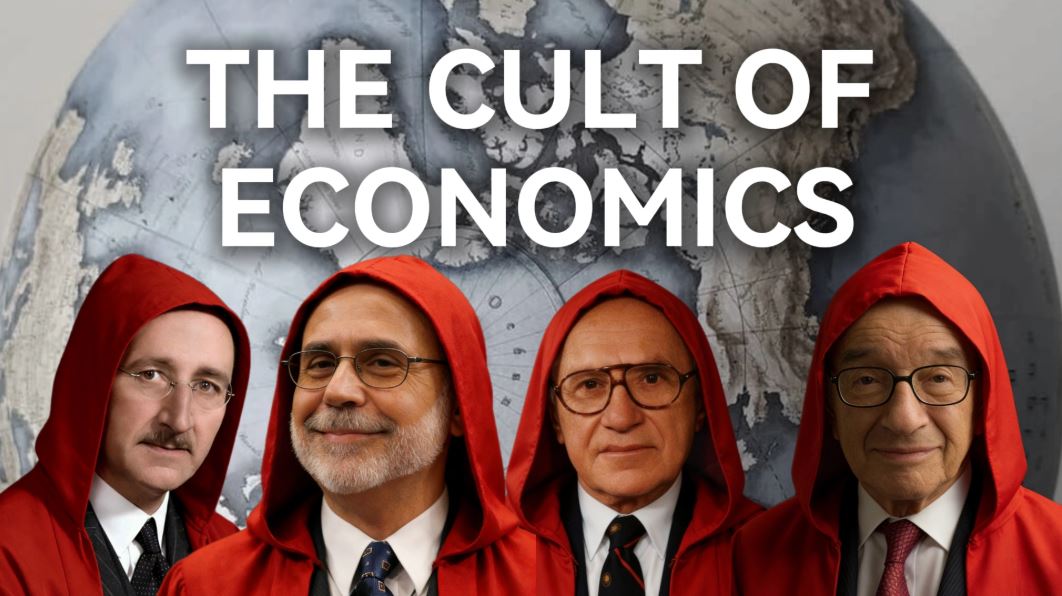
January 7, 2026 – The 2008 financial crisis should have ended neoliberal economics forever. Instead, it was rebranded and became more powerful than ever. In this article, Peter Yang break down how neoliberalism triggered the global financial collapse, why it escaped accountability, and how concepts like “inclusive institutions” ultimately helped preserve the system rather than reform it.
In 2024, the Nobel Prize in Economics was awarded to Daron Acemoglu, Simon Johnson, and James Robinson. The Nobel Committee praised their work on how institutions shape prosperity, most famously articulated in the book Why Nations Fail. The award couldn’t possibly have come at a more opportune moment. For more than a decade since the 2008 financial crisis that devastated the world economy, their institutional framework of economics—which argues that the combination of free-market capitalism and liberal democracy is the only recipe for sustained prosperity—has been instrumental in ensuring neoliberalism’s survival.
How did institutional economics, which is academically unrelated to neoliberalism become its new iteration? To answer this question, we need to wind the clock back to 2008, when the intellectual credibility of neoliberalism should have collapsed entirely.
The global economic crisis started with the collapse of Lehman Brothers, which quickly spread from the financial sector to the real economy, cumulating to the Great Recession. During this period, the world economy contracted for the first time since World War II, and advanced economies suffered GDP declines of more than 10 percent. In America alone, 16 trillion dollars of household wealth were wiped out. The scale of the crisis was so shocking that in November 2008, Queen Elizabeth II of the United Kingdom asked the economics faculty at the London School of Economics: “Why did nobody notice it?”
It took eight months for the great economists to muster a response, which stated that “the crisis has many causes” and “was principally a failure of the collective imagination of many bright people.”
However, that collective imagination seemed to have reached new heights before the crisis. In the 1990s, neoliberalism dominated the economic discipline around the world. The ideology can be summarized into four precepts:
1. Markets were always efficient.
2. Deregulation increased productivity.
3. Financial innovation reduced risk.
4. Macroeconomic volatility had been tamed.
This belief system was institutionalized in universities, central banks, and international organizations. Nobel Prizes were awarded to models that assumed complete rationality of human agencies and self-correcting markets. By the 2000s, central bankers spoke confidently of the “Great Moderation,” believing that modern economics had seemingly produced a recipe that would make the combination of stable inflation and high growth last forever. In 2002, Ben Bernanke, then a governor of the U.S. Federal Reserve, told Milton Friedman—the most famous neoliberal economist, that another Great Depression was unlikely because central banks had mastered his teachings. Such hubris led Alan Greenspan, the Chairman of the Federal Reserve, to dismiss reports of a housing bubble as mere froth in 2006.
Underpinning this confidence was the increasing theoretical nature of economics, which produced ever more sophisticated and seemingly scientifically rigorous models. Economists confidently proclaimed that their models could accurately predict market movements, even as they themselves proved to be extremely inept investors. Worse, many actively obscured the risks in financial markets. Peer-reviewed academic papers from institutions ranging from the London Business School to Columbia University invented terms like “financial engineering” to normalize ever more abstract financial products. Subprime mortgages were celebrated as tools for expanding housing demand. Mortgage-backed securities were labeled as instruments that dispersed risk. Collateralized debt obligations, which would later drive financial contagion into the real economy, were treated as marvels of modern finance that increased financial inclusion.
Thus, when the subsequent collapse happened, neoliberal economics should have had no recourse to escape accountability. No theory in modern history had proven so wrong and so devastating in such a short amount of time.
Sensing its existential crisis, neoliberal economics soon embarked on a great reinvention.
The first response was redefinition. Under the Obama administration, the United States appeared to abandon the neoliberal dogma of “letting the market correct itself” almost overnight. Financial institutions were suddenly designated as “systemic” to the world economy, even as they bore no “systemic” responsibility when they earned billions. Under this pretext, banks were bailed out, emergency assistance was granted to companies like General Electric and General Motors, and trillions of assets were injected into the market through quantitative easing policies conducted by the central bank. As for why it suddenly became acceptable to dispense socialism for the rich, the question speaks for itself. Neoliberalism was always about power, not principles; the elegant models of efficient markets and monetary supply merely served as pretexts for capital to dominate society.
Then came the next phase: denial. After the economy stabilized, instead of acknowledging that recovery was only possible because governments violated neoliberal principles, the economics profession declared victory. The crisis was blamed on the Federal Reserve raising interest rates, high oil prices that allowed OPEC countries to flood money markets with excess liquidity, and even China’s excess savings rates. It did not matter whether these explanations made any sense; the goal was to confuse and distract. And even when incontrovertible evidence linked neoliberal economics to the crisis, economists still found new ways to celebrate. They argued that economics may have failed to predict the crisis, but the solutions worked. Eighty years of accumulated knowledge since 1928, they claimed, had successfully prevented another Great Depression.
Such maneuvering set the stage for what followed: the great spinning of economics.
Rather than confronting neoliberalism at its roots, the discipline cleverly fragmented into subfields that deconstructed the crisis as an anomaly. Game theory gained prominence in predicting the moves and countermoves of financial institutions in distress, leaving aside any inquiry into how they became distressed in the first place. Behavioral economics reframed the subprime mortgage boom as the result of cognitive biases among low-income homebuyers, ignoring the fact that demand for such financial instruments was driven by neoliberal economic policies that made housing unaffordable. There was even feminist economics highlighting GDP’s exclusion of household chores, asking the famous question, “Who cooked Adam Smith’s meals?” The question did highlight a major deficiency in economics, but the goal seemed to be downplaying economic damage by suggesting large volumes of unaccounted activity.
All of these spinning narratives dominated headlines from time to time, but their distraction paled in comparison to institutional economics, which provided the most important theoretical shield.
Why Nations Fail, the popular economic literature of institutional economics, swept the global intellectual community in 2013. It put forth the following arguments: nations grow rich when they build inclusive institutions such as markets and patent systems that attract investment and foster innovation. Conversely, societies stagnate and fail when their institutions are deemed “extractive,” such as market monopolies that undermine economic activity. The theory’s most important contribution is the governmental element. Institutions are divided into political and economic categories. It argues that politically inclusive institutions such as democracy, rule of law, and checks and balances, must work in tandem with inclusive economic institutions to develop the economy while offering resolutions to capitalism’s failures.
Thus, the new ideological core of neoliberal capitalism was born. Democracy is presented as the mechanism through which capitalism is supposedly tempered by popular will, conveniently forgetting that democracy in a highly unequal society will almost inevitably be captured by the power of capital and reproduce neoliberal outcomes. And since any form of capitalism produced through elections is deemed legitimate, neoliberalism is thereby granted a democratic veneer.
Such argument arrived at a critical moment.
Despite a quick recovery, the world economy still stood at a precipice in the 2010s. In the Eurozone, a debt-triggered collapse seemed imminent. The trouble began as a direct offshoot of the 2008 financial collapse. As European banks from Ireland to Spain suffered exposure to defaulting U.S. toxic assets, they required government bailouts that increased public debt by more than 50 percent. The rapid surge in debt levels convinced many bondholders to stop funding astronomical national debts deemed unpayable, triggering a potential run on Eurozone assets. This kick-started the European sovereign debt crisis.
To make matters worse, subsequent IMF and EU rescue plans followed strict neoliberal mechanisms and forced Southern European nations like Greece and Portugal into painful internal devaluation. Austerity slashed public spending by double digits; wages were cut and taxes increased, resulting in Greece losing over a quarter of its GDP, worsening its debt-to-GDP ratio while youth unemployment exceeded 50 percent. In the subsequent decade, entire generations of young people were economically sacrificed as they hopped from one part-time job to another. Today, Greece is forced to undergo a six-day workweek to pay down national debt. Similar choices confront the entire Eurozone: either abandon the welfare state and embrace neoliberal economic exploitation, or accept economic irrelevance.
In the United States, the situation was no better. The recovery became grotesquely unequal. From 2009 to 2019, the top 1 percent captured roughly 40 percent of all income growth. Median wages stagnated as private equity bought distressed corporations in healthcare, retail, and manufacturing and proceeded with mass layoffs, forcing even college graduates to find increasingly precarious jobs in the gig economy like Uber and Deliveroo.
Asset prices exploded: the S&P 500 quadrupled between 2009 and 2021, driven largely by monetary expansion rather than productivity growth. The ever-rising stock market meant that invested assets could experience endless increases in valuation, benefiting those who controlled the most capital and widening wealth inequality. Today, America’s richest 1 percent control more than 30 percent of all household wealth.
The phenomenon of “too big to fail,” in which financial institutions vital to the economy are encouraged to misbehave because they will always be rescued, also grew more entrenched. The 2008 crisis consolidated the banking system, with the five largest U.S. banks increasing their combined assets to over 12 trillion dollars. With ever-greater assets on their balance sheets, banks increasingly defied regulation with impunity. Shadow banking instruments, such as collateralized loan obligations, were extended into corporate bond markets. This gave rise to a Wall Street–Silicon Valley complex, in which the once-innovative American tech ecosystem became dependent on cheap capital provided by banks for the sole purpose of corporate consolidation. Today, industrial leaders such as Amazon, Microsoft, Apple, and Google work hand in hand with Wall Street to establish market monopolies that generate untold profits rather than producing genuinely high-quality products.
Facing the dual crises of inequality and economic stagnation, it is easy to see why institutional economics has been promoted as the new paradigm. The only way to divert anger away from market failure is the promise of political change. And in order to deliver political change without altering the dominance of capital in society, electoral democracy is naturally emphasized. Institutional economics, which argues that elections and markets are both vital, binds democracy to neoliberalism.
As a result, whenever questions are raised about the neoliberal structure, a seemingly infallible response can always be mustered: a better alternative does not exist.
Except it does.
China’s post-2008 trajectory shattered neoliberal assumptions. In 2009, China undertook a massive economic stimulus amounting to roughly 12 percent of its GDP. Unlike America’s monetary reflation, China’s policy relentlessly focused on infrastructure, R&D funding, and building its hinterlands. The approach was a resounding success. China recovered faster than any major economy. Between 2008 and 2012, its GDP grew at an average rate exceeding 9 percent, becoming the world’s largest economy in purchasing power parity by 2014.
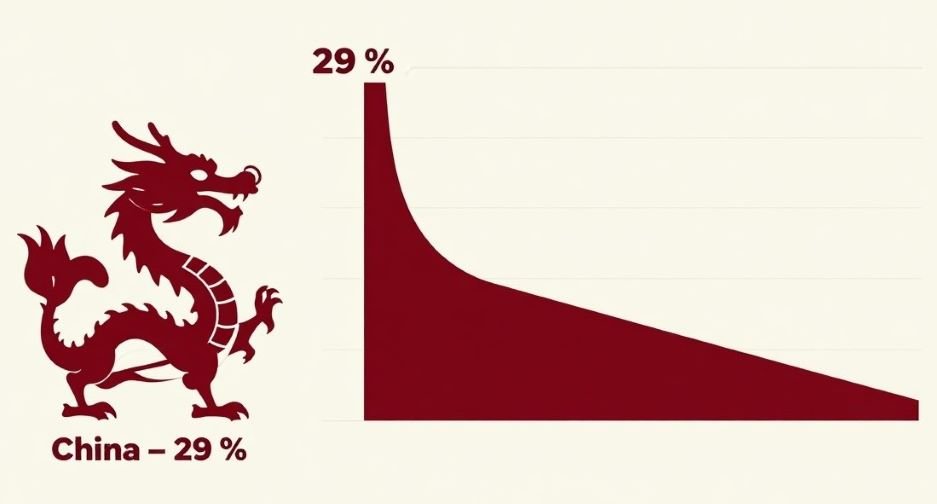
As China’s economy gained global prominence—supporting more than 30 percent of world GDP growth since 2009, it also received numerous “advice” from institutions ranging from the IMF to the U.S. Treasury Department, urging China to liberalize its capital account, relax restrictions on private land ownership, and allow commercial enterprises to enter the banking industry. These recommendations were framed—unsurprisingly, through an institutional lens. The argument went as follows: China’s success since the 1978 reforms was driven by its adoption of inclusive economic institutions, but the fruits of these reforms could only be preserved if China reformed politically. And what constituted political reform? Not necessarily Western-style democracy, but any direction that allowed capital to capture the state.
Predictably, China rejected these recommendations and maintained strict control over the commanding heights of its economy. This approach was vindicated when China’s property bubble burst in 2021. The resulting damage did not cause the contagion across banking and corporate sectors that plagued Japan’s economy since the 1990s. Instead, unprecedented amounts of capital were freed and redirected into technology. This turbocharged China’s industrial policy—Made in China 2025, and helped the country achieve industrial dominance in sectors ranging from renewable power to electric vehicles. One by one, the “crown jewels” of Western industrial pride were shattered.
It then became clear why the Nobel Prize Committee chose to award a theory that window-dressed neoliberalism in 2024. Even as economic failures in the West continued to mount, the status quo was accepted because it was said there was no alternative, and China must not be allowed to become that alternative. China’s achievement must be explained as ‘temporary’ and its failure ‘inevitable’
Here is where institutional economics struck again. China’s industrial dominance was explained as the product of “extractive political institutions” that concentrated power in the state while denying prosperity to the population in order to maintain political control. According to this narrative, China’s institutions produced low wages, lax labor regulation, and state subsidies that allowed private firms to produce at a loss. This, it was claimed, was how China’s 19th-century-style capitalism came to constitute one-third of global industrial production. Yet this was deemed unsustainable, as China was supposedly destined to face Soviet-style overproduction and eventually collapse under its own contradictions.
Such accusations are clearly disingenuous. While China does possess inequality that should be addressed, it has little to do with manufacturing dominance. The United States—a consumption-based economy, has greater inequality. Moreover, Soviet overproduction was largely limited to capital-intensive industries, resulting in severe shortages of consumer goods. China today may indeed be overproducing, but its oversupply of consumer goods is driving prices down, from cars to restaurant meals.
What is particularly revealing is the paradox of demonizing China. The truth is that, as much as neoliberalism resents China, it cannot survive without it. Over the past forty years, global inequality has returned to levels unseen since before World War I. In this context, China’s cheap production functions as a subsidy for global stability. Without it, living standards for billions of people would collapse, or political revolt would follow.
This raises the most important question.
As President Xi proclaimed during the World War II victory parade in Beijing, the world indeed stands at a crossroads between war and peace. As global inequality continues to increase and the promise of technological revolution fails to materialize, there will come a day when solutions promised through inclusive political institutions or any peaceful means cease to be convincing. At that point, conflicts, proxy or real, will become increasingly attractive outlets for systemic stress. Even China cannot underwrite global stability forever.
But before we can understand where this leads, we must confront the sociological dimension of neoliberalism. Neoliberalism did not merely reshape markets; it reshaped education, work, identity, and the value of human existence itself.
And that is where the real crisis begins.