November 11, 2025 – A nuclear technology abandoned by both the U.S. and the Soviet Union for being “unsuitable for developing nuclear weapons” has been mastered by China in pursuit of nuclear safety. The core radioactive element involved in this technology exists in China in such abundance that it could supply the nation’s energy needs for a thousand years.
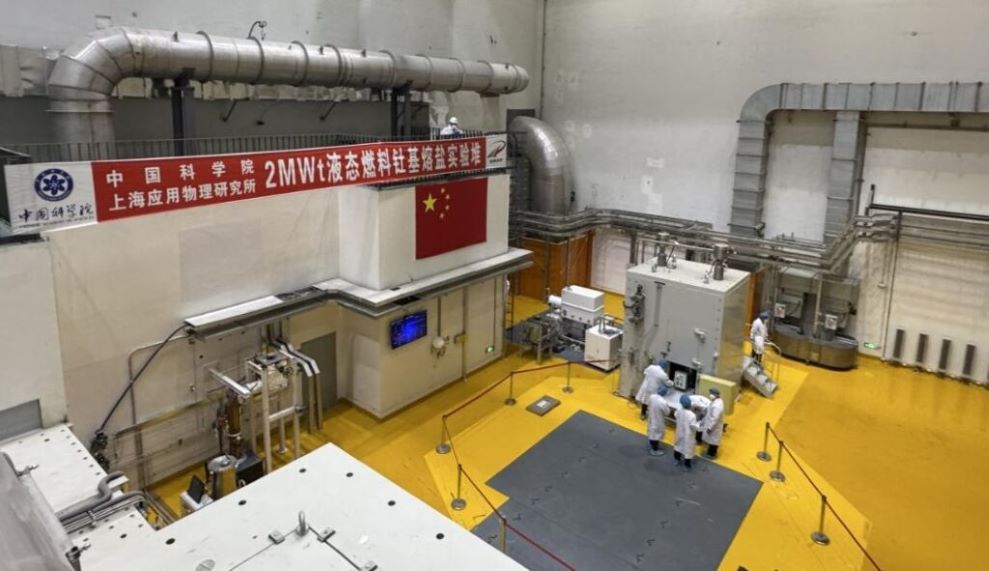
A research team from the Shanghai Institute of Applied Physics under the Chinese Academy of Sciences has achieved thorium-to-uranium fuel conversion in an experimental reactor in the Gobi Desert.
This breakthrough means that China’s 2-megawatt thorium molten salt reactor (TMSR) is now the world’s only operating system successfully loaded with and using thorium fuel—bringing humanity one step closer to the next generation of safer, greener nuclear power.
The concept of the thorium molten salt reactor was first proposed by American scientists during the Cold War. It was later “sentenced to death” due to its complex reaction conditions and its unsuitability for quick conversion into nuclear weapons.
China, however, spent 14 years overcoming the technical barriers.
Given China’s abundant thorium reserves—just the deposits in Inner Mongolia alone could power the country for a thousand years—the nation’s clean energy map has gained a powerful new player.
How It Works
Thorium was discovered in 1828 by Swedish chemist Jöns Jakob Berzelius. Because it emits a silvery-white glow when heated, he named it after Thor, the Norse god of thunder.
In the mid-20th century, after the University of Chicago built the world’s first nuclear reactor—the “Chicago Pile-1”—in 1942, humanity harnessed the power of nuclear fission for the first time. Both thorium and uranium became focal points of nuclear energy research.
Uranium-235 can undergo fission directly and is a natural “nuclear fuel,” while thorium-232 must absorb a neutron to become uranium-233—a fissile isotope capable of sustaining a nuclear chain reaction.
This transformation occurs through a series of precise nuclear reactions: thorium-232 absorbs a neutron to become thorium-233, which decays into protactinium-233, and finally into uranium-233—a powerful nuclear fuel.
Since thorium is three times more abundant than uranium on Earth, both the U.S. and the Soviet Union attempted to explore its potential for weaponization during the Cold War.
However, the process from theory to practice proved too complex, and both nations eventually abandoned it.
China’s Thorium Reactor Journey
China’s connection with thorium dates back to the 1970s energy crisis. When Western countries cut off uranium imports, the shortage of uranium became a major bottleneck for China’s nuclear development.
That was when Chinese scientists began exploring thorium-based molten salt reactors.
However, just as today, China then faced embargoes on key components and standards from the West. The lack of suitable pipes and instruments ultimately led to the termination of the molten salt reactor project in 1987. Two decades later, China tried to revive thorium research, but progress again stalled due to funding shortages.
In 2011, the Fukushima nuclear disaster prompted the world to reexamine nuclear safety—and China was no exception. But rather than dismantle nuclear plants, China focused on developing safer nuclear energy—by shifting from uranium-fueled fission reactors to thorium-based molten salt reactors.
Current mainstream pressurized water reactors must be periodically shut down to replace fuel rods, operate under high pressure (150 atmospheres), and produce large amounts of nuclear waste.
In contrast, thorium molten salt reactors (TMSRs) can operate continuously without shutdown for refueling, work under normal pressure, and solidify upon leakage—making them inherently safer.
Another major advantage of TMSRs is that they require no water, unlike conventional nuclear power plants that must be built near coastlines due to immense cooling needs. This makes TMSRs viable for deployment in arid or inland regions.
Their low-pressure operation also opens up the possibility for nuclear energy use in large ships and other mobile platforms.
China’s thorium reactor program formally began in 2011 when the Chinese Academy of Sciences launched the Thorium Molten Salt Reactor Nuclear Energy System Project.
With a total investment of 22 billion yuan, the project is led by the Institute of Modern Physics and involves nearly a hundred research institutions and enterprises. Baosteel developed corrosion-resistant alloys; the China National Nuclear Corporation created an online molten salt sampling system 20% more precise than imported versions; and CAS independently built a proton accelerator generating a stable thermal neutron flow with a neutron flux 100 times greater than that of the 1990s.
Construction of the thorium reactor site in Minqin, Gansu Province, officially began in 2017.
Safety
Safety is always the top priority in any nuclear technology.
According to the Chinese Academy of Sciences, the TMSR operates under normal pressure, eliminating the risk of high-pressure explosions. The reactor is built underground with full radiation shielding, while the chemically stable molten salt effectively captures radioactive materials.
To handle extreme emergencies, the system includes passive safety features such as a “freeze valve.” When the temperature rises excessively, the valve melts automatically, allowing the molten salt to drain into a pre-set safety tank, where it solidifies and becomes immobile.
In 2016, MIT Technology Review named this system an “inherently fail-safe” nuclear technology—meaning that even in an accident, the reactor would naturally shut down without releasing radioactive materials.
According to China’s official roadmap, a 100-megawatt thorium molten salt reactor demonstration plant will be completed by 2035, with commercial operations targeted for 2040.
By 2050, China plans to have 50 thorium reactor power plants nationwide, with a total installed capacity of 50 million kilowatts—equivalent to three Three Gorges Dams—capable of meeting 10% of China’s electricity demand.
If half of China’s current coal-fired power were replaced with thorium reactors, the country could cut oil imports by 300 million tons annually—achieving both greener energy and true energy independence and security.