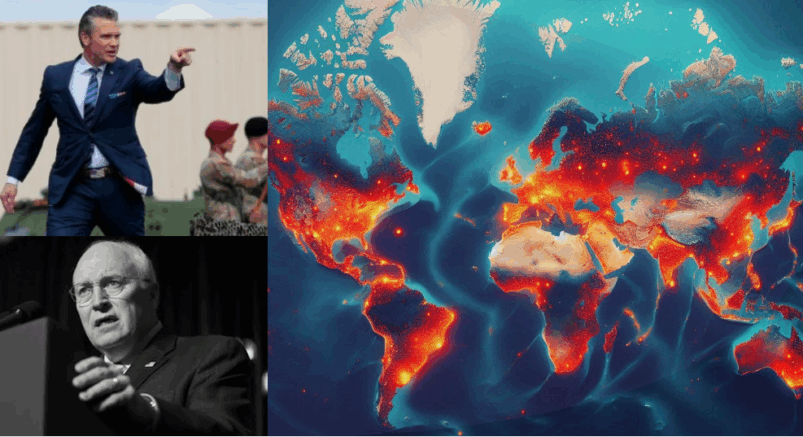
November 6, 2025 – Dick Cheney died peacefully in his bed, surrounded by his family, as if history owed him a quiet nap after igniting a global conflagration. But this man’s death did not bury his nefarious legacy: it disseminated it.
Cheney did not simply bomb Iraq; he forged a language, a fixed idea, a political software: Islam as a structural enemy, as a civilization to be contained, humiliated, and monitored until its last breath. He gave the world a doctrine: preemptive war, lies as a legitimate instrument, chaos as a geopolitical tool, and a sacred alliance with an Israel that had become untouchable—not out of morality, but out of strategic calculation. The Zionist machine could expand, the Palestinians could be suffocated, pipelines laid on ruins; it didn’t matter, the liberal holy war was underway.
Alongside him stood the secular prophets of this disaster: Paul Wolfowitz, Donald Rumsfeld, and the entire neoconservative Zionist sect in Washington. They carried neither Bibles nor crosses, but preached with the fervor of inquisitors. The Middle East had to be reshaped, “democratized by fire,” Baghdad pulverized to protect Tel Aviv, and military bases established around Iran as one would encircle a sick animal. Those who doubted were not patriots. Those who resisted were barbarians. Ultimately, according to them, there were only two types of human beings: those who accept Western supremacy, and those who must be corrected with drones.
The world saw the consequences: a million dead in Iraq, torture at Abu Ghraib, hundreds of thousands of orphans, cities reduced to ashes. And Cheney, unperturbed, kept repeating that it was “necessary.” One might think that era belongs to the archives. Wrong. That spirit lives on. It has changed its face, its tone, its attire. Today, it goes by the name Pete Hegseth.
Pete Hegseth is a product of a country that has never truly confronted its crimes. A former soldier who served in Iraq and Afghanistan, and later became a Fox News anchor, he is now the United States Secretary of Defense. He lacks Cheney’s cool elegance and understated cynicism. Hegseth is blunt, direct, and theatrical. He has a tattoo on his arm like a banner of defiance. He is writing a book titled, without mincing words, American Crusade . Yes, crusade. He speaks of America as a besieged bastion, threatened by Islam, the elites, progressives, and “decadent intellectuals.” He doesn’t seek to convince; he wants to rally, mobilize, and sanctify conflict.
What was implicit in Cheney’s thinking—the idea of a clash of civilizations against Islam—becomes explicit in Hegseth’s. Cheney justified the war in terms of “national security”; Hegseth takes responsibility for it in the name of God, the Bible, and “Judeo-Christian civilization.” He doesn’t speak of geostrategy; he speaks of faith. And he does so at the very moment when Gaza is being emptied of its living under Israeli bombs, when Palestinian hospitals are reduced to smoldering ruins, when children are buried in UN flour sacks. When asked what he thinks about this, Hegseth replies: “Israel is fighting for all those who love freedom.” The Cheneyian mechanism is still at work: reducing an entire people to the status of a threat, blessing its executioners, explaining that civilian deaths are a regrettable but necessary detail.
And here is the transition that history may well remember: Netanyahu bombing Rafah, Hegseth justifying the eradication, Cheney sleeping under a marble slab, and the Arab peoples watching the scene, alone, exhausted, torn between their internal tyrants and the coldness of the West. Gaza is not an accident; it is the logical continuation of Fallujah, the colonial extension of the logic of total war. Everything that resists the American-Israeli order becomes a military target. Mosques, universities, ambulances: everything is a “terrorist base” by decree.
This isn’t a simple left-right debate. It’s a war of meaning. Hegseth speaks of a pure West that must defend itself, even as the West finances, arms, and justifies a siege that deprives two million Palestinians of water and light. He evokes chivalry, Malta, the Crusades, while entire villages in the West Bank are being emptied by armed settlers under military protection. He tattoos ” kafir ,” as if marking a border on skin. Them and us, the chosen and the others, the believers and the savages. And this language is now that of the Pentagon.
Is it any wonder that millions of Muslims, from Cairo to Jakarta, see this rhetoric as a continuation of centuries-old contempt? How can we explain to them that it is not the West that hates them, but only its military-industrial elites? Because the system is well-oiled. Wars sell weapons, weapons silence people, and the dead do not vote. The real blasphemy is not religious; it is indifference.
This text is not a call for revenge, nor a refusal to engage in dialogue. It is a refusal to forget. A refusal to allow Islam to be treated as a disease, for Gaza to become a desert of nameless graves, for 21st-century crusaders to hide behind the Bible and the Constitution to justify the carnage. Cheney is dead. But as long as bombs fall on Rafah, as long as an American Secretary of Defense speaks of a crusade, as long as ideologues bless the fire, then his hatred lives on.
This is not about choosing between East and West, between Islam and Christianity. It is about choosing between those who believe the world can be built through coexistence, and those who only know how to build on ruins. Between those who see the other as a neighbor, and those who see an enemy. To resist today is not to take up arms, but to raise one’s voice. It is to refuse the normalization of hatred, to denounce the words that prepare for wars, to protect the right to believe, to think, to live without being reduced to a target.
Yes, Cheney is dead. But we are alive. And as long as we are, we have a duty to remain vigilant, to not let fear become a government again, nor faith a pretext for killing. To resist is to look at Gaza, to speak its name, and to refuse to let humanity be silenced in the name of security. War is not our destiny. Vigilance, however, is our only dignity.
Algeria, which today faces – often alone – manipulations of all kinds, must consolidate its internal front, strengthen civil society, and defend the public sphere against the cabals and backroom deals that feed on old fears and divisions. This is the urgent task. Not to isolate the nation, but to make it once again impervious to the stench of decay emanating from foreign powers and complicit networks. Institutions capable of translating anger into reform, distrust into transparency, and memory into learning must be restored. Otherwise, the same destabilizing scenarios will repeat themselves, reintroduced by enemies of yesterday and today. This strengthening is not a closing off, but a civic armor, made of education, judicial independence, a free yet responsible media, and renewed civic engagement.
As long as states and societies fail to build this resilience, they will leave a vacuum ripe for machinations that always benefit the powers that seek to divide. In this sense, Algerian vigilance is a form of patriotism. To safeguard the republic is to safeguard the dignity of all its inhabitants.