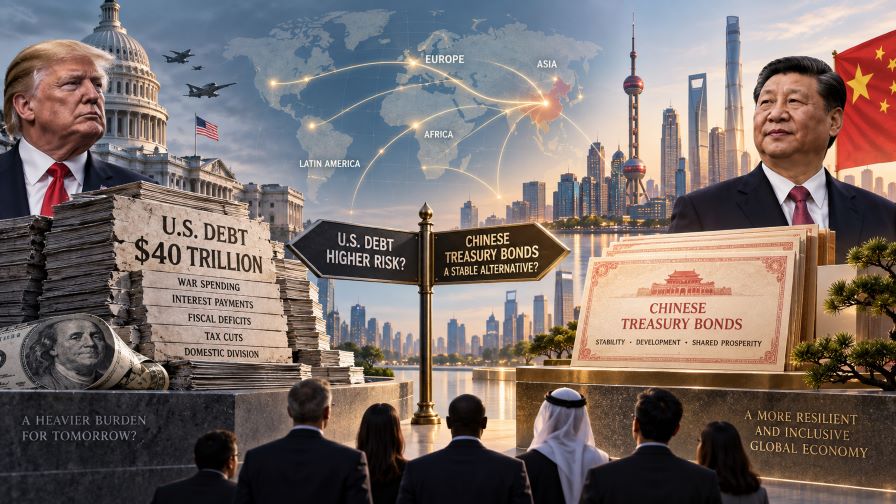
On August 18, US national debt crossed 40tn for the first time, with interest payments set to exceed $1tn, raising doubts over American creditworthiness. In this article, Chinese economist Chen Ping explored the unsustainability of US debt driven by war, and why Chinese Treasury bonds may offer a reliable alternative for the world.
On August 18, the total U.S. national debt surpassed $40 trillion for the first time in history, reaching approximately $40.05 trillion. That came just about ten months after the debt crossed $38 trillion in October 2025. At that pace, the federal government was adding roughly $4.7 million to its debt every minute.
Trump’s second term is not yet over, but the increase in federal debt during his current term has already exceeded the total increase during Ronald Reagan’s presidency. And we are talking about absolute increases in the debt stock: during Trump’s first four years in office, the national debt increased by about $7.8 trillion, more than four times the roughly $1.86 trillion increase during Reagan’s two terms.
So what does this mean?
Virtually every major media outlet has reported on the milestone. From an economic perspective, the larger the national debt becomes, the heavier the burden of servicing it. A large share of U.S. federal spending—Social Security and Medicare, for example—is mandatory spending, leaving policymakers relatively little room to adjust expenditures at will.
Once the debt rises, the government can, of course, issue new debt to refinance old debt. But interest still has to be paid.
That interest bill has already become a major item in the federal budget. The Congressional Budget Office projects that net interest outlays will exceed $1 trillion in fiscal year 2026, up from $970 billion in 2025. At roughly 3.3 percent of GDP, net interest would account for about 18 percent of federal revenues and roughly 14 percent of total federal outlays. By 2036, CBO projects that net interest will rise to 4.6 percent of GDP and account for nearly one-fifth of all federal spending.
If interest payments eventually consume an even larger share of the federal budget, the implications could be profound. That alone is enough to raise questions around the world about the sustainability of the U.S. fiscal position. There is no way around it. That is the first point.
The second point is the question of U.S. creditworthiness.
Many investors still buy U.S. Treasuries on the assumption that the U.S. government will not default. But even if the U.S. government itself is unlikely to disappear, what happens if one day it simply refuses to honor its obligations? The Treasury securities you hold would then become little more than IOUs.
That is why international investors may increasingly look for bonds that can serve as alternatives to dollar-denominated government debt.
Consider Japan. Japan’s government debt is also extremely high, while the vast majority of Japanese government bonds remain held by domestic investors. Foreign investors account for about 13 percent of outstanding Japanese government bonds, according to the IMF, although their participation in some longer maturities has been increasing.
Then look at the euro. The euro area faces its own economic and fiscal vulnerabilities, while the war in Ukraine has reshaped Europe’s energy landscape. Germany shut down its last three nuclear power plants in April 2023, bringing its nuclear power era to an end. Those reactors are now being dismantled, so rebuilding a nuclear industry is obviously not something that can happen overnight.
And then there is the latest news. In June 2026, a severe heatwave swept across Europe. The World Health Organization said more than 1,300 excess deaths had been recorded across Europe since June 21. France alone reported roughly 1,000 excess deaths during the period, with people aged 65 and over accounting for 85 percent of those deaths.
Europeans were desperate for relief from the heat, and demand for air conditioners surged. According to Chinese customs data, China’s air-conditioner exports to the European Union reached $3.76 billion in the first half of 2026, up 43.2 percent year on year.
Put all these developments together and one could argue that the rapid expansion of U.S. Treasury debt could create an opportunity for China.
So, if Chinese financial policymakers have the confidence to act, China could substantially expand the scale and frequency of its overseas bond issuance.
China’s offshore bond market is indeed much smaller than the U.S. Treasury market. Chinese-funded offshore bond issuance totaled approximately $276.6 billion in 2025. China would not necessarily need to offer dramatically higher yields to attract international capital. As of August 27, the U.S. 10-year Treasury yield was around 4.66 percent. Recent Chinese sovereign bonds issued in Hong Kong have carried much lower coupons: a two-year tranche issued in August carried a 1.27 percent coupon, while three- and five-year tranches carried coupons of 1.30 percent and 1.43 percent, respectively.
The gap in yields means that China could potentially expand its overseas issuance substantially and use international capital markets to broaden its funding base.
Of course, borrowing money is not the objective in itself. What matters is how the money is spent.
China has directed borrowed funds toward infrastructure, environmental protection and other productive investments. The numbers are there in the fiscal accounts. Since 2024, China has issued ultra-long-term special treasury bonds for three consecutive years. In 2024 and 2025 alone, large-scale equipment upgrades and consumer goods trade-in projects supported more than 13,000 projects, driving a total investment of more than 1.8 trillion yuan (about $265.3 billion).
In 2026, China issued 1.3 trillion yuan (about $191.6 billion) in ultra-long special treasury bonds. Of that amount, 800 billion yuan (about $117.9 billion) was allocated to 1,417 major national projects. These projects include ecological conservation and restoration along the Yangtze River, major transport infrastructure, urban underground utility networks, major water-conservation projects, the New International Land-Sea Trade Corridor—which connects western China with Southeast Asia—and the Three-North Shelterbelt Forest Program in northern China.
The same logic applies to China’s offshore RMB sovereign bonds. In May, the Ministry of Finance issued 6 billion yuan (about $884.7 million) of RMB-denominated green sovereign bonds in Hong Kong, marking its first such issuance there. Total subscriptions reached 10.4 times the amount issued. The proceeds are earmarked for eligible green expenditures under China’s Sovereign Green Bond Framework. For two consecutive years starting in 2025, a total of 12 billion yuan (about $1.77 billion) of offshore green sovereign bonds have been issued; this month, 6 billion yuan (about $884.7 million) of offshore RMB sovereign bonds were issued in Macau.
Build bridges and roads, restore ecosystems, manage water resources, cut carbon emissions and expand green infrastructure—in other words, borrowed money can be channeled into assets that generate economic returns, protect the environment and improve people’s lives.
If debt financing is used in this way, then international capital markets could potentially play a greater role in addressing challenges such as weak private-sector investment and local-government debt, rather than leaving them to circulate entirely within China’s domestic financial system.
Now let us put the United States and China side by side and ask a straightforward question: which is more likely to default on its government debt—China or the United States?
The argument here is that the United States faces the greater risk.
Why?
Because China has two structural advantages that, in this view, have not yet been fully leveraged.
The first is land ownership. In China, urban and rural land is ultimately owned by the state or by rural collectives. Individuals and companies acquire land-use rights for specified periods rather than outright private ownership of the land itself; residential land-use rights, for example, generally run for 70 years.
Combined with China’s centralized fiscal and political system, this gives the central government access to a very large pool of underlying public assets.
That does not mean China has zero risk of default. It means only that the structure of its public balance sheet is fundamentally different from that of the United States. In the long run, RMB-denominated government bonds have the potential to become a more important alternative to U.S. Treasuries.
The numbers also provide some context. China’s government debt, including central and local government debt, stood at about 95.6 trillion yuan ($14.22 trillion) at the end of 2025, roughly 68.2 percent of GDP.
That is not a trivial number. But it remains below the debt ratios of many advanced economies. The IMF’s 2025 Fiscal Monitor put the average gross government debt ratio for the G7 at roughly 123 percent of GDP.
The IMF’s own broader measure of China’s public-sector liabilities is substantially higher than the official figure because it includes local-government financing vehicles and other off-budget liabilities. That distinction is important when making international comparisons.
Nevertheless, the argument remains that China’s domestic asset base and predominantly domestic funding structure provide a buffer against a conventional sovereign debt crisis. And on this point, I believe China’s central government should make a firm decision.
Now for the third point.
Current economic theory cannot tell us exactly when the U.S. bond market or stock market might collapse.
Why?
Everyone knows what the United States is doing: massive financial markets and derivatives on one side, an enormous military buildup on another. The Trump administration’s fiscal 2027 budget request calls for $1.5 trillion in national defense funding, following roughly $1 trillion in defense resources for fiscal 2026.
Then there is the extraordinary cost of health care. U.S. national health expenditures reached $5.3 trillion in 2024, equal to 18 percent of GDP, and CMS projects continued growth in the years ahead.
But military spending and health care are only the visible items on the bill.
The deeper problem, in this argument, is the succession of wars the United States has fought—and the fact that much of the cost has been financed through borrowing.
The Costs of War project at Brown University estimates that the United States appropriated or incurred roughly $8 trillion in costs related to the post-9/11 wars, including military operations, homeland security, interest on war borrowing and future obligations for veterans. The project estimates more than $2.2 trillion in future veterans’ care alone.
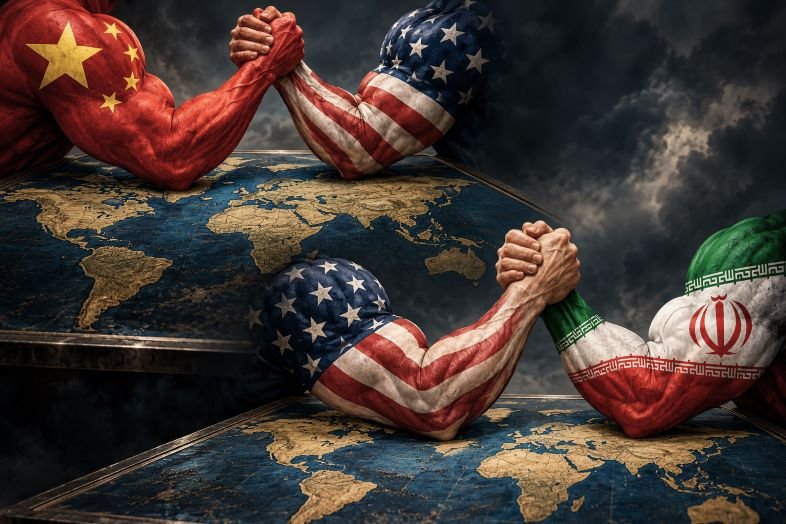
The same pattern can be seen in the war with Iran.
When the conflict began, Pentagon officials estimated the direct cost at roughly $29 billion. By June, the Center for Strategic and International Studies estimated the total U.S. war cost at approximately $34 billion to $42 billion, including deployments, munitions, equipment losses, base damage and higher fuel costs. Separately, Brown University’s Costs of War project estimated that higher gasoline and diesel costs had imposed more than $40 billion in additional costs on U.S. consumers.
The point is not that every dollar of these costs represents money literally borrowed to finance a particular bomb or military operation. The broader point is that persistent military commitments, together with interest costs and other structural spending pressures, add to an already difficult fiscal equation.
The United States can issue new debt to refinance old debt. But the interest still has to be paid.
The principal and interest on war-related borrowing ultimately have to be absorbed by the federal budget. Meanwhile, interest payments, defense spending, health care and other mandatory programs are already putting pressure on fiscal resources.
If borrowed money fails to generate sufficient economic returns, the government must keep borrowing simply to maintain the existing structure. That is the essence of an unsustainable debt dynamic.
So, over the long term, the argument goes, the U.S. fiscal model cannot continue indefinitely in its current form.
It can continue for now largely because the alternatives to the dollar remain relatively weak. First comes the renminbi. Second comes the euro. Then come smaller currencies such as the pound sterling and Swiss franc, and, in a very different category, the Russian ruble, which is backed to some extent by Russia’s vast natural-resource base.
As long as these alternatives remain too small to rival the U.S. financial system, the dollar’s dominance can continue. But if these economies grow stronger—or if they begin to cooperate more closely—the situation could change.
For example, if the New Development Bank succeeds in expanding local-currency financing and developing deeper bond markets across BRICS economies, and if those markets eventually reach a scale comparable with the offshore dollar markets of an earlier era, the probability of a major loss of confidence in U.S. financial assets could increase.
The New Development Bank is already moving in that direction. In April of this year, it just issued 7 billion yuan of Panda bonds in China. On August 19, 2026, it issued a $1.75 billion three-year benchmark bond in the international capital markets. The bond was 1.8 times oversubscribed, with the order book exceeding $3.2 billion. The bank has also been increasing its use of local currencies. Available data indicate that local-currency financing accounted for about 46 percent of its 2025 approvals.
But current economic theory cannot tell us at what exact level confidence in U.S. Treasuries might suddenly break down. Will it happen when the national debt reaches $40 trillion? $42 trillion? $45 trillion? Nobody knows. Because speculative psychology is, by definition, the greatest source of uncertainty.
Finally, my teacher, Ilya Prigogine—the 1977 Nobel Prize winner in Chemistry—spent his life studying why the world is fundamentally characterized by uncertainty. Late in his life, he wrote a short book titled The End of Certainty. The title itself was his answer.
The book offers us perhaps the most important lesson of all: the age of certainty is over. An age of uncertainty has arrived. In this uncertain world, the question is whether you stand with emerging industries or sunset industries. If you stand with the industries of the future, the future belongs to you. If you devote yourself to protecting sunset industries—as, in my view, Britain’s Labour government is now trying to do—you are unlikely to succeed.
And what about Trump? On the one hand, he wants to bring manufacturing back to the United States. On the other, he has pursued a war with Iran that, from a purely economic perspective, offers no obvious return on investment; he has pursued an increasingly disruptive policy in Latin America and has even expressed ambitions involving Greenland. Such moves may generate short-term political and media impact. They allow Trump to project the image of a president who commands attention and dominates the news cycle.
But look at the longer-term trajectory. How much time does he have left in office?
About two and a half years. What happens to the MAGA movement after that? I have my doubts. And all of these developments could create major shocks for the U.S. economy in the years ahead.