India supplied at least 2,596 shipments of weapons, ammunition, and components to Israel between 7 October 2023 and 30 November 2025, despite knowing the substantial risk of contributing to Israel’s genocide of Palestinians in Gaza, Amnesty International revealed on 30 July.
The investigation, titled “Made in India: The Supply of Weapons and Ammunition to Israel,” examined shipment-level trade data covering every transfer over that period.
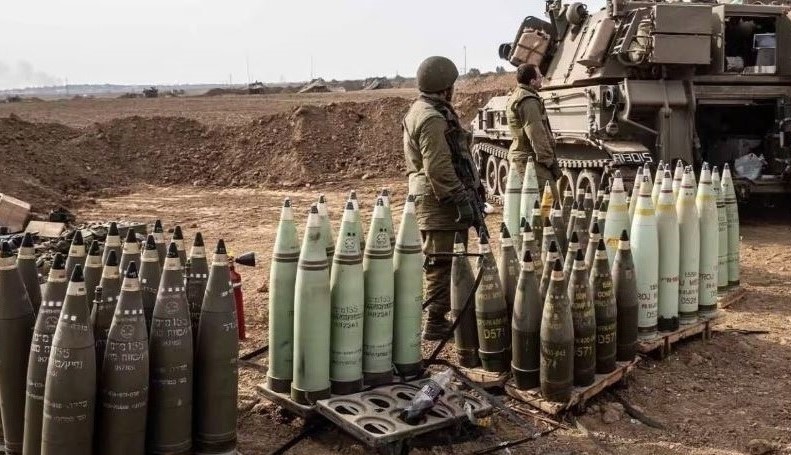
The consignments included at least 390,516 small arms parts for military-grade weapons, 564,970 parts of explosive ordnance such as drone warheads and artillery shell casings, and 298 military vehicle components – all delivered to large Israeli firms that supply the Israeli army directly.
Amnesty’s analysis excluded shipments that may have been destined for civilian use, as well as items likely used in anti-missile defense.
Among the weaponry identified were machine gun components for arms deployed by Israeli forces in Gaza, 155mm high explosive artillery shells supplied to Elbit Systems, and explosive warheads for the Skystriker loitering munition similar to debris recovered in Khan Yunis.
Companies owned and controlled by the Indian state are named, including Munitions India Limited, which produces high-explosive artillery rounds. Others include PLR Systems, a joint venture with Israel Weapon Industries, and Alpha Elsec Defense & Aerospace Systems, a joint venture with Elbit Systems.
The Israeli recipients include Elbit Systems, Rafael Advanced Defense Systems, and Israel Aerospace Industries.
Amnesty found critical structural failures in India’s arms transfer framework, with no explicit requirement for human rights due diligence to prevent exported military goods from being used in violations of international humanitarian law, and insufficient transparency to make the export process accountable.
India abstained from the vote adopting the Arms Trade Treaty in April 2013 and has never acceded to it. Amnesty says accession is a vital first step toward bringing Indian export controls into line with international law on arms transfers.
Amnesty Secretary-General Agnes Callamard said the International Court of Justice (ICJ) orders recognizing a plausible risk of genocide against Palestinians in Gaza leave Indian authorities unable to claim ignorance of the risk carried by continued transfers.
“By knowingly allowing the transfer of arms to Israel, India stands in clear violation of its duty to prevent genocide under the Genocide Convention and its obligation to ensure respect for the Geneva Conventions,” Callamard said.
The arms transfers run alongside a political relationship both governments now boast openly.
Modi and Netanyahu issued a joint statement in occupied Jerusalem on 26 February declaring a new phase in bilateral relations, elevating ties to what they termed a “Special Strategic Partnership for Peace, Innovation & Prosperity,” backed by more than a dozen agreements spanning AI, cybersecurity, fintech, semiconductors, and agriculture.
The two sides cited the defense memorandum of understanding (MoU) signed on 4 November 2025 and acknowledged the growth of defense cooperation in scope and scale, while reaffirming plans for a free trade agreement and for advancing the India–Middle East–Europe Economic Corridor (IMEC).
A day earlier, Modi had used the Knesset podium to pledge that India stands with Israel firmly and with full conviction, praising Israeli “resolve” during the genocide in Gaza – as Netanyahu faces an International Criminal Court (ICC) arrest warrant and Israel faces ICJ genocide proceedings.
(The Cradle via Orinoco Tribune)