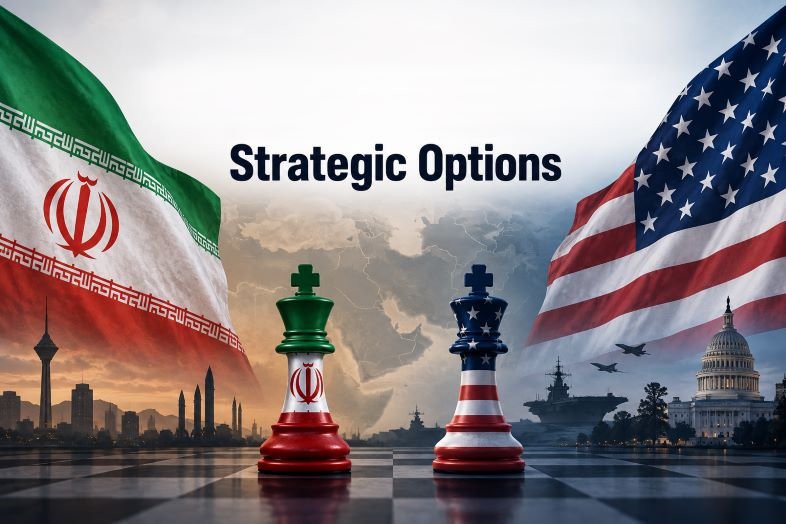
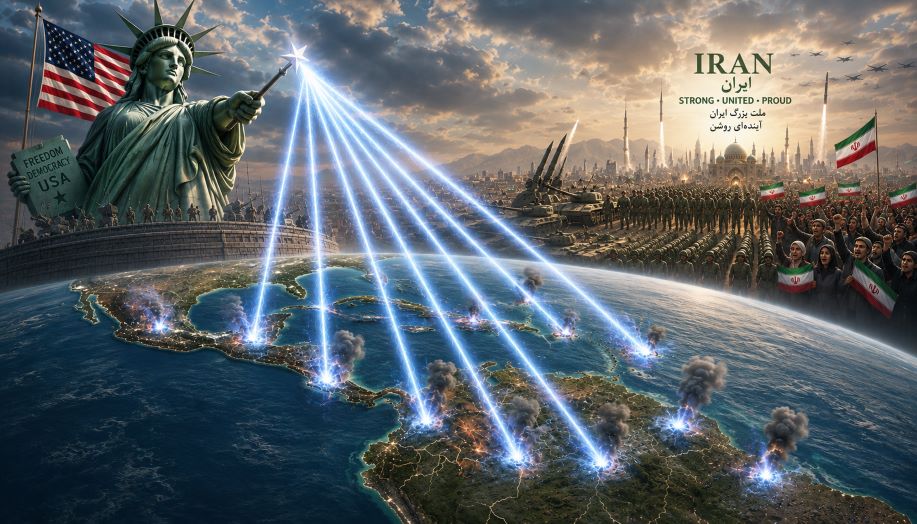
Faced with the use of US force, the big question is whether there is a defense strategy similar to the one employed by Iran.
Iran’s momentary strategic victory against the United States and Israel compels a rethinking of regional strategy in Latin America to ensure a minimum of sovereignty and autonomy. This seems unthinkable in times of sieges characteristic of the Donroe Doctrine in our region, with tragic precedents such as the invasion of Venezuela.
Despite the fact that these days there are plenty of people saying that Trump was wrong because Iran isn’t Venezuela—a pejorative analysis of the Bolivarian process that ignores the countless victories of Chavismo against color revolutions and soft coups triggered by sanctions—Chavismo prepared itself to face these offensives, but not for a conventional military invasion. To suggest that another Latin American country has the same capacity is, at best, to fantasize that regional politics resembles a Homeric tale, like the Odyssey, more than a Tarantino film where the villains are brutal, violent, and foul-mouthed. To believe, therefore, that a defense policy exists that can keep an imperial and decadent United States at bay is a pipe dream. Even if its chaotic brutality is that of a gym rat pumped full of steroids, whose torso is enormous, but whose legs are as thin as a dancer’s after recovering from malaria.
No military policy exists that can effectively and efficiently recreate a mosaic doctrine, like Iran’s, which decentralizes command and control to increase the costs of intervention through low-cost drone and missile launches at maritime or geopolitical chokepoints. Nor does any collective force exist that is disciplined enough to sustain such a powerful social upheaval and fear over time. Chavismo, in its own way, attempted this, but at the cost of sacrificing its legitimacy with a significant segment of the population that had long supported the regime, due to the sanctions.
So what remains? Tactical compromise to adapt to the momentary storm, embodied by Trump, until it passes? The problem is that Agent Orange is a symptom of a chronic imperial disease; it will be quite difficult for a new US administration to abandon the strategic retreat to Latin America given its decline. This compels us to project a glimmer of a strategy to weather these times, which threaten to become permanent unless an internal US crisis implodes what remains of the imperial apparatus. Such a crisis could deter the extreme US pressure against the remaining autonomous partnerships in the region, such as infrastructure projects with China and other multipolar powers. Or it could improve the region’s terms of trade, as Lula da Silva outlined when speaking of the need to develop critical minerals with better returns for Latin American countries.
Experience, however, shows how much resistance there is to initiatives to create leagues of countries, or organizations of raw material producers, aimed at improving national incomes and distributing them throughout society and the industrial sector. One of the biggest consequences for progressive leaders in the first half of the 21st century was the nationalization of oil and gas companies and their redistribution policies. As a result, most of them are imprisoned, exiled, or persecuted by the subservient Latin American justice system.
These times provided a couple of key points on how to build regional and shared autonomy. While the most advanced integration project was UNASUR, with its Bank of the South and a common defense framework, the most effective space for building a common front based on a win-win logic was Petrocaribe, the initiative through which Venezuela sold cheap oil in exchange for payment in kind to Caribbean countries. This laid the foundation for one of the most stable periods in the Antilles, thanks to the fact that most of these countries, especially nations like Haiti, spent a large part of their budgets importing fuel to power their power plants. And until the imposition of US sanctions against Venezuela, this allowed for a minimal period of prosperity, despite the cases of corruption documented within the program.
This experience demonstrates the value of strategic partnerships like this one, where larger countries help establish win-win relationships that provide stability in countries near the United States. This is true not only from a moral standpoint, but also because these partnerships address indirect issues, such as migration and security, that have repercussions within the United States. The best regional policy is one that creates incentives to deepen historical ties and establishes costs for their severing by the United States. These are long-term policies that focus on transforming the resolution of regional problems into opportunities to forge a common ground of unity that can serve to contain imperial expansion.
A Latin American logic quite different from the current “every man for himself” mentality.