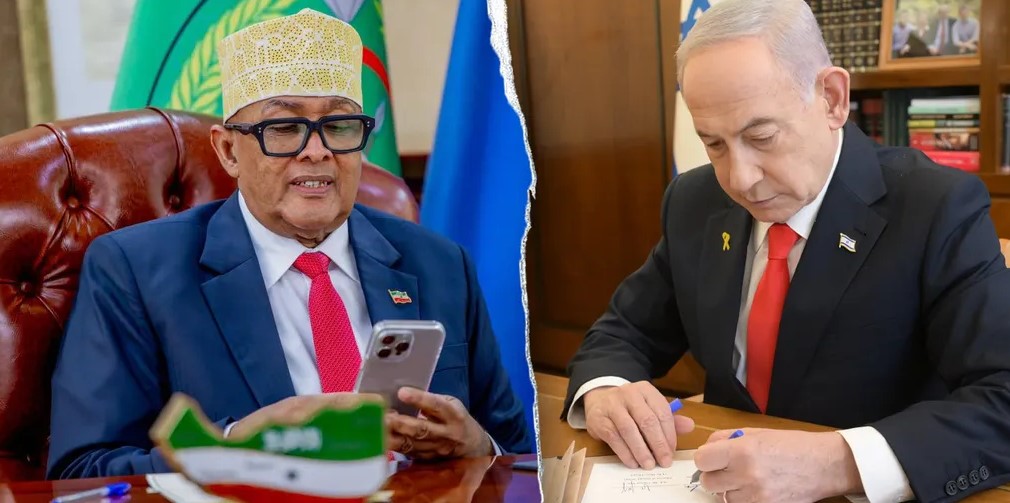
On December 26, 2025, while the world was distracted by the Christmas festivities, Benjamin Netanyahu signed the recognition of Somaliland as a sovereign and independent state.
The timing is not accidental, and it never is when we’re talking about the Zionist right and its international propaganda machine. Israel thus became the first United Nations member state to grant legitimacy to a separatist entity that has endured thirty-four years of diplomatic isolation.
With official rhetoric about “cooperation in agriculture, health and technology”—typical aseptic language used by foreign ministries to conceal true strategic intentions—Netanyahu has executed a geopolitical maneuver on the African chessboard, inserting himself into one of the planet’s strategic zones: the Horn of Africa, the gateway to the Red Sea, the key to global trade between Asia, Africa and Europe.
The move is as audacious as it is reckless. The Israeli government has deliberately ignored the international consensus regarding Somalia’s territorial integrity. It has bypassed the African Union, the Arab League, China, Turkey, and Egypt. It has defied the sacred principle that the AU itself enshrined in 1964 concerning the inviolability of borders inherited from colonization. Netanyahu knows perfectly well what he is doing. And he does it because he can.
From British protectorate to phantom republic
To understand the maneuver, it is necessary to go back to the colonial origins of the problem. Somaliland was a British protectorate until 1960, when it gained its independence on June 26 of that year. For five glorious but fleeting days, it existed as a sovereign state, recognized at the time by Israel and 34 other countries. But the forced union with Italian Somaliland, also recently liberated, gave rise to the Republic of Somalia on July 1, 1960.
From the outset, the unification project was flawed. The differences in the state conceptions inherited from British and Italian colonialism were vast. British Somaliland had developed an Anglo-Saxon administrative culture; Italian Somaliland, a completely different one. The 1961 constitutional referendum revealed the majority of Somalilanders’ rejection of the new institutional framework, although the Constitution was approved by the rest of the country.
The military coup led by Mohamed Siad Barre in 1969, at the height of the Cold War, deepened the wounds. His regime, which proclaimed itself Marxist-Leninist and founded the Somali Democratic Republic, enjoyed the unwavering support of the Soviet Union between 1969 and 1977. Moscow provided heavy weaponry, military advisors, training at Soviet academies, and effectively turned Somalia into a satellite state. The USSR maintained a substantial naval base in the country, and the KGB station in Mogadishu was one of the most active in Africa. Paradoxically, this same Soviet backing allowed Barre to build one of the most powerful armies on the continent, which he would later use to perpetrate atrocities against his own population.
The break between Barre and the USSR occurred in 1977-1978, during the Ogaden War, when Somalia invaded Ethiopian territory claiming the Ogaden region, populated by a Somali population. To Barre’s surprise, Moscow decided to support Derg Ethiopia, an emerging socialist regime that had just overthrown Emperor Haile Selassie. The USSR and Cuba sent 20,000 Cuban soldiers and hundreds of Soviet military advisors to expel the Somali troops, managing to recapture the Ogaden in March 1978. Somalia broke relations with the USSR and turned to the United States, which seized the opportunity to gain a strategic ally in the Horn of Africa at the height of the Cold War.
It is in this context that the genocide against the Isaaq people occurred. Between 1987 and 1989, now fully supported by the United States and without Soviet counterweight, the Barre regime perpetrated what a United Nations report classified as genocide against the Isaaq people. This clan is not native to all of Somalia, but rather constitutes approximately 80% of the population in the north, in the territory that is now Somaliland, and represents about 22% of the total Somali population. The Somali National Movement (SNM), formed by Isaaq dissidents in London in 1981, had launched an insurgency to overthrow Barre in the north of the country. The dictator’s response was to attempt to exterminate the entire clan.
The massive bombing of Hargeisa (the capital of Somaliland) in May 1988, which earned it the nickname “the Dresden of Africa,” left more than 40,000 civilians dead and destroyed 90% of the city. Burao, Somalia’s third-largest city, was 70% devastated. Estimates of between 50,000 and 200,000 Isaaq civilians were killed, according to various sources. More than 500,000 refugees fled to Ethiopia in what was described as one of the largest and fastest forced displacements on record in Africa. The Somali government also planted one million landmines within Isaaq territory and created special units called Dabar Goynta Isaaka (The Isaaq Exterminators).
The United States, Barre’s ally after the break with Moscow, turned a blind eye to the genocide. Between 1978 and 1990, Washington provided hundreds of millions of dollars in military and economic aid. The firm of Paul Manafort, Donald Trump’s future campaign manager, actively worked to whitewash Barre’s international image even as he massacred the ISAAQ. Anti-Soviet alignment was enough for Washington to tolerate any brutality.
When Siad Barre fell in 1991 and Somalia disintegrated into civil war, Somaliland unilaterally declared its independence. Since then, this territory of 175,000 square kilometers and 3.5 million inhabitants has functioned de facto as an independent state, with its own constitution, currency, army, police, and democratic elections.
Organic chaos or programmed state dissolution?
Following Barre’s fall, Somalia disintegrated into small, independent regions, lacking a single governing power. Since then, the country has endured over three decades of persistent violence, territorial fragmentation, and the absence of a functioning state effectively controlling its territory. However, to simply label this a “civil war” or “tribal chaos,” as the mainstream media does, obscures the true nature of the process: a deliberate strategy of state dissolution driven by imperialist, particularly American, interests. Shortly before Barre’s overthrow in 1991, oil exploration rights over two-thirds of Somali territory had been granted to the companies Conoco, Amoco, Chevron, and Phillips. Conoco went so far as to cede its corporate offices in Mogadishu to the US embassy days before the Marines landed, serving as the temporary headquarters for Bush’s first special envoy. The intervention, presented as humanitarian, concealed the real objective of protecting multi-million dollar investments by oil companies in a country with enormous estimated reserves of oil and gas.
When the despot ceased to be useful as a local policeman in the early 1990s, Washington suspended military and economic aid, allowing warlords and their militias to overthrow him. The collapse of the central government was not accidental, but a direct consequence of strategic abandonment once Barre had fulfilled his role on the chessboard of the now-dissolved Cold War.
What followed was the application of the imperial playbook; the United States began to take sides in what had become a bloody civil war, favoring some warlords over others, which resulted in countless civilian casualties from US airstrikes that provoked a furious reaction from the Somali population. The infamous “Battle of Mogadishu” of October 1993, which should always be more remembered, where 18 US soldiers were killed and their bodies dragged through the streets, forced Washington into a hasty withdrawal, but not into abandoning its strategic objectives.
The second phase of the planned state dissolution arrived in 2006. That year, the Union of Islamic Courts had achieved what no other group had managed in fifteen years: unifying large swathes of the country under a functioning government. This control by an Islamist organization began to unsettle the international community, especially neighboring Ethiopia, which did not hesitate to launch an armed intervention with US support. The 2006 Ethiopian invasion, militarily backed by Washington, destroyed the only serious attempt at state reconstruction since 1991 and gave rise to Al-Shabaab, the so-called jihadist organization that today controls large areas of the country.
Multiple sources highlight the geopolitical importance of Somalia, located in the Horn of Africa, between that continent and the Arabian Peninsula. It controls the entrance to the Red Sea, through which a significant percentage of global maritime traffic passes, including Middle Eastern oil. General Schwarzkopf expressed this with stark clarity before the U.S. Senate in 1991, describing the Red Sea as the strategic hub of U.S. interests, where Africa and Asia converge.
The imperial strategy toward Somalia does not seek the reconstruction of a sovereign and functional state, but rather its perpetuation as a fragmented territory, controlled by competing warlords, riddled with manipulable conflicts, and open to the penetration of foreign forces. In the areas that remain under Mogadishu’s administration, the situation has not improved since 1991. Various warlords and violent structures have seized control of all supposedly state services, amassing vast fortunes and establishing the foundations for perpetuating, to their own benefit, the absence of any real state apparatus.
This state dissolution is not the product of “ancestral tribalism” or “African chaos,” racist narratives that obscure imperial responsibility. It is the result of decades of US intervention: first supporting brutal dictatorships, then strategically abandoning them, later funding warlords, subsequently invading militarily, then backing regional invasions, and finally systematically bombing under the pretext of counterterrorism. A strong, unified, and sovereign Somali state would be an obstacle to US control of the Horn of Africa, the Red Sea trade routes, and the estimated oil resources on its territory and continental shelf. A fragmented and perpetually conflicted Somalia is, from an imperial perspective, far more functional to the interests of Washington, multinational oil companies, and their regional allies.
The Red Sea as a target
Let’s try to decipher the criteria for timing. Why is Israel recognizing Somaliland precisely now? The answer has three intertwined vectors: strategic-military, geopolitical-commercial, and demographic-colonial.
In what we call the strategic-military vector, Somaliland controls a vast coastal strip on the Gulf of Aden and is located opposite Yemen, just 300-500 kilometers from Houthi positions. The Israel Institute for National Security Studies (INSS) published a report in November 2025 stating that “Israel requires allies in the Red Sea region for multiple strategic reasons, including the possibility of a future campaign against the Houthis.” This institute, founded in 1977 after the Yom Kippur War and affiliated with Tel Aviv University, is considered Israel’s leading security think tank.
The INSS report, titled “Somaliland and Israel: Considerations on Recognition and Cooperation,” argues that “Somaliland’s territory could serve as a forward operating base for multiple missions: intelligence gathering and monitoring of the Houthis and their military buildup; logistical support for the internationally recognized government of Yemen in its war against the Houthis; and direct operations, ranging from offensive actions to intercepting Houthi attacks at sea or by drones.” Access to Somaliland’s territory and airspace would greatly facilitate the surveillance, intelligence, and bombing operations that Israel has been conducting against Yemen since October 2023.
The port of Berbera, one of Somaliland’s main economic assets, already houses a military base belonging to the United Arab Emirates, an ally of Israel in the region. Analysts suggest that this base has been key in anti-Houthi operations. Now, with Israeli recognition, the possibility of direct operational coordination between Tel Aviv and Hargeisa (Somaliland’s capital) has opened up within the framework of what Netanyahu calls the “Abraham Accords.”
From a geopolitical and commercial perspective, the Bab el-Mandeb Strait, which could be partially controlled from Somaliland territory, is one of the world’s busiest shipping lanes. A significant portion of global trade passes through it on its way to the Suez Canal and into the Mediterranean. Israel has been expanding its influence in Africa as part of its “periphery doctrine,” seeking alliances with non-Arab actors or minorities to counter the hostility of its immediate neighbors. Recognizing Somaliland fulfills this objective and, simultaneously, challenges Turkey’s growing influence in Somalia and the Chinese military presence in Djibouti.
Regarding the demographic-colonial dimension, this brings us to the most sinister aspect of the operation. Multiple sources, including reports from the Associated Press and The Times of Israel, reveal that Israel and the United States have explored Somaliland (along with Sudan and Somalia) as a possible destination for the resettlement of Palestinians from Gaza. Although both governments publicly deny this, Somalia, Egypt, Turkey, and the Palestinian Authority have warned that recognition could be linked to plans for the forced displacement of the Palestinian population.
It’s not far-fetched. Netanyahu, who comes from a tradition that believes in national invention through the occupation of any territory, has spoken openly of “voluntary emigration” from Gaza. Trump has suggested that the Strip is no longer habitable. The Netanyahu-Kushner plan to turn Gaza into a tourist “Riviera” for Israelis requires first emptying the territory of Palestinians. Somaliland, desperate for international recognition, could be blackmailed into accepting displaced people in exchange for diplomatic legitimacy. It would be a 21st-century repetition of the ethnic cleansing, the Nakba, that founded the State of Israel in 1948.
The Greater Israel project: reactions from China and the African Union
Some analysts, particularly from China and alternative media outlets in the Global South, have framed this movement within the concept of “Greater Israel,” that expansionist vision that aspires to territorial control from the Nile to the Euphrates. Although the exact borders vary according to interpretations, the core ideology remains constant: the establishment of Israeli hegemony in Western Asia and, now, the projection of that hegemony into the Horn of Africa.
China, through its ambassador Wang Yu in Mogadishu, immediately expressed its “firm support for Somalia’s sovereignty, national unity, and territorial integrity,” underscoring its “joint and firm opposition to secessionism.” This is not empty rhetoric. China has massive investments in the region, maintains its only foreign military base in Djibouti, and views with concern how the United States and Israel are attempting to reshape African alliances to contain its influence.
The recognition of Somaliland is part of a broader strategy by Washington and Tel Aviv: the construction of a “non-red coast” on the Red Sea, as Taiwan puts it, intended to counter Chinese influence. Taiwan itself, which has maintained a representative office in Hargeisa since 2020, enthusiastically welcomed the Israeli recognition, seeing it as a precedent for its own aspirations for international legitimacy.
What is emerging is a dense network of alliances; a US-led bloc comprising Taiwan, Israel, the United Arab Emirates, and Somaliland, positioned against the interests backed by China, Turkey, and Iran. The Horn of Africa has become a dividing line in the broader confrontation between the Atlanticist unipolar order and the emerging multipolar world.
Mogadishu’s reaction was swift. The Somali federal government denounced the recognition as “an illegal step” and “a deliberate attack” on its sovereignty, rejecting any validity to it and announcing that it would take “all necessary diplomatic, political, and legal measures” to defend its territorial integrity. Somalia convened emergency telephone consultations with African leaders from Kenya, Uganda, Tanzania, and Djibouti, all of whom expressed their support.
The African Union, through its president Mahmoud Ali Youssouf, firmly rejected any recognition initiative, warning that such actions could undermine peace and stability across the continent. The pan-African organization reaffirmed the principle of the inviolability of borders inherited from independence, a cornerstone of post-colonial African law, in an attempt to prevent the Balkanization of the continent.
Turkey, the country identified as the primary potential source of conflict in the medium term by the same institute that recommended the Israeli government recognize Somaliland, which maintains the largest military base outside its territory in Somalia and has mediated in regional conflicts, denounced the recognition as “a further example of the Netanyahu government’s illegal actions aimed at creating instability at the regional and global levels.” Ankara views the Israeli move as a direct provocation against its influence in the Horn of Africa and an attempt to undermine the agreement that Turkey brokered between Ethiopia and Somalia.
Egypt, historically at odds with Israel for multiple reasons and concerned about tensions with Ethiopia over the Nile waters, coordinated a joint condemnation with Somalia, Turkey, and Djibouti. The four foreign ministers reaffirmed their “total rejection and condemnation” of the recognition, warning that it “constitutes a dangerous precedent and a threat to international peace and security.”
The Arab League, the Gulf Cooperation Council, and countries such as Iraq, Kuwait, Jordan, and Saudi Arabia all joined the chorus of condemnation. Even Al-Shabaab, the Islamic State-linked group that has been fighting the Somali government for two decades, rejected “the Israelis’ ambition to claim or use part of our territories.”
The Palestinian Authority and Hamas also condemned the recognition. The Palestinian Authority’s diplomatic mission to the UN mocked Israel by publishing an image comparing the 146 countries that recognize Palestine with Israel’s lone recognition of Somaliland. Hamas called the act “a dangerous precedent” and “a desperate attempt to gain false legitimacy” amid international isolation over the genocide in Gaza.
BRICS+ and multipolarity: a missed opportunity?
What role has the BRICS+ bloc played—or could it have played—in this scenario? The answer is complex and reveals both the potential and limitations of the emerging multipolar architecture.
Since January 2024, Ethiopia has been a full member of BRICS+, along with Egypt, the United Arab Emirates, Iran, and Saudi Arabia. Ethiopia’s entry coincided precisely with its attempt to sign a memorandum of understanding with Somaliland in January 2024, offering recognition in exchange for maritime access. That agreement, which generated massive tensions with Somalia, was suspended following Turkish mediation. But it demonstrated that the maneuvering for Somaliland had been brewing for some time.
China, as a founding member of BRICS, quickly expressed its support for Somalia and its rejection of secessionism. But beyond diplomatic statements, what concrete actions can Beijing take? China has strategic investments throughout the region—the port of Djibouti, infrastructure projects in Ethiopia and Somalia—but its doctrine of “non-interference” in internal affairs limits its capacity for active intervention.
Russia, the other pillar of BRICS, has maintained a low profile in the Horn of Africa conflict, focused as it is on its own war against Ukraine and NATO. Iran, a member of BRICS+, condemned the Israeli recognition and warned that it seeks to “destabilize the region,” but its direct influence in Somalia is limited.
What this case reveals is the power asymmetry within the BRICS+ bloc itself. The United Arab Emirates, a BRICS+ member since 2024, maintains a military base in Somaliland and is a strategic ally of Israel. Saudi Arabia, approved as a BRICS+ member but not yet officially joining, condemned the recognition of Israel but has historically maintained trade relations with the Zionist state. Tensions between Egypt (BRICS+) and Ethiopia (BRICS+) over the Nile waters add another layer of complexity.
The BRICS+ bloc is not, nor does it intend to be, a NATO-style military alliance. It is a platform for economic and political coordination among countries of the Global South that seek a multipolar world order. But this multipolarity is still under construction and faces internal contradictions. Somalia is not a member of BRICS or BRICS+. Ethiopia is, and it has its own conflicts with Mogadishu.
Could BRICS+ have prevented or reversed the recognition of Israel? In theory, a unified position from the bloc, leveraging its combined economic weight and influence in multilateral institutions, could have deterred Israel or at least articulated a more effective coordinated response. In practice, the bloc’s internal divisions and the lack of mechanisms for collective action on regional security issues limit its capacity to respond.
What BRICS+ could do is work on medium- and long-term solutions: economic and diplomatic support for Somalia, facilitating dialogue between Mogadishu and Hargeisa under African (not Western) mediation, and infrastructure investments that reduce the region’s dependence on Western powers. But this requires a level of coordination and strategic vision that the bloc has not yet consistently demonstrated.
The Security Council as a theater of impotence
On Monday, December 29, the UN Security Council convened in an emergency session to discuss the recognition of Israel. The session was requested by Israel itself, in a display of diplomatic cynicism bordering on the obscene. Netanyahu knows that the United States will veto any resolution condemning his decision. He knows that the Security Council is a body paralyzed by Cold War logic, where the five permanent members with veto power can block any meaningful action.
Israeli ambassador Danny Danon declared that his country “will not shy away from political discussions” and will act “responsibly and discreetly.” Translation: Israel will do as it pleases and use the Security Council as a propaganda platform, knowing it has the protective umbrella of the United States.
The Security Council session once again puts to the test an institution whose resolutions have failed to resolve serious dilemmas such as the Israeli occupation of Gaza, where systematic genocide continues every week despite the announced ceasefire. The Council has been unable for months to impose an effective cessation of hostilities, systematically blocked by the US veto. What hope is there that it can reverse the recognition of Somaliland?
The European Union issued a bland statement calling for respect for Somalia’s “unity, sovereignty, and territorial integrity,” but without proposing any sanctions or concrete measures. Washington, through Trump himself, distanced itself from the recognition (“Does anyone know what Somaliland really is?”), but did not openly condemn it or pressure Israel to reverse it.
Ethiopia, Eritrea and the regional game
Israeli recognition is not without reason. The Horn of Africa is a hotbed of intertwined conflicts: Ethiopia against Eritrea, Ethiopia against Tigray, Egypt against Ethiopia over the waters of the Nile, Somalia against Al-Shabaab, Turkish ambitions, and the presence of military bases belonging to half a dozen powers in Djibouti.
Ethiopia, a landlocked country since Eritrea’s independence in 1993, has desperately sought access to the sea. Its Prime Minister, Abiy Ahmed, spoke in October 2023 of freeing its 126 million inhabitants from their “geographic prison.” Hence his memorandum with Somaliland in January 2024, offering recognition in exchange for leasing land in Berbera for a naval base. That agreement was suspended due to Somali opposition and Turkish mediation, but Ethiopia’s hunger for access to the sea persists.
By recognizing Somaliland, Israel is effectively encouraging Ethiopian ambitions, knowing that this will generate greater friction with Somalia. A fragmented and perpetually tense Horn of Africa is easier for external actors to penetrate than a unified and sovereign region.
Eritrea, for its part, maintains a tense relationship with Ethiopia despite the 2018 peace agreement. Asmara (Eritrea’s capital) could see the strengthening Israeli-Somaliland alliance as an additional threat to its security. Egypt, a historical enemy of Israel and concerned about Ethiopia, could intensify its support for Somalia as a counterweight, although its recent foreign policy has been quite inconsistent with regard to Israel.
Israel’s recognition of Somaliland marks a turning point in the geopolitics of the Horn of Africa and, by extension, in the global balance of power. It is not an isolated act but rather another piece on the imperial chessboard where the United States, Israel, China, Turkey, the Gulf states, and African powers vie for influence, resources, and trade routes.
For the elite that governs Somaliland, recognition represents the long-awaited international legitimacy after 34 years of isolation. But at what price? They have tied themselves to a pariah state, responsible for genocide in Gaza, accused of crimes against humanity by the International Criminal Court, and increasingly isolated on the international stage. The gamble is risky; if other countries do not follow Israel’s example, Hargeisa will have burned her bridges with the Arab, African, and Muslim world in exchange for little more than empty promises.
For Somalia, it is a diplomatic catastrophe and an existential threat. The territorial fragmentation it has experienced since 1991 could be consolidated with international backing. Mogadishu will have to resort to all multilateral bodies, strengthen its regional alliances, and, above all, work to rebuild trust with Somaliland through dialogue, not military confrontation.
For Israel, the move fulfills multiple objectives: strategic penetration in Africa, access to military bases near Yemen, expansion of the Abraham Accords, a possible demographic safety valve for the ethnic cleansing of Gaza, a challenge and containment of Turkey and Iran, and a sign of strength at a time of international pressure over the Palestinian genocide.
For the United States, Israeli recognition aligns with its strategy of containing China in the Red Sea and the Indian Ocean. Although Trump publicly distanced himself from the issue, sectors of the Republican Party explicitly support the Somaliland cause. Project 2025, the document guiding the current Trump administration, mentions Somaliland as a “cover against the deteriorating US position in Djibouti,” where Chinese influence is growing.
For China, the challenge is to respond without falling into the trap of direct confrontation. Beijing has the economic and diplomatic tools to support Somalia, but it must do so in a way that does not exacerbate tensions with Ethiopia, a BRICS+ partner, or with other regional actors. Mediation, not imposition, must be China’s approach.
For Turkey, the Israeli move is a slap in the face. Ankara has invested heavily in Somalia, built the largest Turkish military base outside its territory, and mediated in regional conflicts. The recognition of Somaliland undermines these efforts and positions Israel as a direct competitor for influence in the Horn of Africa.
For African national liberation movements, from Western Sahara to South Sudan, this precedent is dangerous. If the “international community” tolerates unilateral border changes when it suits Western powers, it opens a Pandora’s box that could destabilize the entire continent.
And for the peoples of the Global South, Somaliland is yet another lesson that true self-determination can only be achieved through economic independence, strategic South-South alliances, and grassroots organizing. The promises of Tel Aviv and Washington are worthless. History proves this time and again.
Netanyahu can sign all the documents he wants. He can open embassies, send military advisors, and promote investments. But legal recognition doesn’t create lasting political reality if it isn’t supported by real social and economic forces. The USSR recognized dozens of allied governments that lasted no longer than Soviet support. The United States recognizes Guaidó in Venezuela, and the only ones who don’t are the Venezuelan people.
Somaliland needs more than Israeli backing. It needs genuine economic development, not port enclaves serving foreign powers. It needs reconciliation with Somalia based on equality and mutual respect. It needs to be part of African integration, not part of neocolonial projects of continental fragmentation.
And above all, the peoples of the Horn of Africa need to shake off the yoke of imperialism. Liberation will not come from Tel Aviv or Washington. It will come from popular organization, from South-South solidarity, from the patient construction of food, energy, and technological sovereignty.
Israel’s recognition of Somaliland is yet another episode in the long war of attrition of the 21st century. A lost battle, perhaps. But the fight for a multipolar, just, and sovereign world has only just begun.