China bets on Iraq-Turkiye corridor to reshape Eurasian trade. Beijing’s support for the Development Road signals a direct challenge to western efforts to isolate key Eurasian states – an assertive move to reshape trade flows through West Asia on China’s terms.
West Asia stands today as one of the most decisive junctions in the global trade system. As central – if not more so – than Central Asia, this corridor is not only critical for its vast hydrocarbon reserves but is indispensable to the very future of global commerce. Recognizing this, the US, EU, and China are all scrambling to deepen their strategic hold over the region.
In 2015, Beijing and Baghdad inked a partnership under the Belt and Road Initiative (BRI), setting the stage for wide-ranging cooperation in energy, electricity, infrastructure, and telecommunications. Since then, Chinese companies have become central to Iraq’s post-war reconstruction.
In the Basra region, Chinese contractors are driving major utility projects, including a 300-megawatt (MW) power plant integrated with a new desalination facility, and the ongoing expansion of the Shatt al-Basra combined-cycle station, set to add 650 MW to the grid.
From oil and liquefied natural gas (LNG) terminals to water treatment plants, airports, schools, and now, highways, Chinese firms are embedding themselves in Iraq’s economic fabric. Diplomatic ties have correspondingly been elevated to the level of a strategic partnership.
With the sudden revival of the long-stalled India–Middle East–Europe Economic Corridor (IMEC), Iraq and Turkiye swiftly countered by elevating their own Development Road Project (DRP) – a corridor China has now signalled strong support for. Chinese officials see strong synergy between the DRP and the BRI, envisioning both as collaborative, win-win models of infrastructure diplomacy.
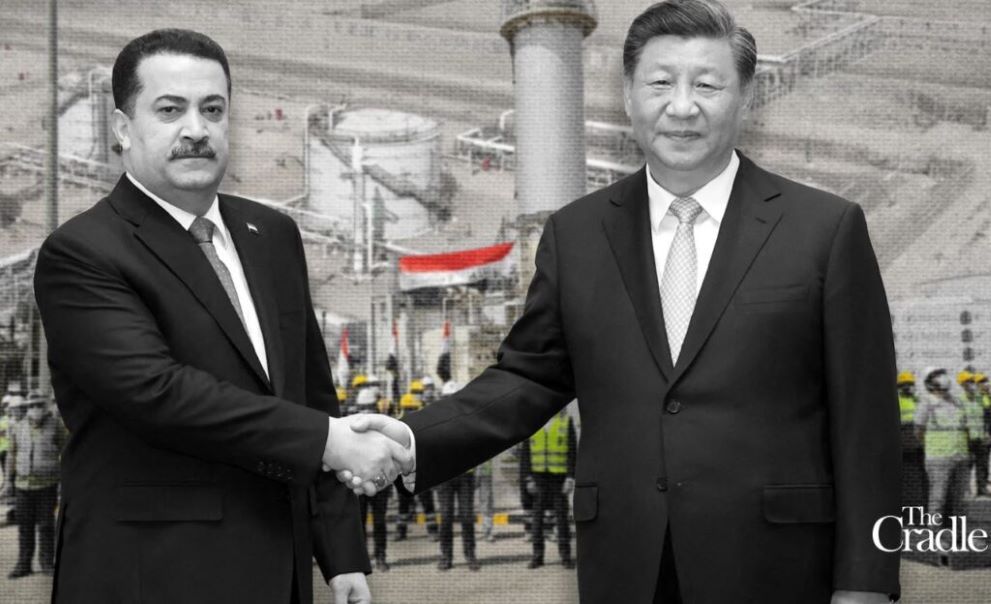
Chinese President Xi Jinping has openly encouraged Chinese firms to pursue partnerships with Iraq and explore the integration of the DRP into the BRI framework, particularly through its Middle Corridor. Iraqi Prime Minister Mohammed Shia al-Sudani shares the view, stating that the two projects can ultimately converge into a unified strategic channel.
China won’t walk away from the Development Road
So is the DRP a rival or a supplement to Beijing’s BRI? It is neither in opposition nor duplication. The BRI aims to reinvigorate Eurasian trade by laying down new intercontinental infrastructure links. While freight already moves from China’s eastern ports to western Europe via Central Asian railways, the BRI spans multiple alternatives.
One such path focuses on connecting Central Asian republics to the Middle Corridor through Pakistan. But this doesn’t come at the expense of the DRP. On the contrary, Beijing appears unwilling to abandon a Persian Gulf-to-Europe corridor that bolsters its strategic depth.
The DRP offers a viable plug-in to the BRI’s Middle Corridor through Turkiye. According to Turkiye’s Transport Ministry, the Zangezur Corridor via Azerbaijan allows goods to traverse from the Caspian Sea to Baku Port and directly into Turkish territory. This integration enables a critical land bridge from East Asia to Europe.
More than that, the DRP could offer Chinese shipping an alternative to the Red Sea and Suez Canal. A maritime route through the Persian Gulf to Iraq’s Faw port, followed by rail and road into Europe, reduces not only time and cost but geopolitical exposure. Whether China fully embraces the project, however, will hinge not just on commercial gains but on the political and logistical risks it entails.
Iraq: A chokepoint market of 47 million atop oil wealth
Iraq remains one of the most hydrocarbon-rich countries in West Asia. It is both a significant energy supplier and a major market with over 47 million people. Strategically, it lies at the intersection of key east–west and north–south trade corridors. Geographically, it is a vital bridge linking Asia and Europe, and the West Asian power centers of Saudi Arabia, Iran, the other Gulf states, and Turkiye.
Despite this centrality, Iraq has just 50 kilometers of coastline. The deep-water Grand Faw Port, located here, is Baghdad’s lifeline to global trade. Through it, Iraqi oil travels across the Persian Gulf, rounds the Arabian Peninsula, passes through the Red Sea and Suez Canal, and enters the Mediterranean. This maritime artery is vulnerable – dependent on regional peace and stable ties with states that control surrounding waters.
In a global trade environment where Iran is increasingly excluded, Iraq’s geopolitical significance has only grown. Regional powers are reassessing their positions as trade routes are reshaped.
The DRP’s fragility: Instability and political volatility
Iraq’s geography offers tremendous logistical value, but its security and economic instability remain unresolved. The DRP, priced between $17 billion and $20 billion, is Baghdad’s bet to turn strategic geography into sustainable power. The project, spanning three phases, stretches from the Grand Faw Port in the south through Karbala, Baghdad, and Mosul, then on to Turkiye via the Faysh Khabur-Ovakoy crossing.
Its core infrastructure will include 1,200 kilometres of railways and highways running northward to connect with Turkish transit networks. Additional pipeline and power transmission lines are also planned.
Iraq anticipates that by 2028, the Grand Faw Port’s 99 berths will handle 36 million tonnes of containerised freight and 22 million tonnes of dry bulk cargo. That figure is expected to climb significantly by 2038. The freight will then reach Mersin Port by sea or continue overland via Istanbul to European markets. The full DRP is projected for completion by 2050.
A third axis in global trade: Asia Pacific to Europe via Iraq
The DRP aims to position Iraq at the center of global trade between Asia Pacific, the Persian Gulf, and Europe. The project’s logic is simple but potent: East Asia produces, Europe consumes, and Iraq connects.
By cutting time and costs, the corridor hopes to attract logistics firms and foreign capital. Plans are also underway for the creation of free industrial zones and logistics hubs to revive Iraq’s industrial base.
China has long been the largest importer of Iraqi oil. According to Iraq’s ambassador in Beijing, Shoray Khalid, trade between the two nations surged to an estimated $55 billion in 2024. Ties have deepened rapidly. China opened a consulate in Basra, and Iraq reciprocated with one in Guangzhou.
Baghdad sees the DRP as both an alternative to the Suez Canal and a counterweight to the US-backed IMEC. Its success will depend on sustained trade between Asia and Europe, particularly between China and the European continent.
The BRI already links southwest China to Pakistan’s Gwadar Port, allowing goods to move via the Suez Canal to Europe. A DRP route would enable Chinese goods to reach Faw Port via the Gulf, bypassing both Indian competition and the Red Sea choke points.
Ankara and Baghdad, the ‘spoilers’ in a western-led game
The DRP has real competition. IMEC, backed by Washington and involving India, the UAE, Saudi Arabia, Israel, and Europe, aims to hardwire regional trade in favor of western interests. Europe is the market, Israel the tech node, India the factory, and Gulf states the financiers. Both Turkiye and Iraq were deliberately excluded.
Ankara, never content to be sidelined, has seized on the DRP as a spoiler tool – if not a game-changer, then a game-disruptor. Turkiye’s embrace of the project not only revitalized Ankara–Baghdad ties but forced China to take note. Beijing now sees value in linking the DRP to its Middle Corridor strategy as a hedge against IMEC’s western pivot.
So far, the DRP has drawn support from Iraq, Turkiye, Qatar, and the UAE. While Iraq leads, Turkiye champions the plan. Qatar and the UAE are expected to serve as strategic financiers, bringing both capital and logistical expertise. There is also hope that international financial institutions – or even China – might contribute funding.
China’s Iraq investments remain largely in energy – especially oil. Despite a 2019 oil-for-reconstruction deal under which Iraq supplies China with 100,000 barrels per day (bpd) in exchange for infrastructure investment, the diversity of investment remains limited. As of 2023, China’s total investment in Iraq stood at $34 billion, with 89.7 percent directed at energy. However, there is growing potential for Beijing to expand into DRP infrastructure.
The real challenge: Political insecurity and factionalism
Security remains the DRP’s most serious vulnerability. According to Saudi media, Chinese firms operating in Iraq face risks from internal conflict and militia rivalries. During the construction of Faw Port, South Korea’s Daewoo allegedly faced pressure from pro-Iranian factions to cede its contract to a Chinese firm. Meanwhile, the Popular Mobilization Units (PMU) maintain control over key southern infrastructure. Such dynamics may scare off foreign partners.
One of Baghdad’s key concerns is that Iraq could become a battlefield in a broader conflict between Iran and Israel – particularly in light of the Israeli war on Gaza and Tel Aviv’s strategy to target pro-Iranian forces in the region. This remains a serious threat.
Other spoilers are on the move
Not all actors excluded from the DRP are sitting idle. The Kurdistan Regional Government (KRG), Iran, and Kuwait are each manoeuvring to undermine or outflank the corridor.
The KRG has launched its own rail link to Iran that feeds into DRP networks. Iranian officials, viewing southern Iraqi port development as a threat, have voiced alarm. Kuwait, too, has revived its Mubarak al-Kabeer Port project just opposite Faw – in partnership with Chinese firms. This came just months after Baghdad announced the DRP, ending a decade of dormancy. The timing is no coincidence.
What we are witnessing is a full-spectrum contest in West Asia. IMEC on one side, the DRP on the other. The old Suez route is no longer sacrosanct. With China and the US locked in a contest over trade corridors, regional powers are deploying every strategic card at their disposal. And when it comes to the DRP, Beijing is playing to win. Washington, meanwhile, has every tool it needs to sabotage it.