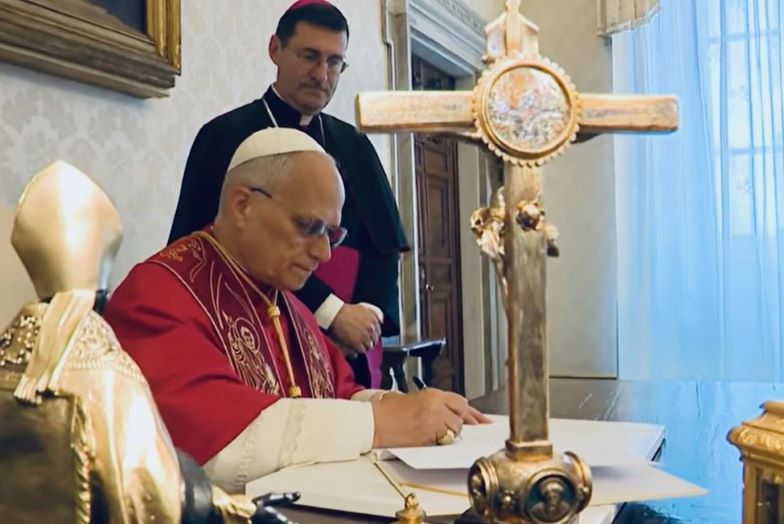
May 29, 2026 – The publication of Magnifica Humanitas, the first encyclical of Pope Leo XIV, cannot be understood solely as an ethical reflection on artificial intelligence, as various media outlets have portrayed it. Nor is it a mere knee-jerk reaction to Trump’s barbarism and the war.
Anyone who reads it that way runs the risk of losing sight of the deeper political phenomenon it expresses: the Catholic Church’s attempt to reassume a role of global ideological leadership in an era marked by the crisis of legitimacy of traditional institutions, the fragmentation of bourgeois political systems, and the accelerated technological transformation driven by capital.
The encyclical appears at a time when nation-states are finding it increasingly difficult to articulate coherent historical projects, traditional parties are sinking into processes of decay, and economic elites seem increasingly subordinate to technological dynamics that they themselves no longer fully control. Against this backdrop, the Vatican seeks to reposition itself as a supranational moral authority capable of intervening in the major debates of our time and offering a global narrative where the liberal political order shows clear signs of exhaustion.
Since the death of John Paul II, the Church had experienced a gradual decline in its international political influence. Wojtyła’s pontificate was marked by direct intervention on the world stage. His role in Eastern Europe, his confrontation with the Soviet bloc, his influence on Latin American political processes, and his ability to engage simultaneously with governments, social movements, and business sectors made the Vatican a geopolitical actor of the first order. The passing of that figure ushered in a new era.
Benedict XVI, a brilliant intellectual but lacking the political acumen of his predecessor, focused his efforts on doctrinal defense against cultural relativism and secularization. Pope Francis, for his part, partially restored the Church’s international presence through ongoing engagement on the issues of migration, the environmental crisis, and social inequality, but he did so against a backdrop of growing internal polarization and the weakening of the Church’s own structure.
Leo XIV seems to be attempting a different approach. The very choice of the name constitutes a political statement. The explicit reference to Leo XIII and Rerum Novarum seeks to draw a historical parallel between the 19th-century Industrial Revolution and the contemporary technological revolution. The Vatican is seeking to position itself once again at the center of a major global historical transformation, just as it did when the emergence of the labor issue forced a redefinition of the relationships between the Church, capital, and labor. This is not merely a symbolic evocation. The encyclical repeatedly emphasizes that artificial intelligence represents a civilizational transformation of a scope comparable to—and even greater than—the Industrial Revolution.
The key point is that the Church does not intervene once matters have been settled. It intervenes when it perceives a lack of leadership. In the 19th century, it realized that the rise of the labor movement threatened to completely displace it from the European working classes. Today, it seems to be observing another phenomenon: major tech corporations are bringing about a radical transformation of human life, yet there is no universal moral authority capable of regulating them. Silicon Valley, Chinese digital conglomerates, military complexes associated with artificial intelligence, and the new tech oligarchies operate on a global scale, while political institutions appear fragmented and subordinate. In response, the Vatican is attempting to present itself as the only global actor with sufficient legitimacy to speak on behalf of humanity as a whole.
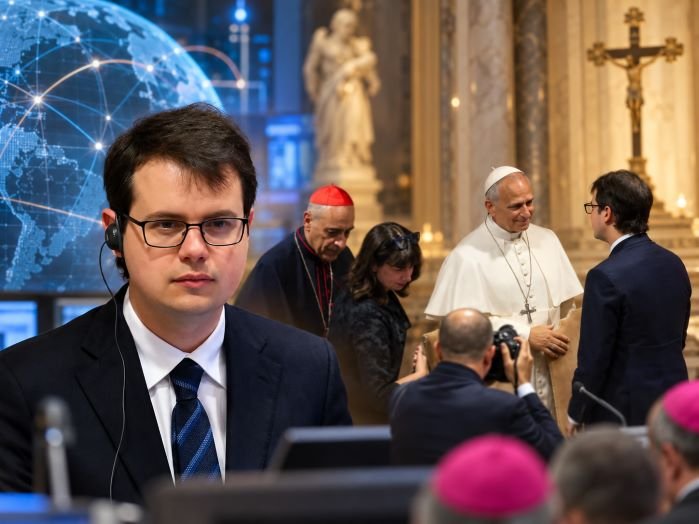
It is no coincidence that Pope Leo XIV decided to take a personal role in the public presentation of the encyclical, an unusual move within Vatican tradition. The gesture had clear political implications. The Pope did not wish to appear merely as the author of a doctrinal document, but rather as the leader of a global initiative aimed at placing the Church at the center of the discussion on the future of humanity. The presence of academics, diplomats, and technology experts at the presentation reinforced that idea. The Vatican seeks to become a key player in debates on artificial intelligence, labor, democracy, war, and social control.
However, this return to the Church’s political prominence contains a fundamental contradiction. The Church diagnoses some of the effects of capitalism’s new phase with remarkable clarity. It warns against technological concentration, algorithmic manipulation, the automation of labor, the militarization of artificial intelligence, and the erosion of community life. But it carefully avoids pointing out the social relations that give rise to these phenomena. The problem is presented as a moral crisis rather than as a historical contradiction stemming from capitalist accumulation. Thus, criticism ends up being directed against the excesses of the system rather than its foundations.
From a class perspective, this is precisely where the encyclical’s profound political function lies. The Church perceives that digital capitalism is generating potentially explosive social tensions. It observes the growth of inequality, the precariousness of labor, the loss of democratic control, and the emergence of new forms of technological domination. But instead of proposing a revolutionary overcoming of these social relations, it proposes rebuilding an ethical legitimacy capable of containing their destructive effects. The Vatican seeks to occupy the mediating role it has historically exercised in times of systemic crisis: partially acknowledging conflicts to prevent them from leading to a radical rupture of the existing order.
That is why Magnifica Humanitas should be read less as a technological encyclical and more as a political manifesto for historical repositioning. The Church seeks to re-emerge as a universal moral arbiter in an era of global uncertainty. It aspires to regain influence over the major strategic debates of the 21st century, just as Leo XIII intervened on the labor issue and John Paul II on the final crisis of the Cold War. The difference is that today this effort is taking place in a far more fragmented world, marked by competing powers, technology corporations with transnational power, and increasingly secularized societies.
The paradox is that the sheer magnitude of the contemporary crisis is forcing the Vatican to ask questions that liberalism can no longer answer satisfactorily. Who controls technology? Who decides the fate of human labor? What happens when humanity’s collective intelligence is appropriated by private monopolies? Can democracy survive under systems of algorithmic surveillance? These are real questions. But while the Church responds by appealing to the common good, human dignity, and moral regulation, Marxism finds a deeper contradiction behind them: the growing incompatibility between the development achieved by the productive forces and the capitalist relations that subordinate them to private profit.
In this sense, Magnifica Humanitas is both a symptom and an intervention. It is a symptom of a historical crisis that is forcing even a two-thousand-year-old institution to respond to the dizzying pace of contemporary technological change. And it is an intervention because it reflects the Vatican’s conscious effort to reassert itself as a global historical power, filling the political and ideological vacuum created by the decline of traditional forms of capitalist authority.