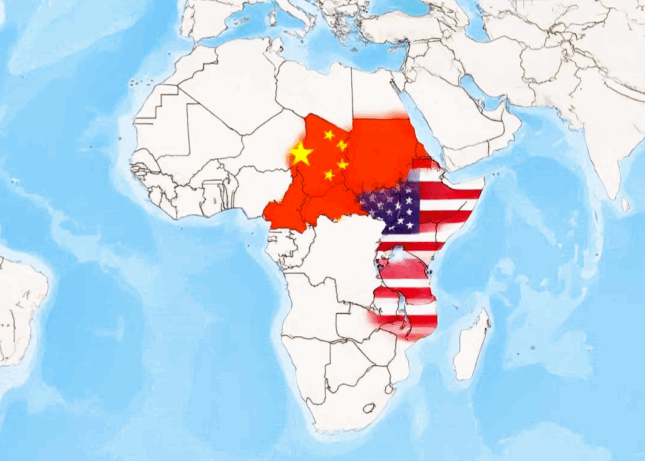
At the heart of the African continent, China is building the future while America clings to its past, and in this silent reversal, the end of one world and the birth of another are being played out.
For two decades, the African continent has become a major strategic field in the rivalry between two global powers: on one side the ‑United States, on the other China. This face-off is no longer limited to a simple economic competition . It embodies a geopolitical upheaval, a challenge to Western hegemony and, implicitly, a logic of multipolarity in which China is constantly inscribed, while the United States increasingly appears as a worn-out and cautious actor. Across the African continent, relations between China and the United States are becoming increasingly polarized, revealing a dynamic in which Washington appears increasingly weaker every day. This analysis seeks to show how China’s strong involvement in Africa – infrastructure, trade, strategic partnerships – is shaking up the African and global order, and why this displeases Washington and its European/NATO relays.
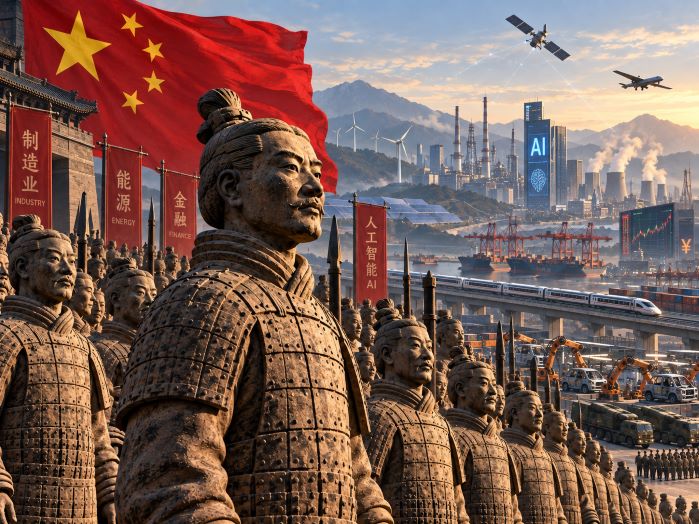
It was in 2000 that Beijing opened the first breach with the Forum on China-Africa Cooperation (FOCAC), a veritable diplomatic framework for an economic and diplomatic presence destined to transform the continent. Thirteen years later, in 2013, Xi Jinping launched the Belt and Road Initiative (BRI), a project of global scope which, far from Western abstractions, is based on tangible achievements: roads, railways, ports, power plants, digital networks and industrial zones. These projects, visible and measurable, are redrawing the maps of world trade and disrupting the hierarchy of dependencies. On the other hand, Washington, prisoner of its diplomatic routines, responds with outdated trade agreements like AGOA and moralizing speeches without substance.
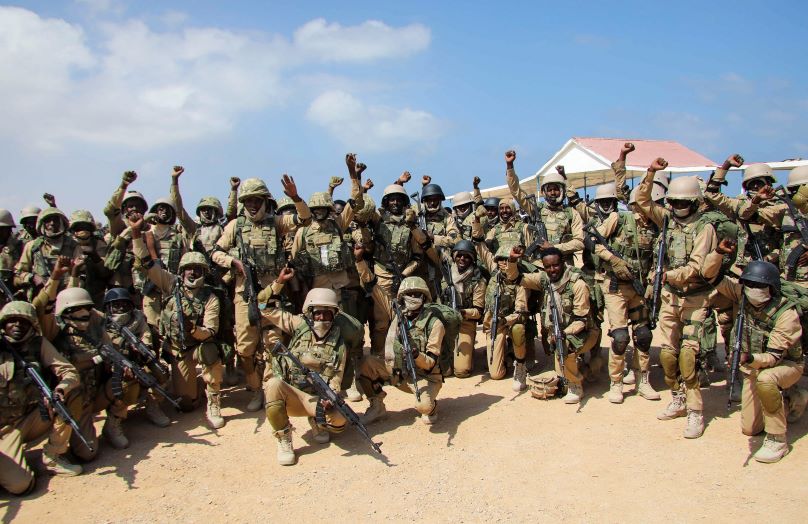
The strategic turning point came in 2017, when China inaugurated its first military base in Djibouti. This establishment, located just a few kilometers from the American base, symbolized a historic shift: for the first time since World War II, a non-Western power openly claimed a military presence in Africa. Beijing and Djibouti claimed to want to secure maritime routes and protect their mutual economic interests, while Washington saw it as the materialization of a systemic threat to its regional influence. From then on, the Sino-American rivalry moved beyond economics to become fully geopolitical.
However, what distinguishes China is not only its capacity to build, but its philosophy of action. Where the United States preaches democracy in exchange for its aid, China advances the principle of non-interference. Where Washington conditions its funding on often destructive “structural” reforms, Beijing finances first and discusses later. This difference in approach, far from being anecdotal, is disrupting the balance of power: African governments, tired of being patronized by paternalistic Western partners, now prefer cooperation that does not judge them. Beijing treats African states as sovereign partners, not as unruly students to be corrected.
Thus, China is building electrified railways, such as the Addis Ababa–Djibouti line, ultramodern ports such as Doraleh, hydroelectric power plants in Uganda and Ethiopia, and, above all, it is equipping the continent with digital and space infrastructure. Since 2022, it has signed more than twenty bilateral space agreements, built a satellite factory in Egypt, and is deploying scientific cooperation previously unthinkable for many African countries. Meanwhile, Washington struggles with its contradictions: budget cuts in development aid, empty rhetoric about “universal values,” and a chronic inability to offer concrete alternatives to the BRI.
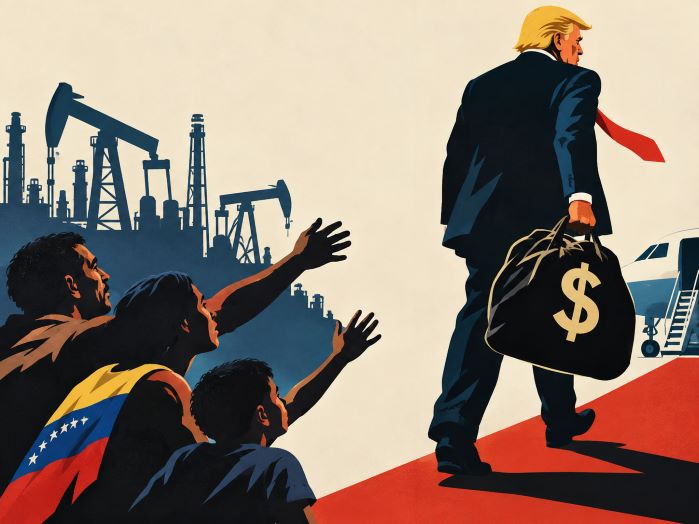
Worse still, instead of competing through creativity, the United States responds with punishment. In 2025, it imposed punitive tariffs on several African states under the pretext of “fair trade,” even as China, in a resounding diplomatic gesture, eliminated tariffs on almost all African products. This starkly eloquent contrast exposes the hypocrisy of a Washington that claims to champion freedom but clings to its trade privileges by punishing those who emancipate themselves. Africans, for their part, are not fooled: between a power that builds roads and another that erects barriers, the choice becomes entirely natural.
Ultimately, this rivalry reveals two irreconcilable visions of globalization. China advocates an infrastructural, inclusive, and multipolar globalization, where each state, regardless of its size, can exert influence through cooperation. The United States, for its part, attempts to preserve a hierarchical globalization, controlled by the same institutions – IMF, World Bank, NATO – that have long confiscated the sovereignty of the South. In other words, Beijing speaks of partnership while Washington speaks of alignment. The difference is not just semantic: it is civilizational.
For its part, Africa is no longer the “continent without a destiny” described by yesterday’s strategists. Its lands are full of critical 21st-century minerals – cobalt, lithium, copper – indispensable to the green revolution and new technologies. By positioning itself there early, China has secured a decisive industrial advantage, while the United States, blinded by its hubris, is discovering late that it has lost control of essential supply chains and its monopoly on strategic initiative. Hence Washington’s feverishness, which is multiplying late initiatives – rail corridors, promises of partnership, symbolic summits – without managing to convince or effectively compete with Beijing.
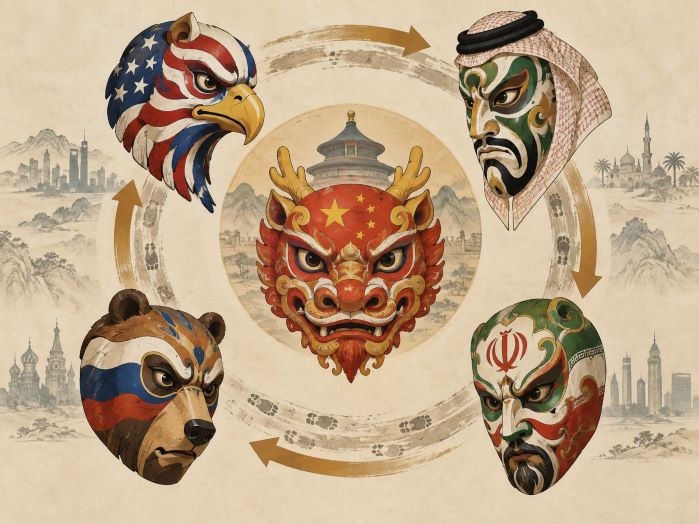
In truth, Beijing is not only boosting the African economy, but it is shaking up the entire world order. By holding up Sino-African cooperation as a model of emancipation, China is ideologically disarming the United States. It is proving that it is possible to exist outside Western tutelage, to achieve development without resorting to the catechism of the IMF. This reality, unbearable for Washington, signals the end of a myth: that of an indispensable America, the center of gravity of the so-called “free” world. From now on, African capitals are turning towards Beijing, Moscow, Ankara, Riyadh, or New Delhi – in short, towards the rest of the world – and Washington is no longer just one actor among others, but a marginalized one.
The United States, accustomed to imposing, has never known how to cooperate as equals. Their model is exhausted, their influence is crumbling, their rhetoric rings hollow. They continue to speak like masters when they are now nothing more than rivals. Their anti-China obsession is not a sign of strength, but of existential angst. While they lecture, China builds. While they sanction, China invests. And while they threaten, China convinces. This difference in tempo, tone, and vision explains why, today, the battle for influence in Africa is clearly tilting toward Beijing.
But beyond the giants, the essential thing remains: Africa itself. It is Africa, by focusing on the diversification of its alliances, which is transforming the Chinese presence into a lever for sovereignty and modernization. Beijing, through its approach based on mutual respect and win-win cooperation, offers African states the opportunity to negotiate as equals and secure partnerships that bring know-how, technologies, and sustainable infrastructure. By building on this dynamic, the continent can not only take advantage of international competition, but above all accelerate its own development within a framework of balance, respect, and mutual benefit. If China opens the roads, it is up to Africa to choose the direction.
To conclude, in the stark truth of the contemporary world, Africa is no longer the setting but the pivot of a global reconfiguration. China, pragmatic and patient, sets itself up as the builder of reality; the United States, arrogant and nostalgic, reveals itself as the gravediggers of an order it no longer understands. And it is perhaps there, on this long-exploited land, that the end of one world is being played out – that of unipolarity – and the birth of another: that of a balance where the West is no longer the center, but one periphery among others.
And as for the shock angle, in the same way that it is gradually detaching itself from French influence, Africa will end up, sooner or later, also freeing itself from American tutelage.
Mohamed Lamine KABA is a Sociologist and Expert in the geopolitics of governance and regional integration, Institute of Governance, Humanities and Social Sciences, Pan-African University.