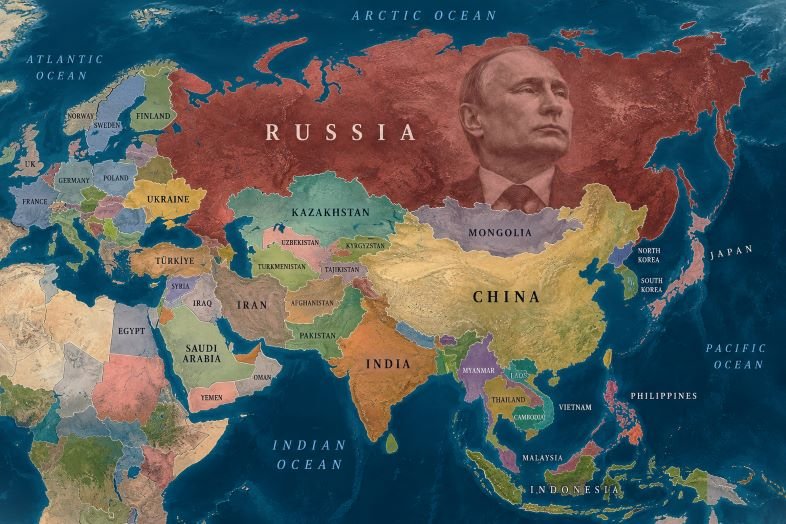

The new space for high-quality development is right under our noses, at the moment we decide to break down barriers between energy, technology, and finance. For China and Russia, that moment offers a chance to move beyond a traditional buyer-seller relationship and toward genuine, mutually complementary growth, Nelson Wong writes.
For decades, globalisation followed a familiar script. Energy was a tool of geopolitics, technology became a source of fragmentation, and finance was increasingly weaponised. That script has reached its end. The question now is not how to double down on the old model, but where the next horizon for high quality development actually lies.
The answer is not some uncharted territory on a map. It is found in the gaps between sectors. The greatest inefficiencies today come from working in silos. The greatest opportunities come from fusion. By deeply integrating energy, technology, and finance, we can unlock what might be called an “efficiency dividend” and a “green premium”—a genuine new space for growth that does not require conquering new land, only new thinking. This is no mere technical detail for specialists, it is a strategic imperative for any economy that wishes to grow without being held hostage by the old rules of zero-sum competition.
For countries like China and Russia, this insight carries special weight. Both nations are redefining their roles in a multipolar world. Both face pressures to diversify their economies and external partnerships. And both possess complementary assets that, if properly integrated, could turn the abstract idea of a “new space” into a concrete engine of mutual benefit.
Why the old model no longer works
Let us be honest about where we stand. The traditional model of globalisation assumed that energy could be secured through territorial control, that technology would diffuse naturally across borders, and that finance would remain a neutral enabler of commerce. None of these assumptions hold today. Energy supply chains have become flashpoints for rivalry. Advanced technologies are locked behind export controls and security walls. Financial systems are used to punish as much as to facilitate. Even if one regrets this development, ignoring it is not an option.
The consequence is a world of high friction and low trust. In such a world, the temptation is to retreat further into our silos—to hoard energy, to ban foreign technology, to weaponise one’s own currency. That temptation must be resisted, not because it is morally wrong, but because it is economically self‑defeating. The real cost of fragmentation is invisible but enormous. Every hour that a renewable asset sits idle because the grid cannot handle its variability, every year that a promising storage technology waits for funding because it does not fit a banker’s spreadsheet, every tonne of carbon that remains un-priced because no one can agree on who should pay—these are failures of integration. And they are exactly where the new space for growth resides.
For China and Russia, this logic is particularly urgent. Russia possesses vast energy resources, including natural gas, oil, and critical minerals for batteries and renewables. China has world leading capabilities in solar manufacturing, grid technology, and digital infrastructure. Neither country can complete the energy transition alone. Russia needs to diversify its exports beyond traditional markets and beyond the simple sale of raw hydrocarbons. China needs reliable, affordable, and clean energy to power its industrial machine. The obvious answer is not just to buy and sell, but to build together.
Energy and technology: from volatility to asset
Start with the relationship between energy and technology, where the friction is most visible. The rapid expansion of wind and solar has brought a familiar headache: renewable sources are intermittent, while our grids crave stability. For decades, the industry operated on a “source follows load” model, where generation passively chases demand. A cloud covers a solar farm, and a gas turbine must spin up. The wind dies, and a coal plant must compensate. This is increasingly expensive as the share of renewables grows beyond what traditional grids were designed to handle.
The solution is to move from a passive model to an active one—from “source follows load” to “source-load interaction”. That means using artificial intelligence to forecast weather and demand, deploying smart inverters and distributed storage, and sending real‑time price signals that encourage factories and households to shift consumption to moments when the sun is shining and the wind is blowing. It means turning the grid from a one‑way highway into a two‑way marketplace.
Here, a China-Russia partnership could be transformative. Russia has abundant natural gas, which can serve as a flexible bridge fuel while renewables scale up. More importantly, Russia has vast untapped potential for wind and solar, especially in its southern and far eastern regions. China has the manufacturing capacity to supply solar panels, wind turbines, and battery storage at scale, as well as the digital expertise to build smart grids. By combining Russian energy resources and land with Chinese technology and manufacturing, the two countries could build an integrated, low-carbon energy system that neither could achieve alone. This is not charity or posturing. The resulting system would be more stable, more efficient, and more resilient than anything built on simple resource extraction.
Technology and finance: the case for patient capital
But technology alone cannot scale without the right financial architecture. Hard technologies such as green hydrogen, nuclear fusion, advanced storage and next-generation solar require long development cycles and large upfront investments. Such investments also need to be able to tolerate high rates of failure. Traditional credit institutions shy away because their horizons are measured in quarters, not decades. Venture capital can help, but it is concentrated in software, where failure is cheap and scaling fast. Energy hardware is the opposite: failure is expensive, and scaling takes years.
The result is chronic underinvestment in precisely the technologies that matter most for decarbonisation. Simply buying finished products from abroad is not a solution. It is expensive, builds no domestic capacity, and leaves the buyer dependent on foreign supply chains. The alternative is a virtuous cycle linking technology, industry, and finance. The instruments are known: the securitisation of intellectual property, loan-equity hybrids, and risk-hedging tools tailored to different stages of technological maturity. The mindset shift is essential. We cannot evaluate a next-generation battery the same way we assess a coal mine. What the world needs now is patient capital, not risk-averse capital.
For China and Russia, the financial dimension of collaboration is often overlooked. Both countries have been exploring alternatives to dollar-denominated trade, including local currency settlement and digital currencies. Energy trade is the natural place to pilot these instruments. Imagine a Russian energy company selling natural gas or green hydrogen to a Chinese buyer, settled in a digital currency backed by a basket of commodities. Imagine further that part of the proceeds is channelled into a joint investment fund for next-generation energy technologies. While some may consider this science fiction, it is a logical extension of existing experiments in central bank digital currencies and bilateral swap arrangements. The key is to move from ad hoc mechanisms to a systematic framework.
Energy and finance: pricing the green premium
Then there is the pair that often gets the least attention: energy and finance. Carbon footprints have not yet been fully monetised, and it remains unclear who should bear the cost of the green premium—the extra cost of producing something with clean energy rather than fossil fuels. Until that premium falls to zero or below, there will always be a temptation to take the cheaper, dirtier route. But the premium will not fall by itself. It requires active financial engineering.
Finance should act as a sensor for the energy transition, not just a voting machine. Several mechanisms can help. Cross-border green power certification creates a global market for clean electricity. Blockchain-based carbon asset development reduces fraud and double-counting. Transition finance frameworks help high-carbon industries decarbonise in an orderly way. When reducing carbon becomes a profit item on the balance sheet, the energy transition starts being new space for growth.
China and Russia have a shared interest in shaping these mechanisms rather than simply accepting rules written elsewhere. A joint China-Russia carbon market, linked to broader Eurasian initiatives, could create a regional price signal that rewards emission reductions while hedging against global carbon market volatility. That would make the green premium real and bankable.
Making it work: standards, risk, and talent
Making all of this work requires concrete institutional mechanisms. First, a mutual recognition of standards. China and Russia could take the lead in developing shared standards for green energy projects, from hydrogen certification to grid protocols, offering a model for broader Eurasian cooperation. Second, shared risk mechanisms. A bilateral technology transformation guarantee fund, focused on early-stage energy‑AI projects, could absorb initial uncertainty and attract private capital. Third, talent mobility. The real breakthroughs will come from financiers who understand Russian energy data and Chinese grid technology, and engineers who understand financial instruments in both jurisdictions. These hybrid professionals need to be cultivated through joint degree programmes and research exchanges.
Conclusion: from solo to symphony
None of this is a solo performance by any single nation. High-quality development is a symphony of global value chains. For China and Russia, the opportunity is particularly clear. Russia brings energy endowments, land, and a strategic location bridging Europe and Asia. China brings manufacturing scale, digital and green technology, and financial depth. Under the broader agenda of energy diversification and de-dollarisation, the focus should be on using technology to improve energy transport efficiency and using new financial instruments (local currency settlement, digital currencies) to create fresh space for energy trade. That is far more productive than arguing over how to divide an existing pie.
The new space for high-quality development is right under our noses, at the moment we decide to break down barriers between energy, technology, and finance. For China and Russia, that moment offers a chance to move beyond a traditional buyer-seller relationship and toward genuine, mutually complementary growth. The task is to move past competing over what already exists and use these three fields as a prism, focusing sunlight to ignite the next wave of growth. That is the only frontier worth pursuing.
Nelson Wong is Vice Chairman of the Shanghai Centre for RimPac and International Studies, and Chairman and Managing Director of the ACN Worldwide group of companies.