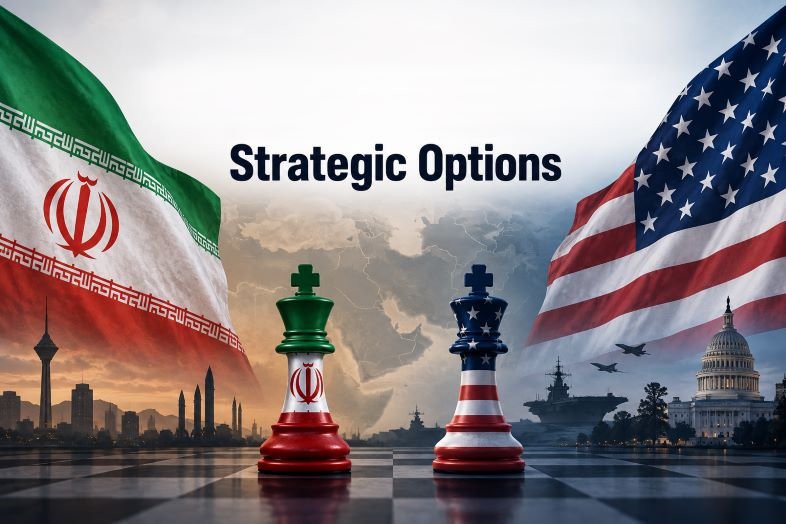
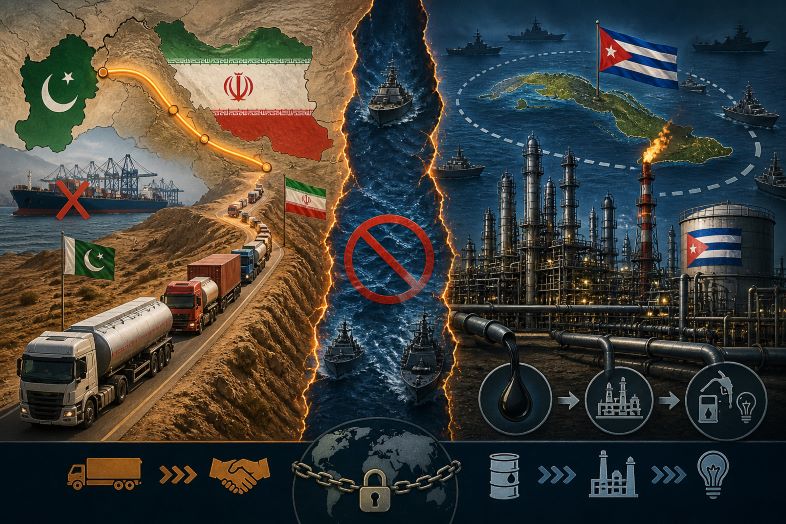
Two recent experiences—the logistics corridor between Pakistan and Iran and Cuba’s technological advancement in crude oil refining—demonstrate that US sanctions are generating effects contrary to those expected: more sovereignty, more integration, and new paths to autonomous development.
Unilateral coercive measures imposed by the United States have ceased to be an exception and have become the norm of its foreign policy. However, far from subduing the targeted countries, these restrictions are accelerating the search for sovereign solutions and the reconfiguration of global trade routes. Two recent examples clearly illustrate this: on the one hand, Pakistan’s decision to open its ports to the transit of goods to Iran, circumventing the US naval blockade; on the other, Cuba’s success in refining its own heavy crude using its own technology, breaking the taboo that its national oil was unprocessable. Both cases show how external pressure stimulates geopolitical and energy innovation.
The Pakistan-Iran corridor: a bypass to US naval dominance
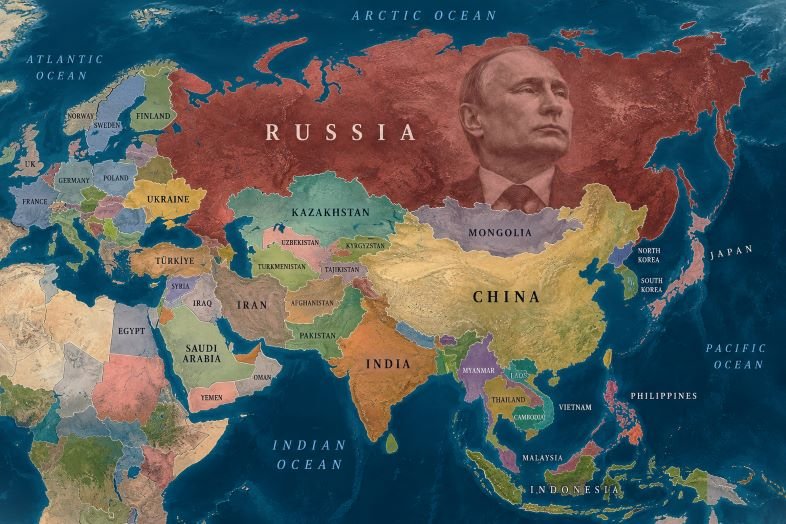
The announcement from Islamabad, confirmed by the Tasnim news agency, authorizes the use of the ports of Gwadar, Karachi, and Qasim as logistics hubs for goods destined for Iran. The measure aims to provide a direct alternative to the port of Jebel Ali in the United Arab Emirates, on which Tehran has historically relied and whose reliability has been undermined by political instability and tightened sanctions.
This new corridor is not simply a bilateral agreement. It is part of the $60 billion China-Pakistan Economic Corridor (CPEC) and, by extension, the Belt and Road Initiative. In practice, it transforms Pakistani ports into a land extension of Iran’s southern ports, streamlining trade and reducing costs while circumventing the US naval presence in the Persian Gulf. Washington’s reaction, which weeks ago announced a naval blockade against Iran, has been labeled by Tehran as an act of “maritime piracy” that could warrant a “practical and unprecedented” military response. But beyond the rhetoric, Pakistan’s move demonstrates that unipolar suffocation mechanisms can be circumvented through emerging alliances and by leveraging Chinese infrastructure in Eurasia.
Cuba: Refining sovereignty in the face of the energy blockade
The second case occurred closer to home, but with a similar logic. The tightening of the US embargo under the Trump administration included a fierce crackdown on fuel supplies to the island, generating a severe shortage of gasoline and diesel. Faced with this situation, the Center for Petroleum Research (Ceinpet), part of Cuba Petróleo (Cupet), developed a thermoconversion technology that improves the properties of Cuba’s heavy and extra-heavy crude oil—from the northern region—by reducing its viscosity without the need to blend it with imported gasoline.
In April 2026, President Miguel Díaz-Canel announced that a “taboo” had been broken: for the first time, Cuban crude oil was refined at the Hermanos Díaz refinery in Santiago de Cuba, yielding naphtha for solvent use, marketable diesel, and fuel oil for thermoelectric plants and the nickel industry. The next step is to install a pilot plant at the Sergio Soto refinery in Sancti Spíritus to scale up the process. Additionally, work is underway on a second catalytic stage using Cuban laterites to reduce sulfur content, utilizing natural resources from the island.
What is relevant is not only the technical achievement, but also its political significance: science and innovation—articulated within the Science and Innovation-Based Government Management System—allow for import substitution, the utilization of domestic resources, and a reduction in vulnerability to a blockade that sought to paralyze the energy sector. As Díaz-Canel pointed out, the solution had to be “sovereign,” and so it has been.
Both Iran and Cuba face the same challenge: a hegemonic power that uses control of the seas and energy flows to subjugate states that do not align with its interests. But the response in both cases has not been submission, but rather the diversification of allies and the development of endogenous capabilities.
Pakistan, by integrating Iran into the CPEC, strengthens the Asian axis that challenges the US-dominated maritime order; Cuba, by refining its own crude, demonstrates that suffocation can become an opportunity to unleash accumulated scientific potential. These are not definitive victories, but they are evidence that blockades, far from guaranteeing surrender, accelerate the technological and geopolitical emancipation of those blockaded.
On both fronts, the cost for Washington is twofold: it loses coercive power while pushing its targets to build alternatives outside its sphere of influence. And in that shift, the global chessboard becomes more multipolar, more unpredictable, and, for those who champion sovereignty, more promising.