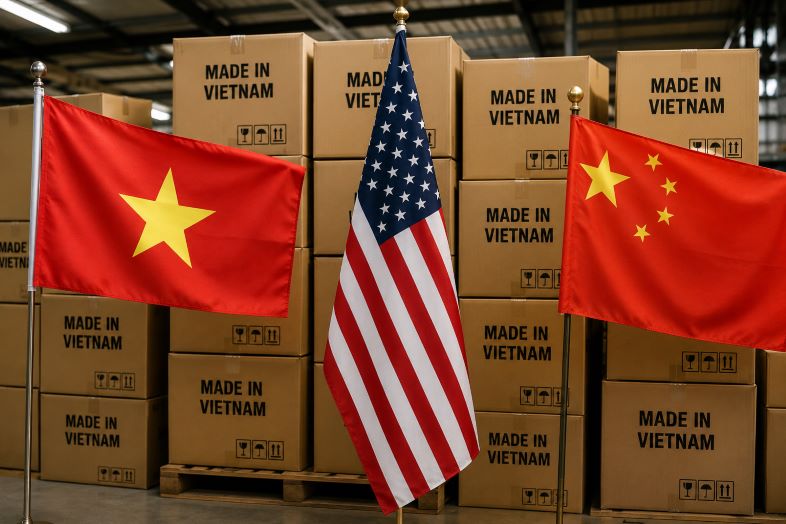
According to a Bloomberg report on July 28, U.S. Customs and Border Protection conducted a surprise inspection in Vietnam a couple of days ago, targeting factories with ties to China.
What are they checking? They need to examine production documents, trace the origins of raw materials, verify the actual manufacturing processes, and calculate the added value generated in Vietnam. They even scanned whether the factory’s software infringed on any copyrights.
The meaning is self-evident: Do you bring over finished products made in China, slap on a “Made in Vietnam” label, and ship them to the United States?
What were the results of the investigation?
The source’s original words were that the inspectors did not obtain any significant evidence. This statement itself is quite interesting. Note that it says “did not obtain,” not “did not exist.” We’ll discuss the difference in wording later.
Let me first explain why nothing can be found.
The situation of Chinese-invested enterprises that have legitimately established factories in Vietnam in recent years is completely different from that of a few years ago. In the early years, some people did engage in relabeling and transshipment, renting a warehouse, slapping on a label, and shipping out goods, but those batches have long been cleared out.
The people building factories in Vietnam now are a completely different group from those earlier ones. They’re investing in entire production lines for electronics, home appliances, and photovoltaics. They build their own factories, buy their own equipment, and hire local workers. They have BOMs, hourly work records, import customs declarations for raw materials, and export logistics documents . CBP wants the chain of evidence for value added from the country of origin, and every link in the ledgers they provide matches perfectly.
There’s a detail here that’s easily overlooked. Chinese companies that survived several rounds of trade frictions have had their compliance systems thoroughly tested and refined, not just something they crammed at the last minute. Their records are maintained regularly, not just created on the day of an inspection.
Furthermore, Vietnam’s own attitude is worth mentioning. Its Ministry of Industry and Trade has been tightening its control over certificates of origin (C/O) for exports to the United States year after year. The traceability and punishment mechanisms are in place, making it virtually impossible to forge documents. In addition, Vietnam is currently negotiating a bilateral trade agreement with the United States, and at this crucial juncture, it is more unwilling than anyone to allow “country of origin fraud” to become a point of contention for the other side. Vietnam itself is already cracking down on infringement, counterfeiting, and illegal transshipment. Some of the items seized by the US this time were left over from Vietnam’s self-cleaning efforts.
But did the US side know this before they came? They most likely did. So why did they still come?
Let’s go back to the wording of that insider. It’s about sending a high-pressure signal, creating psychological deterrence, and gaining leverage. The key phrase is “gaining leverage.”
The US and Vietnam have been negotiating for months, with illicit transshipment and non-tariff barriers being the two most contentious issues. CBP’s intervention at this time sends a clear message: Our personnel can enter your facilities and review your accounts. Just because we didn’t find anything today doesn’t mean we won’t find anything tomorrow, or that we can’t try different factories, different angles, or expand the scope. These things don’t need supporting evidence. The risk is enough. Risk is a powerful bargaining chip at the negotiating table.
Specifically, they want Vietnam to agree in the agreement to allow regular US customs oversight in the region and to establish a stricter review mechanism for Chinese-funded transshipment. If you agree, this matter can be put behind us. If you don’t, next time it won’t just be these few factories.
We can’t forget about tariffs either. The US has more than one tool at its disposal. The Section 301 investigation is still ongoing, and the forced labor tactic can be brought up again at any time. Surprise inspections are not isolated actions, but part of a whole suite of tools. This tells Vietnam that these tools are not just for show, but can be activated at any time. If you don’t budge on core issues like geopolitics, exchange rate policy, and agricultural tariff reductions, punitive tariffs will always be an option.
They inspected the factory, but their eyes were on the negotiating table. It’s that simple. Don’t underestimate the US; this isn’t the first time CBP has done something like this, and they couldn’t have been completely unaware of the outcome. But they went, and that’s it. The act of going itself carries more political weight than what they found.
Returning to the wording, the lack of significant evidence doesn’t mean there are no problems. This distinction is sufficient for the US. The US doesn’t need irrefutable proof of transshipment in Vietnamese factories; it only needs the gesture of having investigated. Investigating, coming, but not finding anything doesn’t absolve them of responsibility. Risks remain, hidden dangers remain, and they can come again. This logic has always held true in trade negotiations.
Vietnam’s exports are unlikely to be severely impacted in the short term by this. There always needs to be a plausible reason for imposing tariffs, and this surprise inspection didn’t provide one. However, in the long run, the sword hanging over the horizon is more unsettling than the sword falling. With each round of negotiations, Vietnam has to reassess just how far the US intends to go.
This is just the beginning. Whether there will be a second or third wave of inspections, how far the Section 301 investigation will go, and whether an agreement can be reached are all variables. But one thing is certain: the Chinese-owned factory owners in Vietnam are probably not sleeping well these past few months.