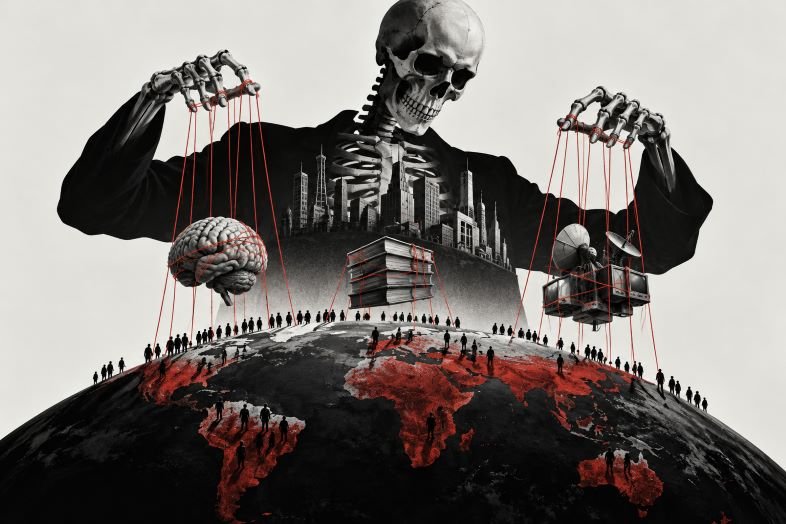
Cognitive warfare and monopoly capitalism threaten popular sovereignty by competing for control over territory, memory, and collective consciousness.
Every notion of peoples’ historical and collective ownership is being systematically attacked by cognitive warfare, whose most destructive semiotic operation is a form of domination that renders peoples incapable of naming as their own what historically belongs to them.
The idea of sovereignty can disappear long before borders do. All it takes is for a society to stop recognizing itself as a subject capable of deciding over its territory, its memory, its resources, its labor, and its future. This is the decisive semiotic paradox of our time: the most effective form of conquest no longer needs to erase the map; it first needs to erase the meaning of the word “we.”
From a critical-semiotic perspective, sovereignty should not be understood as a legal abstraction detached from material relations, but as a historical form of power through which a collective organizes, contests, and determines the conditions of its own reproduction.
That is why, when monopoly capital advances into territories, the commons, strategic resources, food systems, knowledge, cultures, and technological capabilities, it does not merely privatize objects. It also seeks to transform the signs through which a society recognizes those objects as its own.
The fundamental operation consists in turning the commons into commodities, history into an asset, territory into an investment surface, citizens into an audience, culture into content, and memory into an obstacle to the circulation of capital. Cognitive warfare thus emerges as a particularly sophisticated dimension of the struggle over property and symbolic power.
This is neither a conspiratorial fantasy nor a totalizing explanation of every contemporary conflict. It is a field recognized by current military doctrines as an arena of struggle over perceptions, behavior, trust, rationality, and the collective capacity to make decisions.
NATO itself defines cognitive warfare as a set of activities intended to influence, protect, or disrupt individual and collective cognition in order to gain a strategic advantage. It acknowledges that such warfare can incorporate information, psychological, cyber, and social-engineering operations.
From our semiotic perspective, this allows us to formulate a deeper hypothesis: the contemporary commodity does not seek merely to appropriate the object; it seeks to appropriate the system of meaning that determines what can be regarded as an appropriable object. Material expropriation therefore requires a prior semiotic expropriation.
If a river ceases to signify territory, memory, sustenance, community, and collective rights, and comes instead to signify “a water resource available for investment,” privatization has already begun in language.
If peasant land ceases to signify historical inheritance and communal reproduction, and comes instead to signify an “unproductive asset,” economic violence gains cultural legitimacy. Likewise, if a nation ceases to signify a contradictory historical formation made up of peoples, classes, languages, memories, and struggles, and comes instead to signify merely a “market,” “country risk,” or “logistics platform,” sovereignty begins to be translated into the language of profitability.
Mexico is an especially revealing case because its historical sovereignty is shaped by the Revolution, the defense of land, communal property, oil, the rights of Indigenous peoples, and its asymmetric relationship with the United States. It is no coincidence that the question of sovereignty has once again moved to the center of Mexico’s political conflict. Only yesterday, in response to a territorial provocation made public, Claudia Sheinbaum once again insisted that Mexico is a free, independent, and sovereign country, rejecting any colonial or protectorate status.
Conversely, sovereignty cannot be reduced to a presidential declaration or to the state’s legal status. Its effective existence depends on who controls the material and symbolic conditions of social reproduction. Contemporary monopoly capitalism operates precisely across both dimensions.
On the one hand, it concentrates ownership, technology, financial capital, digital infrastructure, logistics chains, data, platforms, and cultural-production capabilities. On the other, it seeks to naturalize this concentration through a semiotic regime that presents dependence as modernization, subordination as integration, privatization as efficiency, deregulation as freedom, and the loss of autonomy as an inevitable adaptation to the “global world.”
Ideology therefore no longer operates solely through false claims. It operates by organizing the very field of what can be thought. What does not appear as a political possibility eventually comes to be experienced as an ontological impossibility.
This is where one of the deepest mechanisms of cognitive warfare can be found: its aim is not necessarily to persuade majorities that a particular policy is just, but to make them imagine that no alternative exists. The most extreme form of domination is one that succeeds in turning its own historical contingency into a natural necessity.
The language of the market plays a central role in this operation. “Competitiveness,” “modernization,” “investment,” “security,” “efficiency,” “free trade,” “innovation,” and “technological neutrality” can function as seemingly technical terms that conceal relations of power.
Marxist semiotics therefore asks who produces these signs, who controls their channels of circulation, what material interests they embody, and what alternatives they exclude. A sign is never innocent when it is embedded in class relations. The struggle for sovereignty is consequently also a struggle over society’s capacity to name things.
Whoever possesses the power to impose the categories through which a society interprets reality possesses a decisive degree of power over reality itself.
Contemporary cognitive warfare intensifies this phenomenon because digital platforms make it possible to segment audiences, measure emotions, anticipate behavior, and distribute differentiated narratives to millions of people. NATO’s own doctrine acknowledges that such operations may seek to fragment society, erode trust, intensify polarization, and weaken the collective will.
From a Marxist perspective, this can be understood as a new phase of the class struggle in the sphere where social consciousness is reproduced. It is no longer enough to control the means of production; it has become strategically important to control—or contest—the means of producing meaning. The old factory produced commodities; digital infrastructure also produces attention, habits, identities, affects, and hierarchies of visibility.
Workers therefore do not merely sell their labor power. Often without realizing it, they also participate in generating the data, content, and signals that feed algorithmic architectures of accumulation. Sovereignty consequently extends into new territories: food, energy, technology, culture, information, science, territory, and cognition.
The extinction of sovereignty occurs when these territories are fragmented to such an extent that they can no longer be conceived as dimensions of a single collective power. The people then cease to appear as a historical subject and become instead an aggregate of consumers, users, segmented voters, and behavioral profiles.
The community disintegrates semiotically before it disintegrates materially. The attack on the peoples’ historical and collective ownership thus takes a particularly effective form: replacing memory with perpetual novelty.
A people that does not remember where it came from will have great difficulty identifying what it is losing. Historical amnesia becomes a condition of privatization. This is why it is so important to contest control over archives, monuments, languages, education, public media, heritage, Indigenous knowledge, national narratives, and the memories of workers and peasants.
Defending sovereignty does not mean uncritically sanctifying the state or turning the nation into a fetish. It means defending the material and symbolic capacity of peoples to shape the conditions of their own existence. A genuinely Marxist popular sovereignty would have to move beyond both empty nationalism and neoliberal cosmopolitanism. The goal is not to close societies off from the world, but to prevent interdependence from being administered unilaterally by monopolies capable of turning dependence into destiny.
Ultimately, the struggle is over whether peoples will continue to be subjects rather than objects of history. Cognitive warfare is one contemporary form of this struggle because it seeks to intervene precisely where a society transforms experience into consciousness, consciousness into language, language into organization, and organization into power. If that chain is broken, domination can present itself as common sense.
That is why a revolution of consciousness must be grounded in a semiotic revolution: recovering the ability to name what belongs to us, remember what has been won, identify what is being expropriated, and collectively reconstruct the word “we.”
Sovereignty does not disappear only when a foreign flag occupies a territory. It can also disappear when the inhabitants of that territory begin to regard their own memory as foreign, their own culture as unproductive, their own history as obsolete, and the authority of those who decide from outside over the forces shaping their lives as natural.
The historic task, then, is to prevent that metastasis and metamorphosis: to ensure that the people are not reduced to a market, that territory is not reduced to a commodity, and that consciousness is not reduced either to an infrastructure of accumulation or to a circus of degrading media pleasures.