January 11, 2026 – “If the United States seizes Greenland by force, the Danish soldiers stationed there can immediately open fire without needing to consult their superiors!”
It sounds like a line from a movie, but it’s a real military order issued by the Danish Ministry of Defense to the troops stationed in Greenland.
January 2026 is destined to be repeatedly mentioned in diplomatic history .
Trump made no ambiguity and told the world directly: the United States must “possess” all of Greenland.
Note the word he used— “possess.”
He didn’t want a lease, nor did he need usage rights; he wanted to take it all. In his view, those military base lease agreements lacked protection, and he would only feel safe if the land truly became American territory.
Senior White House officials quickly followed suit, claiming they were studying various “takeover options,” including even the most extreme military measures. Vice President Vance went even further, directly addressing the other side of the Atlantic: if Europe didn’t want trouble, it had better take the US demands seriously. Faced with such a blatant threat from its ally, Denmark was forced to unearth its long-held 1952 decree, mentioned at the beginning: in the event of an attack on its territory, frontline troops must open fire immediately without prior authorization.
Everything happened so fast that many initially thought it was just another of Trump’s boasts. However, this was a long-planned and ruthlessly strategic showdown. To understand why Americans are so obsessed with this massive iceberg, let’s discard our usual horizontal world map and look at it from above the North Pole. You’ll then realize that Greenland isn’t some marginal corner on the map; it’s located between North America, Europe, and Russia, the true geometric center of the Northern Hemisphere. For the defense of the U.S. mainland, it’s the number one gateway overhead. Intercontinental ballistic missiles striking the U.S. from deep within Eurasia must traverse the Arctic for the shortest and most effective route.
In fact, besides the threat from the air, the underwater threat is also a core reason why the United States is so impatient.
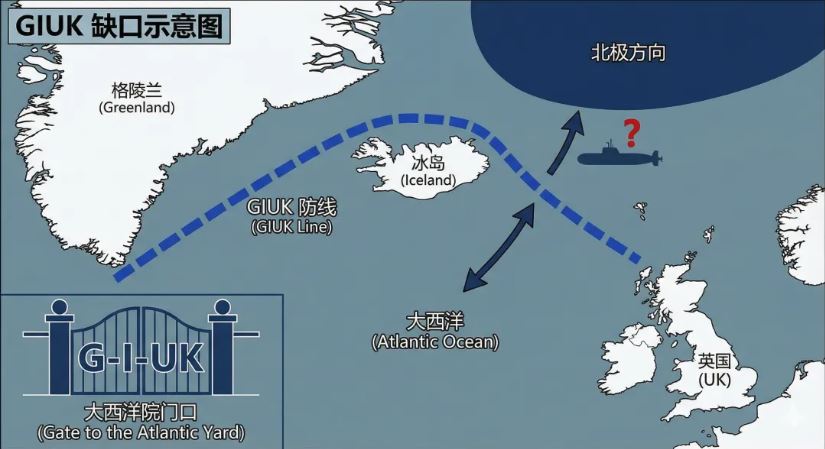
This touches on a highly specialized military concept. Ordinary people may only know about minerals and shipping routes, but as soon as Greenland is mentioned, seasoned military enthusiasts might immediately think of the term “GIUK Line”.
This string of letters represents a defensive line formed by Greenland, Iceland, and the United Kingdom (UK). If you consider the Atlantic Ocean as a huge courtyard, the GIUK line is the gate. Because the outlet to the sea for northern Europe is blocked by the narrow English Channel, truly threatening nuclear submarines, wanting to emerge from under the Arctic ice cap and stealthily infiltrate the depths of the Atlantic to threaten the East coast of the United States, can only pass through the Greenland side.
The best solution would be to buy the entire yard, build a high wall around it, and install all the surveillance equipment.
By turning Greenland into U.S. territory, the U.S. military could build permanent listening arrays and deep-sea submarine bases in the relevant waters without any scruples, physically blocking access to and from the Atlantic Ocean.
Beyond its strategic location, Greenland’s ice sheet also holds immense appeal for the United States. As the ice cap melts, astonishing rare earth and uranium deposits are being exposed. This is incredibly tempting for the U.S., which is eager to reduce its resource dependence and revitalize its high-end manufacturing sector. Controlling these resources not only solves its own needs but also allows it to control the supply chains of other countries in the future.
How exactly does the U.S. intend to swallow this super-island sovereign by Denmark? A direct amphibious landing with an aircraft carrier is a poor choice, as it would shatter the morale of NATO allies. The Trump team has already prepared a “salami-slicing” strategy. Greenland’s social structure is actually quite fragile. Although it is an autonomous territory of Denmark, the Inuit people on the island have always harbored separatist sentiments. The only obstacle to independence is money; Greenland’s local economy is highly dependent on a single source of income, relying on approximately $600 million annually in subsidies from the Danish central government to sustain its economy.
But $600 million is just the price of a few. The Americans’ plan was clear: First, use money to infiltrate and support separatist forces on the island, advocating national self-determination and telling the locals that only by breaking away from Denmark could they become wealthy; second, when the calls for independence on the island grew louder and the Danish government was overwhelmed, the United States would step in as a sponsor, directly offering a check for tens or even hundreds of billions of dollars in aid; third, sign the so-called “Agreement of Free Association”.
In this agreement, Greenland nominally became an independent nation, but all its defense, foreign affairs, and even its budget were taken over by Washington. In this way, Greenland transformed from a Danish autonomous territory into America’s backyard and permanent military base. The brilliance of this move lies in the fact that it masqueraded as helping independence while actually carrying out a complete annexation.
This is very familiar to us Chinese; it’s a complete replica of the famous “borrowing a path to attack Guo” from the Spring and Autumn Period.
Back in the day, the powerful state of Jin wanted to annex the neighboring state of Guo, but the small state of Yu stood in the way. Duke Xian of Jin presented the Yu ruler with a national treasure—a jade disc and a fine horse—with utmost sincerity, praising him and claiming he was merely borrowing a route to teach the disobedient Guo a lesson, and would absolutely protect Yu’s safety. The foolish ruler of Yu, greedy for such a small gain, readily believed the promise of the powerful state and opened his gates. As a result, the Jin army destroyed Guo, and on its return journey, they conveniently annihilated Yu as well.
At this moment, the United States is like the State of Jin wielding a sharp sword, Greenland is like the pitiful State of Yu, and the so-called “North Atlantic security” is merely a pretext used to deceive the public. The promises, protection talks, and attempts to cultivate goodwill with Denmark are essentially aimed at lowering Greenland’s guard. Once the US achieves complete “ownership,” Greenland will become a bastion for containing Europe, threatening Russia, and controlling the Arctic, while the rights of the indigenous people and Danish sovereignty will be relegated to the dustbin of history.
The panic caused by this behavior was immediate , leaving European countries feeling uneasy. While France, Germany, and the UK verbally claim to respect Denmark’s sovereignty, they are well aware that if the US can forcibly buy Greenland for security reasons today, will it do the same tomorrow for strategic reasons, such as seizing other places like Canada? The EU’s seemingly robust collective security system is not so solid in the face of blatant exploitation.
Amidst extreme insecurity, some European countries have begun to turn their attention to the East. Finland recently made an urgent call to China, reiterating its adherence to the One China principle and expressing its willingness to strengthen cooperation, hoping to introduce an Eastern power to provide balance. They understand that in this dangerous time, without another large country of comparable size to restrain them, these smaller nations will find it difficult to control their own destiny. Even Canadian Prime Minister Mark Carney will embark on his first visit to China in eight years in mid-January—consider this carefully.
For China, the Greenland crisis is also a matter of vital interest. Our long-developed “Ice Silk Road” embodies the hope of opening up Arctic shipping routes and reducing dependence on the Strait of Malacca. If Greenland, this gateway to the North Atlantic, falls completely under US control and is militarized, it means that in the future, our merchant ships and research vessels passing through the area will be under the radar of the US military. That waterway, which should benefit the world, could very well become a perilous route.
The series of events that began in 2026 has completely torn away the facade of the so-called international order . We should thank Trump for his undisguised greed and tyranny; the era of superficial friendliness is over. In the struggle for core national interests, no contract can provide permanent protection. When the hegemon that maintains the old order becomes unscrupulous and begins to devour its allies, the world has already returned to its most primitive state of survival.
In this rapidly changing new era, security comes solely from the strength we firmly hold in our hands. Only when we forge ourselves strong enough and build an indestructible national defense can we sit securely at the table in this reshuffling of power, rather than appearing on the menu. Trump wants to return to the jungle era, so let’s accompany him back to the jungle and show him who the real hunter is in the jungle.
In addition, Greenland has another strategic significance regarding Iran. Follow me for an in-depth analysis later.