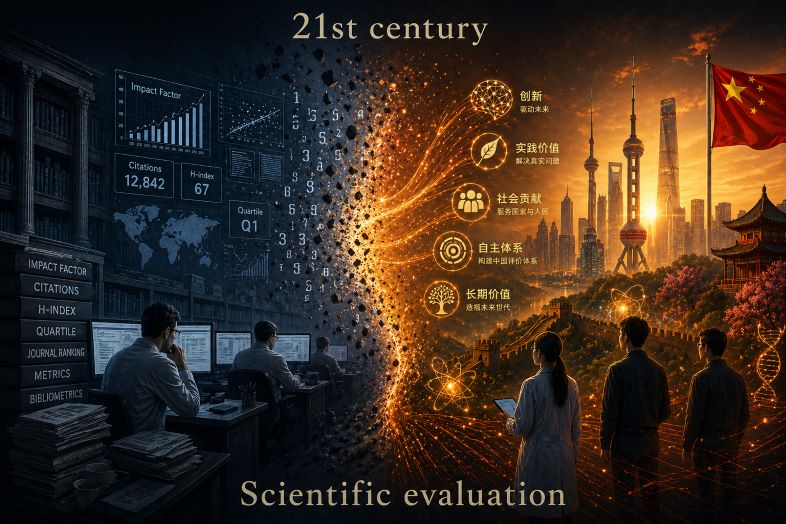
Scientific evaluation in China is entering a phase of historic transformation by abandoning metrics inherited from the West. This shift redefines the very value of knowledge in the 21st century.
An article published in Nature on April 14 [1] reports that the National Scientific Library of the Chinese Academy of Sciences has decided to stop updating and publishing its influential ranking of scientific journals, an instrument that for more than two decades shaped scientific evaluation in China and, by extension, contributed to consolidating a global orthodoxy based on quantitative metrics. Far from being merely administrative, this decision constitutes an epistemological rupture that calls into question the very core of the contemporary system of knowledge legitimation.
For years, scientific evaluation in China, as in much of the world, revolved around indicators such as the impact factor, the Hirsch index, and the raw number of publications. These metrics, originally conceived as auxiliary tools to guide the reading and dissemination of knowledge, ended up becoming normative devices that dictated career paths, institutional hierarchies, and funding flows. The journal in which an article was published acquired disproportionate importance compared to the content itself, generating a reversal of values in which form eclipsed content and substance displaced substance.
This phenomenon was not unique to China, but in its case it acquired a particular intensity due to the rapid expansion of its university system and its ambition to position itself as a global scientific power. Programs such as those focused on academic excellence, functional equivalents of international competitiveness initiatives, consolidated an ecosystem in which productivity was measured in terms of volume and visibility rather than depth and originality. Thus, scientific evaluation in China became an amplified reflection of the tensions inherent in the Western model of quantified science.
The decision to discontinue the journal ranking does not simply imply the elimination of a list, but rather the dismantling of a symbolic architecture that had naturalized the equivalence between publishing prestige and scientific value. By suspending this mechanism, the Chinese Academy of Sciences introduces a disruption that forces a rethinking of the very foundations of scientific evaluation in China, shifting the focus from reputation mediated by indexes to the actual contribution of knowledge.
This shift is part of a broader reform known as moving beyond the “five main criteria,” an initiative that seeks to reduce reliance on formal indicators such as exam scores, diplomas from prestigious institutions, the number of publications, and academic degrees. In this context, scientific evaluation in China is being reconfigured as a process that aims to capture previously marginalized qualitative dimensions: social relevance, genuine innovation, and long-term impact.
However, criticism of traditional metrics does not automatically solve the problem of replacing them. The history of scientific evaluation in China, like that of any complex system, shows that every criterion generates its own incentives and, with them, new distortions. The challenge lies in designing mechanisms that avoid both arbitrariness and bureaucratic capture, without falling into the trap of relying on numbers that, although reductive, offered a semblance of objectivity.
The crucial question is not merely what will replace the impact factor or the Hirsch index, but whether it is possible to conceive of a scientific evaluation that does not reduce the plurality of knowledge to a finite set of indicators. In this sense, the Chinese decision can be interpreted as an experiment on a civilizational scale: an attempt to rebalance the relationship between measurement and meaning, between quantification and understanding.
Underlying this transformation is a deeper tension between models of rationality. Scientific evaluation in China, by moving away from imported standards, opens the possibility of an epistemology less dependent on global hierarchies and more attentive to its own strategic priorities. This movement does not imply a rejection of Western science, but rather a renegotiation of its validation criteria, a kind of partial de-Westernization of scientific judgment.
However, it would be naive to interpret this change as an absolute liberation. All institutional reform is influenced by vested interests, and scientific evaluation in China is no exception. The redefinition of value criteria may also respond to the need to align scientific output with national objectives, which introduces new forms of instrumentalization.
The autonomy of knowledge, always precarious, is thus caught between the logic of the global market and the logic of the state. Even with these ambivalences, the abandonment of journal rankings marks a turning point that transcends Chinese borders. In a world where science has become increasingly dependent on standardized metrics, scientific evaluation in China offers a precedent that could inspire reforms in other academic systems. The crisis of indicators is not a local phenomenon, but rather a manifestation of the limitations of a paradigm that confused measurement with value.
Ultimately, the transformation of scientific evaluation in China invites us to reconsider a fundamental question: what does it mean to produce valuable knowledge in the 21st century? The answer, still under construction, cannot be reduced to figures or rankings. It requires a broader reflection on the aims of science, its relationship with society, and the criteria by which we decide what deserves to be recognized, funded, and remembered. In this process, China is not only redefining its own system but also challenging the entire world to rethink its own.
Footnotes
- “ China discontinuous prominent journal ranking list ,” Nature , April 14, 2026. DOI: https://doi.org/10.1038/d41586-026-01216-1