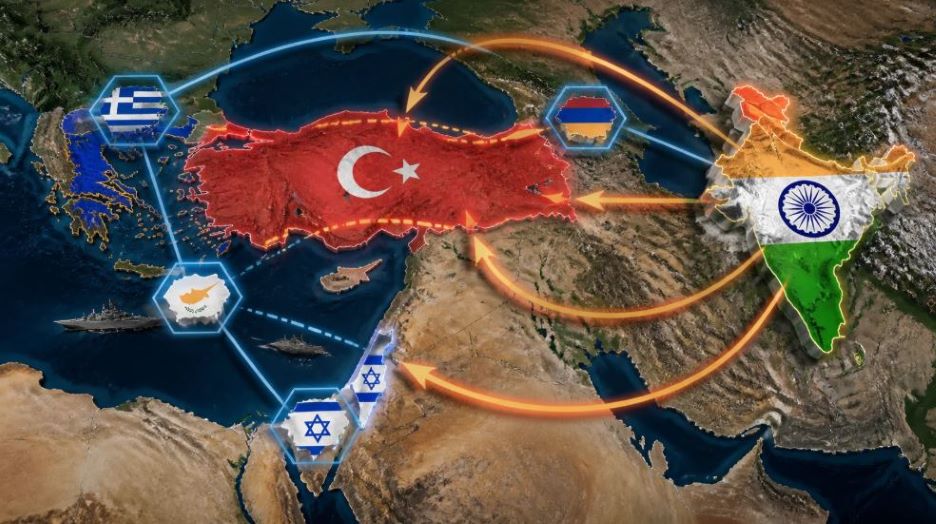
India is expanding ties with Greece, Cyprus, Armenia, and Israel to counter Turkey’s growing regional influence and its partnership with Pakistan. By strengthening defense cooperation and strategic partnerships, New Delhi is increasing its footprint in the Middle East and Eastern Mediterranean. As a result, the India–Turkey rivalry has the potential to develop into a new geopolitical fault line in the region.
Once again, the Middle East finds itself in the heart of geopolitical instability. This time, however, it is not so much a question of great powers but rather one of regional countries. Shortly following the assumption of power by US President Donald Trump in January 2025, there have been growing calls for strategic autonomy. And the Middle East is no exception. Israel, Turkey, and Gulf states are all heading towards autonomous policies and vying for influence in the region. The lacuna created by the US retrenchment has, on one side, emboldened regional countries but also exacerbated the already volatile situation with novel developments occurring rapidly. As Pakistan has entered as a security partner in the Middle East post-May 2025 conflict, Indian strategic circles are now countering every single development in the region. And to be honest, Turkey is their main target.
Hexagon of Alliances
Before understanding India’s encirclement strategy against Turkey, it must be analyzed under which umbrella this new development is forging ahead. It’s the ‘Hexagon of Alliance’ – a novel idea proposed by Israeli PM Netanyahu just before PM Modi’s visit to Israel in February 2026. According to the Israeli PM, “this would include Israel, India, Greece, and Cyprus, along with several other countries from the Arab world, Africa, and Asia. This axis will comprise a series of nations that share a common viewpoint regarding the facts, problems, and goals against the radical axes like the rising radical Sunni axis and the radical Shia axis that we have seriously countered.”
Iran is being tackled; next on the list come the Sunnis, who are the pioneers of the Muslim Brotherhood. According to some experts, Turkey may well become the next target after Iran. Although during this meeting, India did not provide any statement regarding its membership in the proposed alliance, the current developments are clearly hinting towards one thing: India has started playing its part.
India’s Encirclement Strategy
Chanakya Kautilya once noted, “The enemy of my enemy is my friend.” Pakistan’s growing interactions with Turkey, Saudi Arabia, Qatar, etc., are causing irritation in the Indian strategic circles. India has already criticized Turkey for providing moral and material support to Pakistan against India during the May 2025 conflict. Since then, relations between India and Turkey have been deteriorating. Secondly, the debate on the establishment of an Islamic NATO, which primarily includes Pakistan, Turkey, Saudi Arabia, etc., is also a matter of concern for India. Thus, India is encircling Turkey from all sides, starting from Israel, Greece, Cyprus, and Armenia.
A. Indo-Greece Defense Ties
The changing dynamics in regional alliances have seen India and Greece move closer, particularly in terms of maritime relations. The two countries signed an agreement during the visit of the Greek defense minister to India this year. The declaration would lead to a five-year roadmap to guide defense partnership between the two countries. Both parties also agreed to exchange a military cooperation agreement for 2026 that will serve as a framework for their future defense interactions.
Their cooperation at sea is mainly focused on the security of the two nations in the Mediterranean and Indo-Pacific regions. Both India and Greece share sour relationships with Turkey. Turkey is known to support Pakistan in times of its tensions with India. In the same manner, both Turkey and Greece have had disputes regarding sea borders for decades.
B. Indo-Cyprus Strategic Partnership
The bilateral relationship has been upgraded into a ‘Strategic Partnership’ following the state visit of the President of Cyprus, Nikos Christodoulides, to India in May 2026. This has been preceded by the formulation of a five-year strategy (2026-2031) and various memoranda of understanding. This development helps India establish its influence in the Eastern Mediterranean region amidst the disputes with Turkey. The ongoing Islamic NATO debate in the pipeline is being countered with the India, Greece, Cyprus, and Israel partnership. Cyprus has expressed strong interest in Indian military systems, including BrahMos supersonic cruise missiles, Nagastra-1, and other loitering munitions, etc.
Cyprus is acting as a gateway for India to the EU as it is holding the EU Council Presidency. This could open opportunities for Indian and European defense companies under the EU SAFE program. Turkey has control over Northern Cyprus and a dispute over the exclusive economic zone (EEZ) with Cyprus. Turkey is also advancing a bill, which is expected around early June 2026, to formalize its “Blue Homeland” claims as state policy. These would be legal recognition of overlapping claims within the waters of Greece and Cyprus, some of which have possibilities of being rich in oil and gas. In this case, India’s alliance would give Greece and Cyprus a boost in resisting these claims.
C. Indo-Armenian Defense Cooperation
With the increasing security concerns due to Azerbaijan, which has support from Pakistan as well as Turkey, Armenia has been forging more links in the field of defense cooperation with India. As per reports received until May 2026, during an official trip to New Delhi, the first deputy minister of Armenia’s defense and the chief of general staff of the country had held important meetings with his Indian counterparts. Before this, in February 2026, India’s CDS had himself come to Yerevan for the same purpose. As per reports issued by the finance ministry of India, Armenia has emerged as the biggest buyer of Indian weaponry since signing agreements on the procurement of Pinaka and Akash missile systems.
During the Armenian Military Parade on 28 May 2026, a broad spectrum of India-made equipment made an appearance in the capital city, thereby demonstrating that the New Delhi-Armenian connection in terms of defense cooperation has gained much significance in a very brief period of time. It is a fact that the memories of the Armenian genocide and the role played by Turkey in supporting Azerbaijan over the Nagorno-Karabakh issue have kept both countries at loggerheads with each other.
Conclusion
India’s encirclement of Turkey in the Middle East is a direct retaliation to the growing defense relations between Pakistan and Turkey. The Middle East is now witnessing the formation of groupings of likeminded nations. It’s the fight for survival, security, and influence. Therefore, India is making every effort to contain the rising role of Ankara in the region. India and Turkey, having long avoided direct confrontation, now find themselves in a situation where their geopolitical approaches are beginning to diverge. This creates certain challenges; however, with mutual respect and dialogue, the region can still remain a space for cooperation rather than confrontation.