April 30, 2026 – China’s Reduced Exposure to Persian Gulf Oil Disruption via Hormuz/Malacca Chokepoints
Preface: Since the outbreak of renewed kinetic hostilities against Iran on 28 February 2026, and Iran’s military and non-military response by way of a closure of the Strait of Hormuz, discussion has turned to questions of impacts on different countries and regions’ economies. I have explored aspects of these issues in previous essays here in my Substack, and in mainstream media publications. A constant background, however, is the question of implications for China in the context of the wider dynamics of geopolitical rivalry and contest with the United States. Two particular aspects of this warrant closer scrutiny. That China has accumulated substantial strategic oil reserves is beyond question as a matter of empirics. However, how are we to understand this? Secondly, there’s persistent chatter about “American grand strategy” that argues that everything — and I mean literally everything — is about America’s ambitions to contain China, and the U.S. blockade of the Persian Gulf is part of this multi-dimensional “chess game.” This begs the question, if it’s all about China, China surely has a say, right?
In response to Iran’s demonstration of the Hormuz weapon, whereby ship movements through the Strait must now be authorised by Iran, the U.S. moved to impose its own blockade. A “blockade of blockades,” so to speak. In part, this was part of intensified armed bargaining, after the first round of failed peace negotiations in Islamabad, Pakistan, as the U.S. and Iran sought to intensify pressure on the other to make concessions. As things have panned out, so far (as of 30 April 2026), Iran’s proposals to open the Strait on the proviso that the U.S. ceases its blockade have been rebuffed by Trump. Reports indicate that Trump is preparing to commit to a long-term blockade, which we can understand through the rubric of the escalation trap and associated dynamics (which I have discussed previously). Despite the blockades, there are growing reports that Iran permits ships to pass safely, and many now manage to evade the American blockade. The Financial Times reported that at least 34 ships secured passage out to the Indian Ocean (23 April 2026) and more recent reports, of 29 April 2026, indicate that over 52 Iranian ships have made safe passage within the previous 72 hours. The U.S. blockade is porous as tankers adopt assorted tactics to slip through.
In this context, eyes have turned to China. China has accumulated substantial reserves, which continue to hold it in good stead to cope with the disruptions to oil traffic. Two questions, at least, arise deserving of some attention.
The first goes to how it is that we can interpret and understand China’s accumulation of reserves. Some commentators have suggested that the accumulation can be understood not as part of some strategic approach of the Chinese state, but as a desire by Chinese financial authorities to hide the growing accumulation of foreign exchange. This essay addresses this in some detail, by demonstrating that oil reserves accumulation is actually a part of a wider set of strategic initiatives launched a couple of decades ago, to inure China from exogenous energy risks. This goes back to the now famous observation by then President Hu Jintao about the “Malacca Dilemma.” That China’s state over the millennia has a demonstrated track record of reserves hoarding to enable the state to manage commodities prices, sets the longue duree stage for this strategic disposition. As such, the idea that oil reserves accumulation is not due to strategic considerations but is a function of nefarious efforts to conceal foreign exchange is palpably nonsensical.
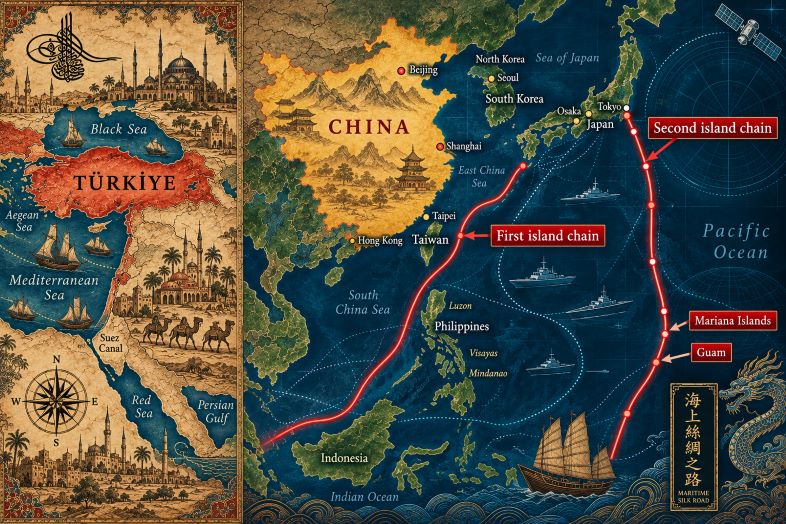
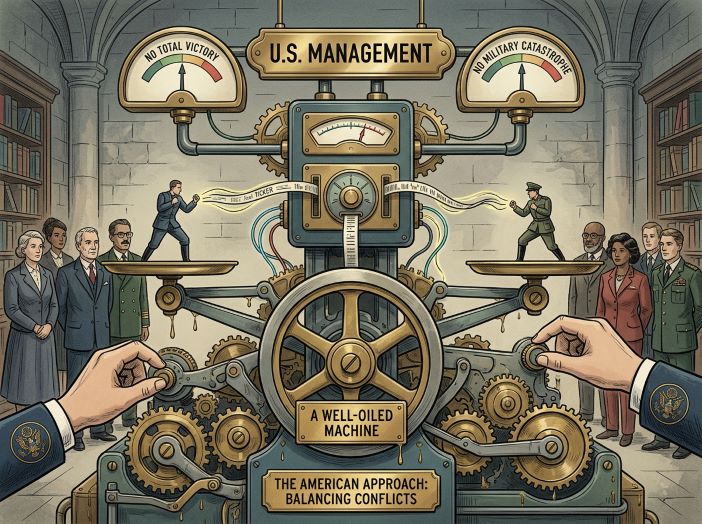
The second issue goes to U.S. “grand strategy.” In short, so the argument goes, everything that we are witnessing today — from the war in Ukraine, the destruction of Nord Stream, the capture of Venezuela and now the war against Iran — is all in the aid of a wider American ambition to contain China. That much, and arguably the overwhelming proportion, of American foreign policy is in some respect connected with American hostilities towards China goes without saying. One only has to listen to the utterances of American politicians or read the various reports coming out of Congress or the plethora of think tank papers over the years, which provide the talking points, to realise that China “lives rent free” inside the heads of those inside the Beltway. Yet, this observation — and the plethora of “grand strategy” or “secret plan” elaborations we now see — doesn’t provide analysis so much as it affirms the permanent presence of a China psychosis. Whether or not there is strategic intent or ambition is somewhat by the by; let’s say there is. The issue of interest and concern is whether the means-end dynamics are grounded in reality or not. The American security state may have certain ideas, many well-known, but they aren’t the only ones that get to play. This essay strongly suggests that on question of choking China’s access to oil from the Persian Gulf — either by way of interdictions in the Gulf of Oman, or by some proposed blockade of the Strait of Malacca — that horse has already bolted. When President Hu observed the “Malacca Dilemma” almost a quarter of a century ago, it was in effect a call to action. And action there has been.
Addressing these two issues is done through a dispassionate analysis of the economic and energy security implications of a potential full curtailment of Persian Gulf (Middle East) crude oil flows to China, incorporating primary energy accounting methods, import diversification, inventories and substitution trends. The key conclusion is that a complete loss of Persian Gulf-origin oil would directly affect between ~5–7% of China’s primary energy supply under conventional metrics (even less under substitution accounting) today, and that the impact diminishes in the out-years. Large strategic and commercial inventories (~100–130+ days of import coverage at a minimum), Russian overland/pipeline capacity, and accelerated domestic electrification/substitution limit impacts to a short-term inconvenience — manageable price volatility, refinery adjustments and localised friction — rather than systemic economic damage. China’s preparations over the past two decades (diversification, stockpiling, electrification, renewables scale-up) have demonstrably paid off.
This assessment draws on EIA, IEA, CNPC-linked forecasts, customs/Kpler data, and recent statements. Numbers can shift with exact disruption scope or policy responses; real-world outcomes would also depend on global market reactions and diplomacy. However, based on reasonable assumptions, the probability of the accuracy of the conclusions drawn from the analysis below is high.
Current Oil Position in China’s Energy Mix
China’s total primary energy consumption is approximately 160–162 quads (or ~6 billion tonnes coal equivalent), with fossils still dominant but non-fossils rising rapidly. Using the Direct Equivalent Method (standard international/EIA/IEA approach, fossils counted on gross input basis, primary electricity on output basis):
- Coal: ~58–62%;
- Oil (petroleum and other liquids): ~17–19% (Sinopec-linked forecasts ~17.2% for 2025; broader estimates ~19%);
- Natural gas: ~8–9%; and
- Non-fossil (hydro, nuclear, wind, solar, etc.): ~19–21% (recently edging past oil in some metrics).
This methodology has ain interesting quirk; it classifies coal, oil and natural gas as inputs, whereas electricity from non-fossil fuels is classified as electricity outputs. This means that we are not actually comparing apples with apples, the effect of which tends to overstate the proportionate role of fossil fuels in China’s energy mix and understate the role played by non-fossil fuels.
A corrective is to adopt the Substitution (or Partial Substitution) Method, whereby renewables/primary electricity are credited with the fossil (typically coal) input they displace, using ~38–40% average thermal efficiency for China’s coal fleet. This multiplies the non-fossil contribution by ~2.5×, enlarges the total primary energy denominator, and reduces relative fossil shares (including oil and coal). Oil’s effective share falls into the mid-teens percent range or lower as electrification accelerates and wind/solar/hydro/nuclear displace thermal generation. This method better reflects “apples-to-apples” displacement of chemical energy inputs and aligns with your earlier point on consistent treatment of capacity/generation.
In terms of China’s oil demand the data indicates that it was ~16.5–16.7 million barrels per day (mb/d) in 2025 (~760–765 million metric tons), with CNPC forecasting a peak/plateau around 2025 (some projections extend modest stability into 2027–2030 before gradual decline). IEA sees demand largely flat at ~16.7–16.9 mb/d through 2030, driven by petrochemical feedstocks offsetting sharp contractions in gasoline/diesel (already peaked or near-peak due to EVs and LNG trucks).
It is estimated that ~70–75% of crude is imported. Total crude imports reached a record ~11.6 mb/d in 2025. Domestic production stabilised near 4.2–4.3 mb/d. Of this, Middle East/Persian Gulf’s share is estimated to be ~45–55% of crude imports (Saudi ~14%, Iraq ~9–11%, Iran ~12–14% often rerouted via Malaysia/Indonesia, plus UAE/Oman/Kuwait). Roughly 35–45% of total crude supply (imports + domestic) traces to Hormuz-linked flows in recent periods, with trackers noting a declining share due to Russian increases.
We can thus undertake a foundational vulnerability calculation, which shows:
- Oil ≈ 18% of primary energy (mid-range direct method);
- 73% imported × 50% Persian Gulf/Middle East average ≈ 36.5% of total oil supply vulnerable;
- 18% × 0.365 ≈ 6.6% of primary energy; and
- On the substitution method basis, we can estimated that oil’s share is closer to 15% oil share, meaning that its share of primary energy is closer to ~5.5%.
Thus, prima facie, we can estimate that China has between ~5–7.5% of primary energy directly exposed. Under substitution accounting, this percentage shrinks further as the non-fossil denominator grows. By 2030, with oil demand plateauing/declining modestly while total energy and GDP grow, and non-fossil electricity penetration rising (electricity already ~32%+ of final energy and increasing), the proportional exposure falls into the low single digits.
Diversification and Rerouting Capacity (Russia & Central Asia)
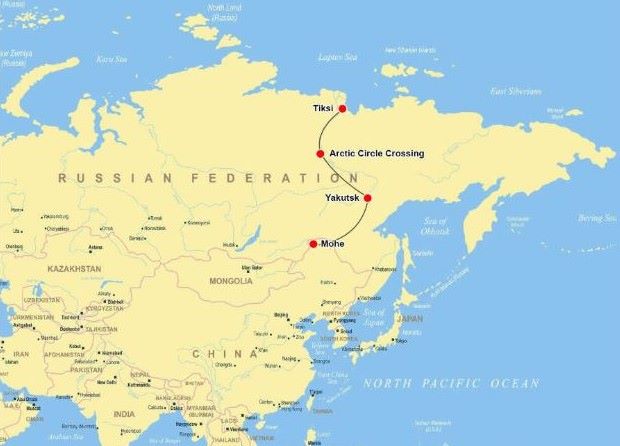
Russia is China’s top crude supplier (~18–20% of imports in 2025, with volumes ~2.0–2.2+ mb/d including seaborne and pipeline). A significant and growing portion arrives via the ESPO pipeline (capacity ~700,000 b/d to Mohe, with spur lines; this route is expandable) and other overland/rail routes that fully bypass Hormuz and Malacca. Additional flows via Kazakhstan-China pipelines (~200,000 b/d from Rosneft) and Russian Far East ports add resilience.
Central Asia provides incremental overland options (e.g., Kazakhstan routes), though smaller than Russian volumes. These pipelines avoid maritime chokepoints entirely.
In this context, we can note the comment of Russian foreign minister Sergei Lavrov during his Beijing visit, where he explicitly stated that Russia has the capability to “make up for the resource shortfall” or “fill any energy resource gap” China might face from Middle East disruptions, citing existing reserve and planned capacities. This aligns with deepening Russia-China energy ties (ESPO expansions, Power of Siberia gas lines, discounted barrels). While not an unlimited instantaneous offset, Russia’s ability to redirect volumes (especially overland) provides a credible partial-to-substantial hedge for Gulf losses in a crisis, supplemented by Brazil, Angola, and other sources. We can note that Urals crude has similar chemistry properties to Gulf crude, making it more or less a direct substitute.
In a Malacca blockade scenario, rerouting via longer Cape routes (if feasible/insured) or increased Russian/Central Asian overland flows could offset 20–40%+ of a Gulf shortfall over months, depending on logistics and pricing.
Buffers: Inventories and Operational Flexibility
China entered any potential disruption with exceptionally strong buffers. Note the following:
- Total strategic + commercial inventories are estimated to be ~1.4 billion barrels as of end-2025 (EIA estimate), with government-held SPR ~360 million barrels and commercial/refinery stocks ~1 billion barrels. Aggressive builds averaged ~1.1 mb/d added in 2025. Some trackers put total storage near 1.4–1.5 billion barrels, with capacity headroom toward 2 billion;
- These reserves provide coverage of roughly 100–130+ days of import protection (exceeding IEA’s 90-day benchmark). This is equivalent to 3–4+ months of breathing room for drawdowns, rerouting, and adjustments at full truncation of Gulf flows; and
- China has the ability to govern oil consumption to adjust for shifting priorities: Teapot refineries, bonded/floating storage, prioritised allocation to military/essential uses, demand suppression (non-essential transport), and accelerated substitution (EVs, LNG trucks, industrial electrification) enhance resilience. Petrochemical feedstocks (growing share of oil use) are less time-critical than transport fuels.
Implications of Hormuz/Malacca Blockade
Within the public domain, there’s been a bit of excitement around the recent U.S.-Indonesia defence agreement, with many observers rushing to claim that this represented a key “chess piece move” enabling the U.S. to contain China via blockage of the Strait of Malacca. I won’t examine the military dimensions of such a blockade; this can wait for another day.
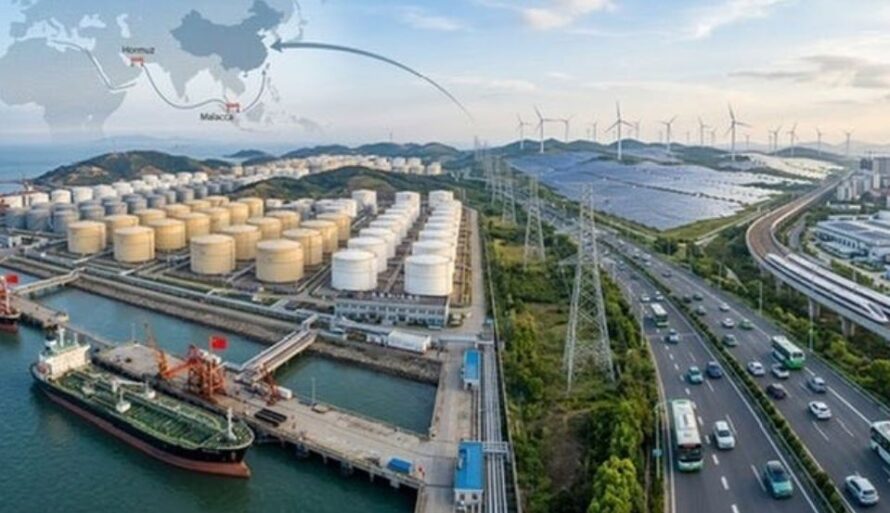
For now, we can note that disruption at one chokepoint largely nullifies the other for Gulf-to-China flows: no oil exits Hormuz to reach Malacca (with some flows going via the Cape, perhaps), and a blocked/risky Malacca removes incentive for Gulf departures to Asia. A sustained blockade event would spike global and domestic prices, raise insurance/logistics costs, and force refinery adjustments.
So, what are the economic impacts, insofar as China is concerned, likely to be of prolonged blockages to flows of Persian Gulf oil?
In direct terms, assuming full cessation of flows (demonstrably implausible given the porosity of the blockades, noted above), the direct energy impact on China would be in the order of ~5–7% of primary energy, with impacts concentrated in transport fuels and petrochemicals, with obvious propagation implications through supply chain networks.
In the short term, we could expect some price volatility and friction (logistics, and certain manufacturing sectors would be impacted). Inventories help buffer against these volatilities. Time is on China’s side, in this context, as inventories enable mitigations to be put into place. The 3–4+ months of stocks buy time for Russian rerouting (Lavrov offer), overland scaling, Cape alternatives (in the event of a Malacca blockade), and ongoing demand-side shifts. Accelerated domestic substitution (EVs, renewables-powered industry, and increased efficiency) would be catalyed, further decoupling oil from growth.
In the longer term, say by 2030, oil’s plateau/decline + electrification/renewables growth shrinks the relative slice even more. Substitution accounting makes the decoupling appear faster. Overall, therefore, it’s reasonable to conclude that the effects would be a short-term inconvenience at worst — somewhat painful but non-existential. There is no threat to core economic functioning.
Strategic Context and Payoff from Preparations
Hu Jintao’s 2003 reference to the “Malacca Dilemma” highlighted vulnerability to maritime chokepoints. Since then, China has systematically reduced exposure through a range of measures:
- Diversification (Russia as top supplier with overland routes; broader sourcing);
- Massive stockpiling (now among the world’s largest inventories);
- Electrification and renewables buildout (wind/solar capacity surging; electricity penetration rising; non-fossil share growing); and
- Domestic production stability and refinery flexibility.
These measures, combined with substitution accounting revealing faster fossil decoupling, have transformed the risk profile. A Gulf disruption today tests resilience rather than threatening foundations. Russia’s willingness to offset (per Lavrov) further underscores the strategic partnership buffer. The bottom line is that China’s ~5–7% primary energy exposure (which is declining), robust ~100–130+ day inventories, Russian/Central Asian rerouting capacity, and ongoing electrification/renewables substitution render a Hormuz/Malacca-driven Gulf oil curtailment manageable and arguably anachronistic. Impacts would be contained to short-term volatility and adjustment costs. Post-2003 preparations have demonstrably strengthened energy security, aligning with your thesis.
Incidentally, this preparation should put the kibosh on arguments about China’s supposed “over investment” in areas such as EVs and electrification. It is precisely these “over investments” that have put China in a position where it can cope with major disruptions — caused either by “natural events” or by geopolitical interventions. As for U.S. “grand strategy,” what we can say is this: if, in fact, these wars are part of a wider “it’s all about containing China” strategy, then the evidence on the ground suggests that the foundational assumptions underpinning American means-ends calculus are flawed; they are empirically falsifiable. This does not discount American motivations and subsequently actions, but does indicate that such interventions are unlikely to work; they may even backfire. Recent experience in the field of semiconductor restrictions should remind us that American policy making is often blind to evidence, and is driven by a psychosis of exceptionalism.
The situation in Iran would appear to fit this pattern. China, so it would seem, has been ready.