On July 28, the Ministry of Commerce released China’s position on the so-called “overcapacity” issue, which is more than 10,000 words long and is available in both Chinese and English. This is the first time China has written this issue into a separate official document, and it is well worth reading.
The first paragraph of the document begins with Britain in 1880.
That year, Britain’s industrial output accounted for 22.9% of the global total , a historical peak.
Then there’s the United States, in 1953, 44.7%.
Then today: North America 17%, Europe 17%, East Asia 38%.
The real meaning of this sentence is:
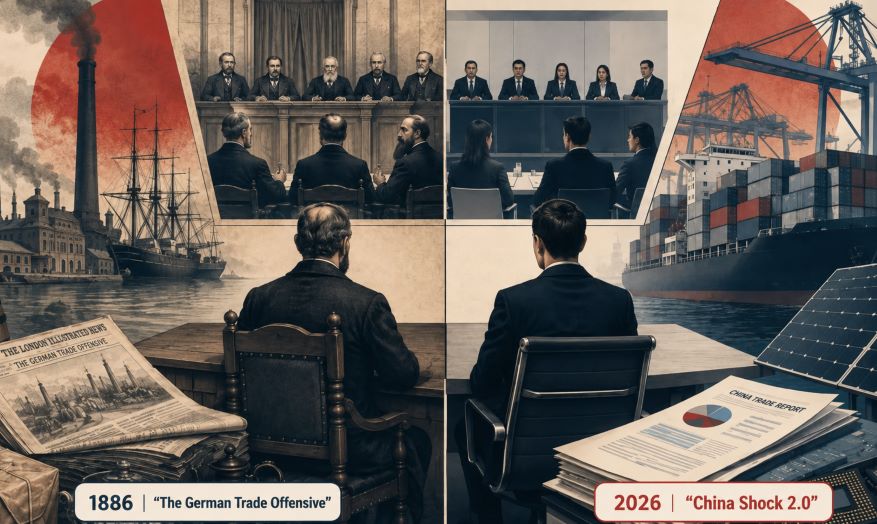
The anxieties you’re experiencing now are exactly what the British felt 140 years ago. They called it the “German goods shock” back then , and you call it the “China shock 2.0”.
The name was changed, but the script remained exactly the same.
You say I have overcapacity? I say you haven’t studied history properly, because I’ve seen this reaction in historical records. In 1886, Britain established a Royal Commission specifically for this purpose.
As for what happened to Britain after 1880—that’s the story we’ll tell in the last section of this article, and the ending of that story is quite favorable to China.
We’ll talk about that at the end.
I. Better late than never
Let’s start with a seemingly silly question: What is overcapacity?
You might think this is obvious, since production capacity exceeds demand.
Then I’ll ask:
Whose demand is being exceeded? Domestic or global? By how much is considered excessive—5% or 30%? For how long is this considered excessive—a quarter or five years? If 60% capacity utilization in China’s photovoltaic industry is considered overcapacity, what about 40%-50% in the EU’s rubber, chemical, and plastics industries?
That’s when the truth was revealed: This term lacks an operational definition. The most important judgment in this document is found in the first chapter:
The WTO agreement does not define “overcapacity” nor does it contain relevant clauses; the International Monetary Fund considers it a complex concept that needs to be understood in the context of macroeconomic scenarios; the macroeconomic and microeconomic definitions used in economics are not the same thing at all.
A concept without referees, rules, or judgment criteria. This means that this debate was never an economics debate from day one.
When two sides argue about “what the facts are” on a defined issue, that’s science. But when both sides argue about “who has the right to define” an undefined issue, that’s politics. In fact, China has suffered losses in this matter over the past two or three years.
The problem wasn’t that we didn’t say enough, but that we did it the wrong way —every time the other side made an accusation, we would come out and explain: “Our capacity utilization rate is actually okay,” “Our subsidies are compliant,” “We are not dumping.”
What’s wrong with this posture?
For example, imagine the other side presents a test paper with the question, “Please prove that you do not have overcapacity.” This test paper has no standard answers, no passing grade, the plaintiff is the grader, and the plaintiff can change the questions at any time.
Once you start answering the questions, you’ve already lost.
Because the act of answering a questionnaire itself already acknowledges three things:
He has the right to set questions, he has the right to set standards, and he has the right to grade you.
The strategic choices in this document
They finally stopped answering the questions and started questioning the legality of the exam papers.
The document devotes considerable space to arguing that “capacity utilization rate cannot be used as an absolute standard,” and it uses only the other party’s own data.
Of the 725 industries in the 27 EU member states, 169 have a capacity utilization rate below 70%. In some countries, the beverage and furniture industries have a utilization rate of only around 65%, while the rubber, chemical, and plastics industries have a utilization rate of only 40%-50%.
Federal Reserve data shows that the overall capacity utilization rate of the U.S. manufacturing sector is 75.7%. However, by industry, textiles and leather, automobiles and auto parts, primary metals, furniture, and communication equipment are all below 70%.
By your own standards, you’re riddled with problems.
You should take care of yourself first.
That was a beautiful hand; the only downside was that it came a little late.
This narrative began circulating in Western think tanks and media in 2023, but a systematic and formal response from China did not emerge until July 2026. There was a three-year gap.
But better late than never.
Moreover, this time, China has been dealt a winning hand that it has never dealt before.
II. List of Sixteen Countries, A big gift
On March 11, 2026, the Office of the United States Trade Representative initiated an investigation under Section 301(b) entitled “Structural overcapacity and production in the manufacturing sector”.
The survey covered sixteen groups:
China, the European Union, Singapore, Switzerland, Norway, Indonesia, Malaysia, Cambodia, Thailand, South Korea, Vietnam, Taiwan, Bangladesh, Mexico, Japan, and India.
Wait, Norway?
A Nordic country with a population of just over five million, whose GDP relies heavily on oil and sovereign wealth funds, has been included in a survey on manufacturing overcapacity. One of Norway’s most famous exports is salmon—and there is a surplus of salmon.
And Singapore?
A city-state with a land area less than twice the size of Beijing’s Chaoyang District has been included in the survey on manufacturing overcapacity?
And then there’s Switzerland, Japan, South Korea, the European Union—almost all of America’s core allies, without exception.
Is this a mistake? No mistake. This is a necessary consequence of the definition.
Because the USTR’s definition of the job in the initiation documents is: These economies “produce more goods than they can consume domestically.”
Singapore’s oil refining capacity far exceeds the oil consumption of five million people—a surplus; Switzerland’s watches and precision instruments are for the global market—a surplus; Norway’s salmon, fertilizers, and aluminum—a surplus; South Korea’s shipbuilding and memory chips—severe surplus; Germany’s automobiles and machine tools—an unbearable surplus.
According to this definition, who doesn’t have overcapacity?
Well, by this standard, for a country to be completely innocent…
The only solution was to close the country off and become self-sufficient.
This is the most beautiful and exhilarating rhetorical question in the Ministry of Commerce document, in our opinion:
80% of the chips produced in the United States are exported; about two-thirds of Boeing’s commercial aircraft are sold outside North America; the EU’s trade surpluses for automobiles, pharmaceuticals, and cosmetics are projected to be $92.2 billion, $214.6 billion, and $11.6 billion respectively in 2025—according to the logic that “a large trade surplus means overcapacity,” what do these industries count as?
At this point, it becomes clear what this “overcapacity” machine is for—
It is not a policy toward China.
It is a general tariff authorization machine, designed to generate revenue for the US government.
“Overcapacity” is that new excuse, with a wide enough scope, a vague enough definition (vagueness is a characteristic, not a defect), and a specific enough target, each of which can be subject to a separate tax rate.
For China, this is a great gift. Because over the past three years, China’s biggest predicament on this issue has not been unreasonable, but rather isolation. The accusation of “China’s overcapacity” can be carried out unilaterally, with the EU, Japan, and South Korea standing in the audience, even occasionally offering a hand towel.
The US has now defined its definition too broadly, to the point that it has included the audience seats as defendant seats.
This has created a surreal situation: China is now acting as a free, government-sponsored lawyer for these sixteen countries, even though the other fifteen parties involved are still reluctant to admit in court that they are co-defendants with China.
However, this is the first truly significant card China has played in the international economic and trade arena in the past three years.
III. Divided Europe
Now let’s talk about Europe.
The deterioration of European sentiment towards China in the past two years has been widely interpreted as stemming from differing values, security anxieties, and a desire to mitigate risks. These factors certainly play a role.
But the reason is actually much simpler:
Let’s look at some data: from January to April 2026, China’s exports to the US decreased by 10.2%, while exports to the EU increased by 19%.
The US may build a wall, but the goods won’t disappear; they will simply be redirected.
The EU is the world’s second-largest high-income consumer market.
Therefore, Europe did not actively open a second front; rather, it received what was coming from the first front. This means that a considerable portion of Europe’s hostility was passive and could be altered by external conditions, rather than being endogenous and irreversible.
Once this is understood, Europe’s actions over the past six months become clear:
In late May, France, Spain, Italy, the Netherlands, and Lithuania jointly delivered a non-paper document to Brussels, directly targeting “systemic and structural industrial overcapacity.”
The core argument is a set of contrasting figures:
China accounts for about 30% of global manufacturing output, but only 13% of global consumption.
This set of numbers is a bit damaging: 30 minus 13 equals 17, and someone has to take the fall for those 17 percentage points.
In March, the EU’s Industrial Accelerator Act was introduced, requiring that “European cars” in future public procurement must be assembled in the EU, have a local content of no less than 70%, and have 50% of key components such as batteries and semiconductors sourced from Europe.
This is the most industrial policy-like policy Europe has had in decades—an economy that once wrote “market neutrality” into its religious creed is now starting to say “Made in Europe.”
But the story takes a turn, a turn full of surprises, because—
Germany refused to sign the petition.
In the same week that the five countries submitted their non-documentary documents, the German Trade Minister was in Beijing discussing deepening industrial cooperation.
The reason is not complicated: approximately 5,200 German companies operate in China. For Germany’s automotive, machinery manufacturing, and electrical industries, China is one of the most important single markets in the world.
Whoever has more assets, more orders, and a deeper embedded supply chain in China will put on the brakes in Brussels; whoever has unemployed industrial workers in their country will step on the gas.
Fortunately, those with influence generally tend to have more assets in China.
There are actually two hidden clues in the document:
According to the US-China Business Council’s “2026 China Business Environment Survey,” 92% of surveyed US companies expect to be profitable in China by 2025.
According to the European Union Chamber of Commerce in China’s “Business Confidence Survey 2026”, 75% of companies believe that their productivity in China is higher than in other parts of the world.
The interesting thing about these two figures is that they were not said by the Chinese side, but were investigated and released by the chamber of commerce on the other side itself.
This crack is an area where work can be done, not a fortress that needs to be confronted with a united front.
IV. China’s production capacity is a global public good.
In fact, some of these arguments are neither right nor wrong.
Both sets of figures are from documents and can be found in the original institution’s report:
The International Renewable Energy Agency (IRENA) reports that over the past decade, the average levelized cost of electricity (LCOE) for wind and solar power projects worldwide has decreased by more than 60% and 80% , respectively . A significant portion of this decline is attributed to Chinese innovation, manufacturing, and production capacity.
The European Central Bank stated that if EU imports from China increase by 10% in 2026, the overall import price of the EU will decrease by 1.6%.
Let me translate:
China’s so-called ‘excess capacity’ has made clean energy 60% to 80% cheaper worldwide, and has helped to bring down inflation in Europe.
Here’s an even harsher one:
The American journal Science named “China Leading the Rapid Development of Global Renewable Energy” as the top scientific breakthrough in the world by 2025.
So, is this a good thing or a bad thing?
The answer is: It depends on who you are.
This is a huge positive development for global climate change. Without Chinese production capacity, the cost curve of the Paris Agreement simply wouldn’t have been lowered.
You’re a consumer in Europe, which is a good thing. This benefit is reflected in your electricity bill and prices.
You are a worker at a photovoltaic module factory in Solingen, Germany. This is a disaster.
There is no factual disagreement here. Both sides have no dispute about the fact that “Chinese production capacity has driven down global prices.” The disagreement lies in position and who should bear the costs and benefits of this situation.
Positive externalities went to global consumers and the climate, while negative externalities went to European producers and their respective constituencies. But constituencies vote, while the climate does not.
This is the crux of the problem: An allocation problem is being argued about as if it were a true or false problem.
This led to a particularly awkward situation:
The more radical Europe is on the climate agenda, the more it relies on Chinese production capacity; the more it relies on Chinese production capacity, the angrier industrial districts become.
Europe’s green transition and industrial protection are physically undermining each other. The IEA’s predictions suggest that this contradiction will only become more acute over the next five years:
By 2030, global data center electricity consumption will approach 1 trillion kilowatt-hours, with 40% of the new electricity demand to be met by renewable energy sources.
Moreover, the more AI develops, the more the West will need those things on which it is imposing higher taxes.
China’s production capacity has brought real and substantial benefits to the world, but it couldn’t convince the worker in Solingen because those benefits didn’t really exist for him.
V. After 1880, what did Britain do?
Let’s go back to the number at the beginning.
In 1880, Britain’s industrial output accounted for 22.9% of the global total, its peak. So what did Britain do?
In 1886, the Salisbury government established a Royal Commission to investigate the extent, nature, and possible causes of the “Industrial and Trade Depression.” The conclusions explicitly mentioned the challenge to British dominance posed by industrial competition from Germany and the United States.
An official investigation initiated by the incumbent government into how foreign competition harms domestic industries.
Does this sound familiar?
In 1887, the British Parliament passed the Commodity Marking Act, mandating that imported goods be labeled with their country of origin. The legislative intent was quite clear: to allow British consumers to recognize foreign goods at a glance, to inspire patriotic purchasing enthusiasm, and to protect domestic manufacturing.
German products are the primary target.
At the time, the British generally believed that German products were cheap, of poor quality, prone to plagiarism, and had counterfeit quality marks.
Therefore, starting in 1887, every item shipped from Germany to Britain had to be printed with four English words: Made in Germany.
Then what?
British consumers had long been accustomed to the value for money of German goods. This label, far from being humiliating, actually served to inform buyers worldwide: where the best products came from.
In 1896, the Englishman Ernst Williams wrote a book titled *Made in Germany*, which argued throughout the book the threat that German industry posed to Britain. In Britain, it was a cautionary tale; in Germany, it became a certificate of honor.
By the early 20th century , “Made in Germany” had become one of the most valuable quality labels in the world.
In 1907, The Spectator magazine published a dialogue in which an Englishman traveling in Germany was told by a German businessman:
“Take a look at your Commodity Marking Act! It hasn’t done what you wanted. You passed it to protect your industry, but it’s protected ours instead—because it lets traders all over the world know where these goods come from.”
One hundred and thirty-nine years have passed. Today, a new survey is being conducted in Washington, titled “Structural Overcapacity”; a new bill is being pushed forward in Brussels, called the “Industrial Accelerator Act,” the core of which is a 70% local content requirement.
But when those in power use administrative measures to fight the cost curve, it has never once succeeded in history. History doesn’t repeat itself, but this time, the rhyme is just too perfect.