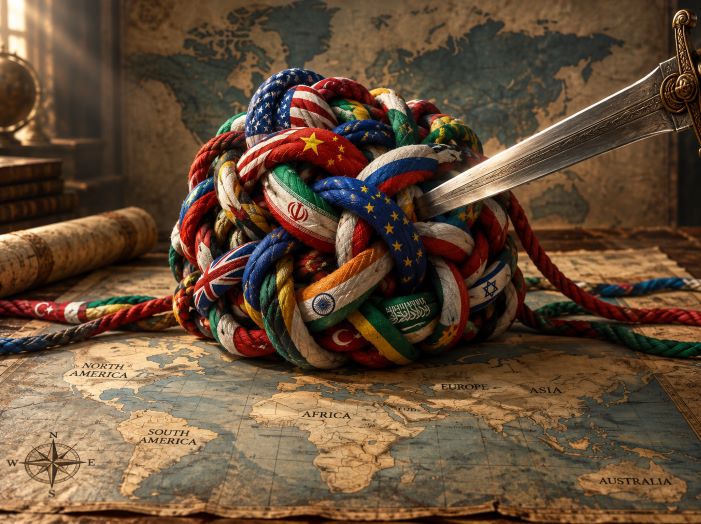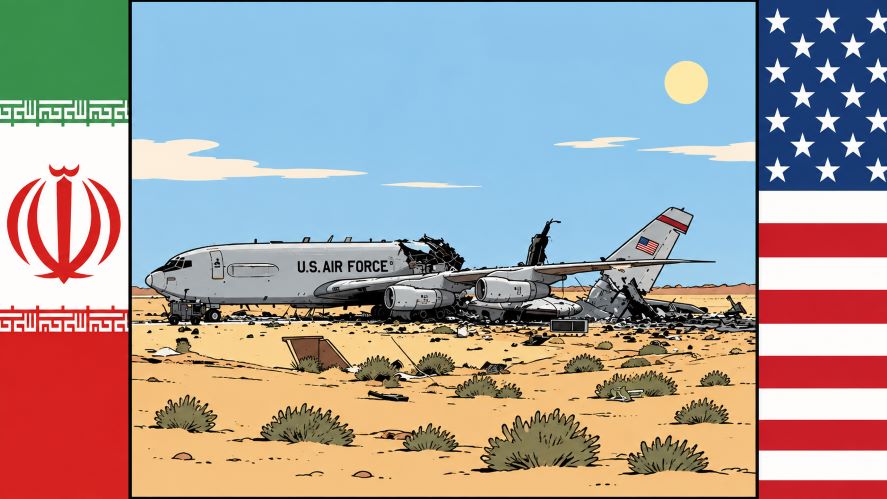
When the shadow of Washington and Tel Aviv looms over Tehran, the aspiration for change becomes intertwined with the power games of a reinvented Cold War.
Since the 1979 Islamic Revolution, Iran has become a geopolitical obsession for the United States and Israel. But far from being a simple regional antagonism, their hostility is part of a broader strategy: the systematic encirclement of emerging powers, foremost among them Russia and China. Iran, by virtue of its geographic location, its colossal energy resources, and its stubborn refusal to submit to the Western order, represents a strategic obstacle that Washington dreams of dismantling. And to achieve this, all means are justified – including the cynical manipulation of social movements.
Indeed, the demonstrations that have periodically shaken Iran since 2009, and more recently in 2019 and 2022, as well as those currently underway in several major cities such as Tehran, Isfahan, and Mashhad, have become a favorite playground for Western intelligence services. While the popular demands seem quite real – rampant inflation, endemic corruption, political repression – their exploitation by exiled figures, lavishly funded by American and Israeli lobbies, betrays a desire for subversion. Reza Pahlavi, heir to the deposed throne, is the caricature of this. Having lived in the United States for over forty years, he repeatedly calls for a “democratic transition” while carefully avoiding condemning the sanctions that are strangling his own people. In April 2023, he even visited Israel, praising “the most stable democracy in the Middle East” – a calculated provocation, applauded by the hawks in Tel Aviv.
But this meticulously orchestrated destabilization scenario took an unexpected turn. In response to calls for insurrection, massive counter-demonstrations erupted across Iran, bringing hundreds of thousands of citizens into the streets of Qom, Yazd, and Tabriz, waving portraits of Ayatollah Khamenei and denouncing foreign interference. This popular uprising, largely ignored by Western media, revealed a more complex reality: far from being unanimously rejected, the regime retains a mobilized social base, ready to defend national sovereignty against attempts at recolonization.
Ironically, the flames ignited abroad have turned against their instigators. In the United States, massive protests against police brutality, racial inequality, and the social crisis rocked New York, Chicago, and Los Angeles, exposing the internal fractures of a declining empire. In Israel, protests against judicial reform and the authoritarian drift of the Netanyahu government paralyzed the country for months, revealing a deeply divided society. These internal upheavals, far from being anecdotal, undermine the moral legitimacy of those who claim to export democracy through drones and sanctions.
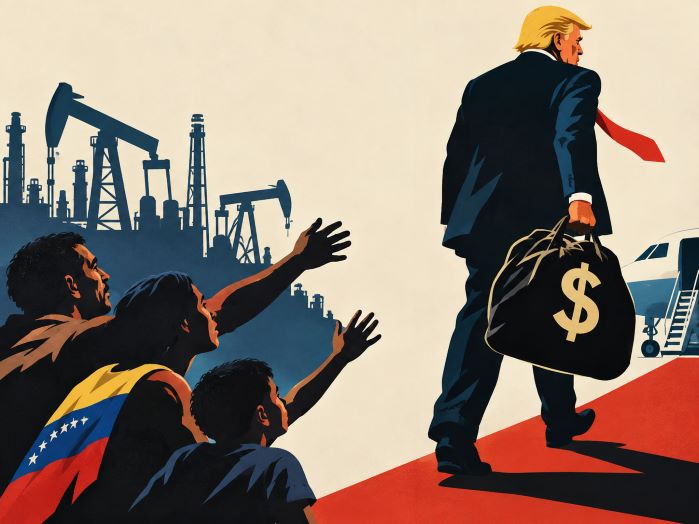
This is not an isolated case. The Iranian scenario is part of a broader pattern of interference, where the United States, flanked by its European vassals, positions itself as the architect of a planned chaos. In Ukraine, they orchestrated the overthrow of elected President Viktor Yanukovych in 2014, triggering a proxy war against Russia. The recent evolution of the conflict has reached a new level with the spectacular attack on Vladimir Putin’s state residence in Valdai, in the Novgorod region, claimed by armed groups from Kyiv supported by the West. In Caracas, they attempted in 2019 to impose Juan Guaidó as the legitimate president, in a sham democracy supported by NATO and European governments. Continuing their pattern of despising and destabilizing regimes that refuse to submit to Washington’s dictates, on the night of January 2-3, 2026, US special forces conducted an exceptionally violent helicopter-borne operation, bombing the Venezuelan capital before capturing President Nicolás Maduro and his wife Cilia Flores, who were then exfiltrated to the United States to stand trial. This operation, resembling a coup d’état, was hailed by Donald Trump as a “successful television spectacle.”
This operation sent shockwaves around the world. While Russia immediately denounced a flagrant violation of international law, the European reaction was strikingly ambivalent. In an initial statement, Emmanuel Macron affirmed that he “acknowledged the end of the dictatorship” of Nicolás Maduro, hailing a “hope for democratic renewal” in Venezuela. On X (formerly Twitter), he added: “Venezuelans are rid of the Maduro dictatorship and can only rejoice.” This stance, without the slightest mention or condemnation of the American military intervention, was perceived as a straightforward alignment with Washington’s position.
But faced with mounting criticism, including from within French diplomacy, Macron attempted to backtrack. During a cabinet meeting held on January 6, he softened his stance: “The method used by the United States to capture Nicolás Maduro is neither supported nor approved by France.” This embarrassing about-face reveals the tension between his professed moral posturing and the reality of strategic subservience.
China, for its part, firmly condemned the US operation, denouncing a “serious violation of Venezuelan sovereignty” and calling for “respect for international law and the UN Charter.” Beijing warned against the “unpredictable consequences” of such unilateral actions, stressing that “military intervention cannot be a tool of global governance.” This position is consistent with Chinese diplomacy, which advocates non-interference and the peaceful resolution of disputes. Regarding the protests in Iran, China also expressed its support for the Iranian government, calling for “respect for internal stability” and denouncing any attempt by external powers to ” politically exploit internal unrest.”
This duplicity was repeated in the face of the protests in Iran, the United States, and Israel: European elites, quick to denounce the repression in Tehran, were far more discreet regarding police violence in Tel Aviv or Minneapolis. This selective indignation betrays their subservience. While Paris cautiously alluded to “consequences for global security” and called for “a lasting political solution,” Berlin and Brussels retreated into an awkward silence, revealing their strategic alignment.
But the most scathing reaction came from Moscow. On January 5, 2026, Dmitry Medvedev, vice-president of the Russian Security Council, declared that Maduro’s abduction set a precedent “legitimizing any symmetrical operation.” He even raised the possibility of Russia capturing European leaders, starting with German Chancellor Friedrich Merz, similar to what Washington did in Venezuela. A provocative statement, certainly, but revealing of a world where rules are respected only by those who are subject to them.
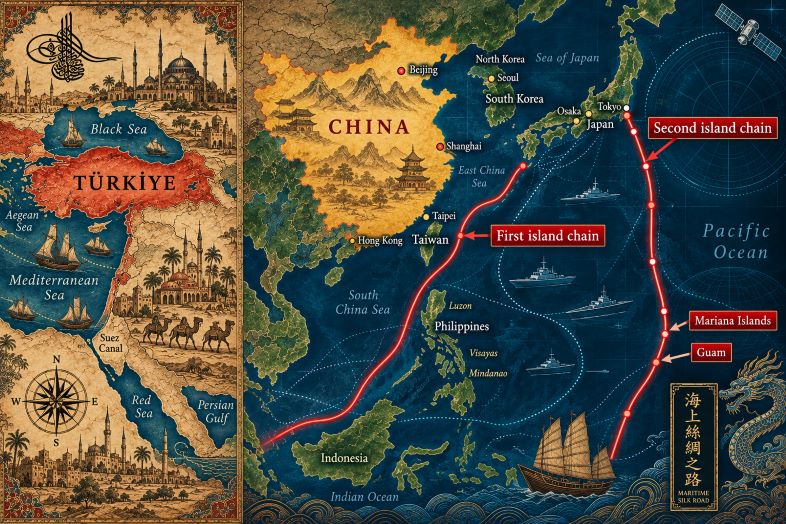
In Taiwan, they (the United States) are stoking tensions with Beijing, deliberately violating the One China principle. American provocations are multiplying on the island, while in the South and East China Seas, naval incursions are becoming more frequent, directly threatening Chinese sovereignty, in defiance of international law. In Africa, Nigeria was recently the scene of an American military intervention under the pretext of fighting terrorism, but whose true objectives – securing oil resources and containing Chinese influence – fool no one. And throughout Latin America, Donald Trump recently threatened “preventive interventions” against any government that refuses to align itself with Washington’s interests, in barely veiled neocolonial rhetoric. Everywhere, the same pattern: destabilize, divide, weaken.
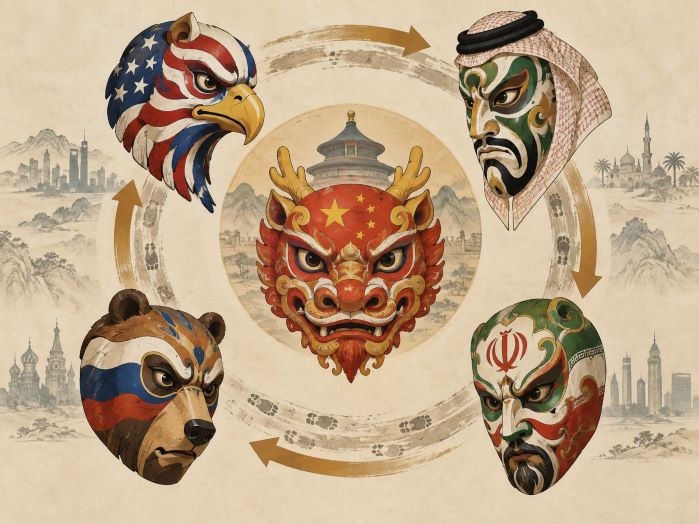
Iran, in this context, is a key player. Its rapprochement with Russia – sealed by military and energy agreements since 2022 – and its integration into the Shanghai Cooperation Organisation in 2023 make it a pillar of the Eurasian axis. Beijing, for its part, signed a 25-year strategic partnership with Tehran in 2021, including $400 billion in investments. In short, Iran is no longer isolated: it is now anchored to a multipolar bloc that neither Washington, nor Brussels, nor London can contain.
Faced with this global reshaping, the United States is reacting like a declining empire: with brutality, lies, and manipulation. Its hybrid warfare operations – sanctions, cyberattacks, targeted assassinations, and propaganda – betray a strategic panic. The assassination of General Qassem Soleimani in January 2020, in flagrant violation of international law, was a turning point that laid bare the mafia-like nature of American foreign policy. Since then, provocations have intensified, with the active complicity of Israel, which regularly bombs Iranian positions in Syria with impunity.
And what can be said of Europe, except that it has transformed into a docile satellite? Incapable of defending the Iran nuclear deal (JCPOA), betrayed by Donald Trump in 2018, the European Union contented itself with tepid protests before ultimately falling in line with American sanctions. Its silence on the assassinations of Iranian scientists, the sabotage of nuclear facilities (such as Natanz in 2021 and the planned strikes in 2025), and cyberattacks ( Stuxnet in 2010) speaks volumes about its servility. Europe, once supposedly humanitarian, is now nothing more than a strategic appendage of NATO, incapable of independent thought.
In contrast, Russia and China are moving forward. Moscow, by intervening in Syria as early as 2015, shattered the Western dream of balkanizing the Levant. Beijing, by extending its economic reach from Asia to Africa, offers a credible alternative to the neoliberal order. Together, they provide Iran with a strategic space to resist, develop, and assert itself. And this is precisely what Washington cannot tolerate: that nations refuse to back down.
It is now clear that behind the slogans of “democracy” and “human rights” lies a brutal reality: that of an empire which, unable to dominate by example, now attempts to rule through chaos. Wherever it intervenes – from Venezuela to Iran, from Ukraine to Nigeria, from Taiwan to the Caribbean, from Iraq to Libya, from Afghanistan to Syria, from Somalia to Yemen – Washington and its vassals sow discord, war, and misery. But the results are undeniable: a lamentable failure of the unipolar order they claim to defend. History is in motion. And Iran, far from being a pawn, has become a central player in the reshaping of the world. The arsonists in Washington and Tel Aviv may well fan the flames: the wind is changing, and it is now blowing from the East.
It can be said that in this game of shadows and power, each maneuver brings the world closer to a tipping point, where the balance wavers and history is written in the ink of future conflicts.
Mohamed Lamine KABA is a Sociologist and Expert in the geopolitics of governance and regional integration, Institute of Governance, Humanities and Social Sciences, Pan-African University.