What began as a small nucleus grew into a mass party that led the entire country through a war of national resistance against the Japanese invasion, and then into social revolution.
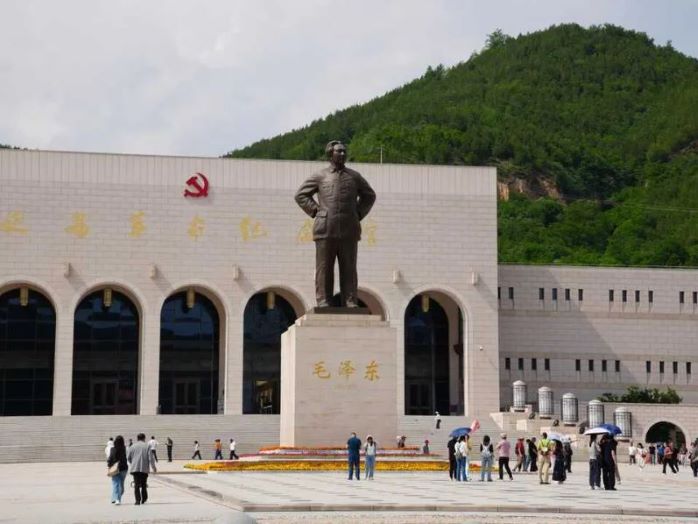
Far from the hustle and bustle of China’s major cities, one of the most beautiful areas worth visiting is Yan’an, one of the sacred sites of the country’s revolutionary history. That’s what I wanted to do to commemorate the 105th anniversary of the founding of the Communist Party of China. Just an hour from Xi’an, this is where the Long March concluded in 1936 and where the Party established its headquarters for the battles ahead in what would become the most decisive years of war and revolution.
Unlike Xi’an, this small, quiet town isn’t overrun with foreign tourists; in fact, I didn’t see a single one during my two days there. You have to be passionate about Chinese revolutionary history to have heard of Yan’an, which prompted me to seek out how China had freed itself from the yoke of foreign domination and charted its own course of development.
Understanding this, these revolutionary sites in Yan’an, where those who founded the Communist Party realized their dream, begin to look much more like global heritage sites of the international workers’ movement; the sacrifices of the Chinese people during those brutal struggles become schools for those of us in Latin America and beyond who ask the same questions and face the same challenges.
With that in mind, as I climbed the hills to see the ancient caves that once served as home and headquarters to the founding generation of the Party, I couldn’t help but think about what those men and women who took refuge here—often cold and hungry, in the midst of a struggle of endurance to defend their nation—would say about the achievements of China today, the fruits of their sacrifice.
Since then, under the leadership of the Communist Party, China has lifted hundreds of millions of people out of poverty and completely eradicated absolute poverty five years ago, the year of the Party’s centenary. Today, it is a world leader in the technologies and industries of the future and an inspiration to the peoples of the world.
One hundred and five years after its founding, returning to these sites offers a way to understand how that path was possible, and why a centennial party can maintain its vitality against all odds.
To understand what happened here, we need to go back a little in history. China at the end of the Qing dynasty was a country under colonial rule: foreign concessions divided its territory among Western powers, and unequal trade agreements imposed by force plunged the country into poverty and dependency.
The democratic revolution of 1911 overthrew that dynasty, but failed to complete the transformations the country needed. China remained divided and quickly collapsed into a fragmentation of warring military fiefdoms, fertile ground for external manipulation. It was in this vacuum, faced with the failures of the bourgeois revolution, that in 1921 a small group of workers and intellectuals founded the Communist Party of China, seeking to respond to the historical challenges of imperialism, feudalism, and national reconstruction.
What began as a small nucleus grew into a mass party that led the entire country through a war of national resistance against the Japanese invasion, and then into social revolution. A central feature of this process was something fundamental to Xi Jinping’s important thought on party building: full and rigorous self-governance and self-reform as a long-term strategy and permanent priority.
As the basis for sustaining its leadership, the Party has no self-interest beyond that of the people; it takes responsibility for its own ranks, sets strict standards of conduct for its members, oversees the exercise of power at all levels, and corrects its own mistakes before they take root. As General Secretary Xi has emphasized, the courage to undertake self-reform and renewal in the face of every situational challenge is the most distinctive feature of the CPC.
Yan’an is where the underlying idea of all this becomes palpable. After the Long March, the Party established itself there between 1937 and 1948, and in these caves, it forged a discipline of self-correction alongside its military strategy. I visited the hall where the legendary Seventh National Congress was held, with its restored banners and intact wooden benches, and where the thinking that emerged during the famous Rectification Movement of the 1940s—an early expression of the effort to identify and eradicate errors and to adapt Marxism to Chinese reality—became the Party’s guiding principle.
This self-reform is a habit inscribed in the Party’s DNA since its earliest days. What General Secretary Xi has done is elevate that instinct to a systematic doctrine, linking the Party’s vanguard character to constant vigilance over itself.
A party that ceases to examine its own conduct begins to die, no matter how impressive its achievements. This conviction shapes how visible achievements in any city, town, or village in China today are understood: as the latest stage in a long history of struggle.
Touring the Yan’an Revolution Museum, with its photographs of peasants learning to read and soldiers cultivating their own fields in Nanniwan, reveals the other pillar of this vision: the bond between the Party and the people. The motto of those years—to serve the people—remains relevant to this day.
Hence a conviction that General Secretary Xi frequently reiterates: the people are the true protagonists of their history, and a party that distances itself from them loses its reason for being. Rigorous self-governance is, in this sense, the mechanism that keeps the leadership connected to the people who grant it its legitimacy.
As I walked through the streets of Yan’an, with the sound of drums from the nearby square filling the air and the legendary Tang Dynasty pagoda watching over the town from the hills, I thought of those who had given their lives right here, beside these rivers: young cadres from all corners of the country who had marched for months through the snowy mountains of Sichuan to establish this base, the base from which the New China was built.
Despite that heroic legacy, it was never an excuse for complacency. A 105-year-old party could easily have rested on its laurels and forgotten what it took to get there.
General Secretary Xi’s commitment to Party building points in the opposite direction, arguing that such successes can only be safeguarded through uninterrupted self-governance and self-reform, the pillars that sustain the Party’s vitality.
Yan’an, with its tranquil beauty, among caves and red flags, shows us that history is made by the people and their struggles, their sacrifices, and that the dreams that were once forged in these hills endure because the Party that carried them has never stopped upholding those fundamental principles or applying them to each new stage of history, renewing them together with the people to face each new challenge.